
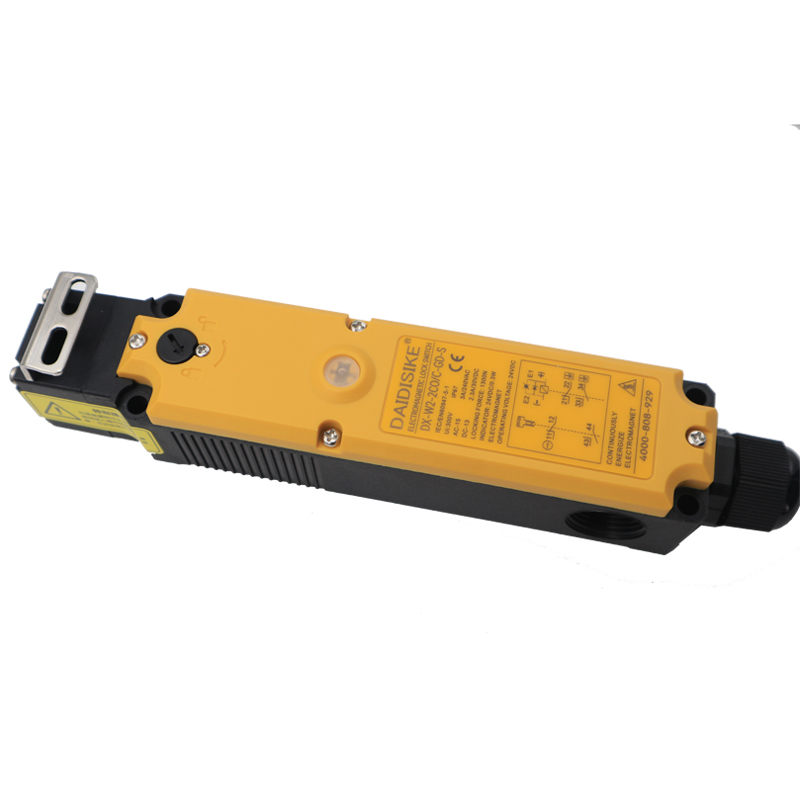
The inquiry: “what lock for a door that meets in the middle?”
A CNC machining-center builder reached us first thing this morning. They wanted an industrial machine-tool safety door lock and sent photos of the equipment. The guard over the work envelope was not a single hinged panel — it was a double-leaf, bi-parting door: two sheet-metal leaves that slide apart and meet at a central stile. The question was simple and fair: “What kind of safety door lock should we buy for this double door?”
It sounds like a one-switch problem. It isn't. A single door has a fixed frame edge to seat against, so one interlock reliably knows when it is shut. A double door has no fixed edge in the middle — just two leaves meeting at a stile, either of which can move first. The opening sequence is uncontrolled. Bolt one switch to each leaf and you now have two independent channels that can fall out of sequence, or be defeated one at a time, and nothing forces the pair to behave as a single guard. That is the real engineering problem hiding behind “it's just a door.”
Two standards, two jobs: ISO 14120 for the door, ISO 14119 for the lock
Before choosing hardware it helps to split the problem the way the standards do. ISO 14120:2015 governs the guard itself — the sheet-metal door and its structure — and it explicitly excludes interlocking devices, handing those to ISO 14119. So on this machine the double door is the ISO 14120 movable guard, and the bolt-and-switch hardware bolted to it is the ISO 14119 interlock. ISO 14119:2024 (the current edition, superseding 2013) is the Type-B2 standard for the design and selection of interlocking devices associated with guards, including guard-locking devices. Preventing unexpected start-up is the job of ISO 14118, while the stop function's performance level / SIL and architecture come from ISO 13849-1 and IEC 62061. Keeping those lanes straight is what stops a conversation about “a door lock” turning into guesswork.
The solution: a DXL-B safety door bolt + a DX-W2 guard-locking switch
Make the two leaves into one closure with a sliding safety door bolt, then lock and monitor that single closure with a guard-locking switch. The bolt we recommended is the DXL-B; the switch is the DX-W2 (the exact unit shipped was a DX-W2-2020C-GD-S). This is a recognised, economical pattern, not a workaround. A sliding bolt that ties the inactive leaf of a door pair at the meeting stile is the same idea as a flush bolt or astragal in building hardware — a well-established mechanical concept.
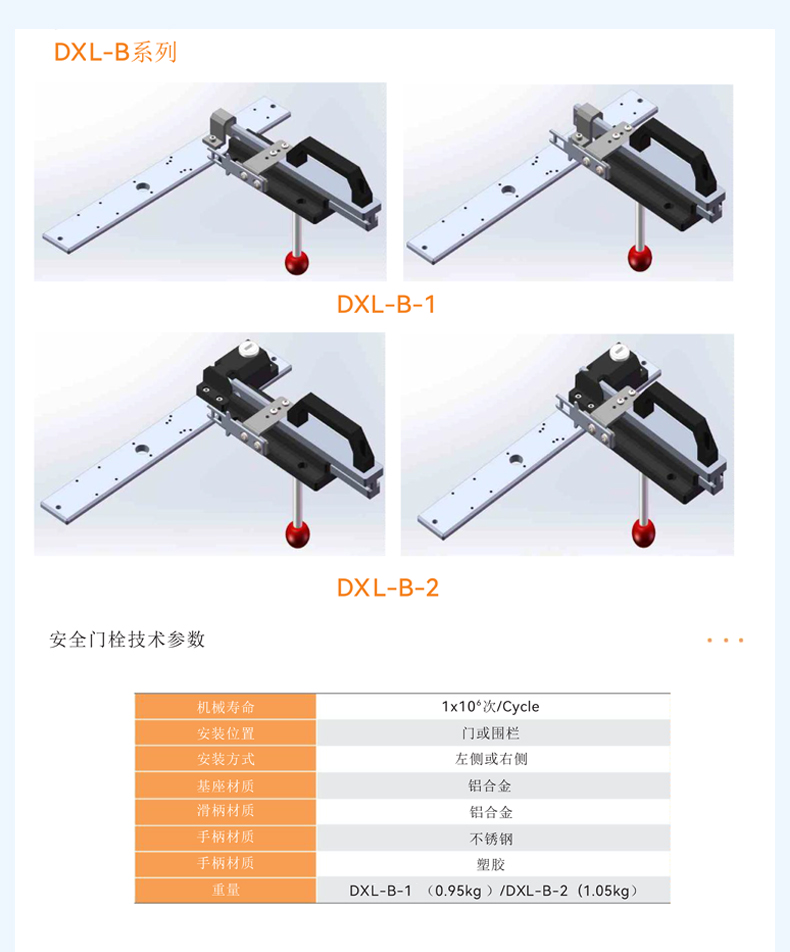
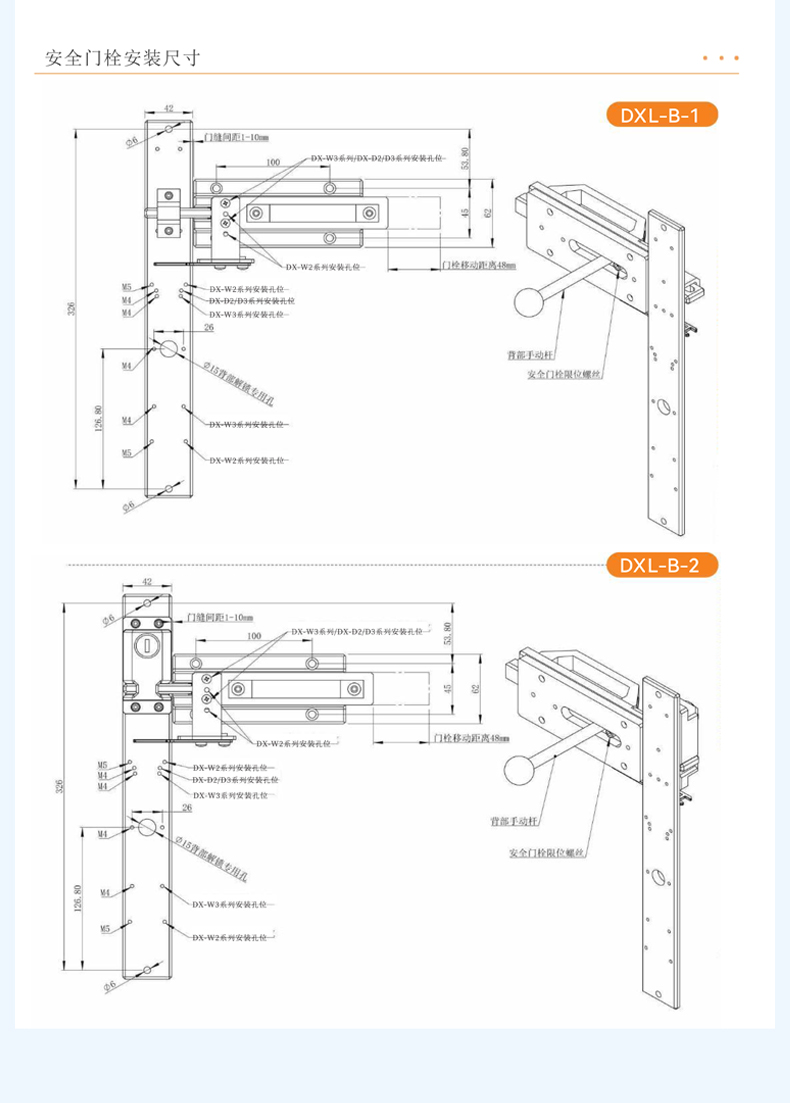
The detail that makes this one designed system rather than two parts taped together: the DXL-B base is pre-drilled with mounting holes for the DAIDISIKE DX-W2 / DX-D2 / DX-D3 / DX-W3 safety switches. The bolt is purpose-built to carry a guard-locking/interlock switch. Slide the bolt home and its actuator tongue enters the DX-W2; the electromagnet then holds the bolt captive, so neither leaf can move. That is exactly why we recommend the pair as a kit — bolt and switch are one product family, and the customer isn't left improvising a bracket.
Why a plain interlock wasn't enough: access time vs run-down time
Guard locking is required when the access time is shorter than the machine's stopping (run-down) time. That is the core selection rule, and it's a comparison of two times. Access time is how long it takes a person to reach the hazard once the guard starts to open. Stopping time is how long the dangerous motion actually takes to coast to a halt after a stop command. On a CNC machining center the spindle and axes have real overrun — they keep turning and travelling after “stop” — so the hazard can still be reached during run-down. A plain interlock that only reports “door open” cannot prevent that; the door must stay physically locked until standstill. This is the ISO 13855 family of reasoning (stopping time versus access/approach), and it is precisely why this job needs a guard-locking switch, the DX-W2, and not a simple door switch.
Power-to-lock vs power-to-release: which principle, and why it matters
Two locking principles exist and you must choose deliberately so the name matches the action. Spring-applied / energise-to-release (also called power-to-release): power releases the lock, and a spring drives it to the LOCKED state when power is removed, so on a power failure the door stays locked. This fail-locked, closed-circuit behaviour is the principle ISO 14119 favours for protecting people. Energise-to-lock (power-to-lock): power must be present to keep it locked, so on a power failure the spring releases and the door can be opened — a fail-unlocked, open-circuit principle generally used for process protection, and acceptable for personnel only where run-down is managed. The DX-W2 “GD” designation is the power-to-lock (energise-to-lock) family, so confirm the fail-state your risk assessment requires before you pick the variant.
The DX-W2 “GD” family is the power-to-lock variant. Presented neutrally: where dangerous overrun exists, as on this CNC, the locking logic and the risk assessment must ensure the guard cannot be opened during overrun — for example with a run-down delay timer or stand-still monitoring releasing the lock only after standstill, in line with ISO 14119 principles. The hardware supports that; the integrator's logic has to enforce it.
Holding force, defeat resistance and the actuator type
Holding force. Choose the rated holding force (FZh) to withstand the static and foreseeable dynamic forces a person could apply to the locked guard. ISO 14119 distinguishes the rated holding force from the actuating and impact forces, so size it from your risk assessment. The DX-W2 family is rated holding force up to 1300 N; the specific GD-S unit on this job is rated 1000 N — a lower-force member of the family, not the same figure expressed two ways. Pick the member whose rated holding force meets or exceeds what your assessment needs; we label the installed unit at its real 1000 N value and don't overstate it.
Defeat resistance. ISO 14119 defines four actuator types — Type 1 uncoded mechanical, Type 2 coded mechanical (a tongue or cam shaped to resist easy field tools like a screwdriver or ruler), Type 3 uncoded non-contact, Type 4 coded non-contact (RFID or magnetic) — and asks designers to minimise reasonably foreseeable defeat, by coding and by mounting so the device cannot be easily reached, removed or substituted. A tongue/bolt-actuated guard-locking switch like the DX-W2 is a mechanically actuated interlock (ISO 14119 Type 1 or Type 2 depending on whether the actuator is coded — confirm the coding level on the DX-W2 datasheet for your variant). On this door, the practical defeat resistance comes from the bolt geometry and from mounting the bolt and switch where they can't be casually reached — conceal and locate, don't rely on a clever trick.
How the bolt and switch combine: the close-to-run sequence
Functionally the pair turns a two-leaf door into a single, lockable, monitored guard in five steps:
- Both leaves closed → the operator slides the DXL-B bolt across the meeting stile, tying leaf-to-leaf and leaf-to-frame.
- The bolt's tongue/actuator enters the DX-W2.
- The electromagnetic guard lock holds the bolt captive, so neither leaf can open.
- Only after the machine commands stop and run-down is complete does the lock release.
- The safety relay needs EDM plus a manual reset before the CNC can run again — re-closing the door alone does not restart the machine.
Wiring it: DX-W2 into a DA31 safety relay with EDM and reset
The DX-W2's safety contacts feed a safety relay or monitoring module such as the DAIDISIKE DA31. Use EDM (External Device Monitoring) so the relay checks the downstream contactors and actuators before allowing a restart, and require a deliberate manual reset so the machine cannot restart merely because the guard was re-closed. The electrical ratings the integrator wires to are the real DX-W2 figures: IEC/EN 60947-5-1 (GB 14048.5), Ui 500 V, IP67, AC-15 / DC-13 utilisation, a 24 VDC electromagnet, a status indicator and gold-plated silver contacts.
DXL-B safety door bolt — specifications
| Parameter | DXL-B series (DXL-B-1 / DXL-B-2) |
|---|---|
| Function | Sliding safety door bolt; ties two leaves (and frame) into one closure and presents the actuator to the safety switch |
| Switch compatibility | Base pre-drilled for DX-W2 / DX-D2 / DX-D3 / DX-W3 safety switches |
| Mechanical life | 1 × 10⁶ cycles |
| Door-gap range | 1–10 mm |
| Bolt travel | 48 mm |
| Base plate | ~42 mm wide × ~326 mm long |
| Materials | Aluminium-alloy base & slide-bar; stainless steel + plastic handle |
| Weight | DXL-B-1 0.95 kg / DXL-B-2 1.05 kg |
| Mounting | On a door or fence/guard, left or right side; rear manual rod / limit screw included |
DX-W2 guard-locking switch — specifications
| Parameter | DX-W2 (unit: DX-W2-2020C-GD-S) |
|---|---|
| Type | Mechanical interlock + electromagnetic guard locking (Type 2 coded-mechanical class) |
| Holding force | Up to 1300 N (the GD-S unit here rated 1000 N) |
| Locking principle | “GD” = power-to-lock family |
| Standard | IEC/EN 60947-5-1 (GB 14048.5) |
| Rated insulation voltage | Ui 500 V |
| Utilisation category | AC-15 / DC-13 |
| Electromagnet | 24 VDC |
| Contacts | Gold-plated silver contacts |
| Protection | IP67; status indicator on unit |
Selection & install notes (and how it compares)
A short checklist for anyone facing the same bi-parting safety door:
- Confirm overrun. Measure or obtain the spindle/axis run-down time and compare it to the access time. Overrun present → guard locking (DX-W2), not a plain interlock.
- Tie the leaves first. The DXL-B bolt makes the pair one closure; pick DXL-B-1 or DXL-B-2 for your door-gap (1–10 mm) and mounting side.
- Match holding force to the risk assessment — up to 1300 N available; the GD-S here is 1000 N.
- Decide the locking principle — power-to-lock (GD) with run-down/standstill management, or a power-to-release variant if your assessment calls for fail-locked.
- Wire through a DA31 with EDM + manual reset. Re-closing the door must not restart the CNC.
If you're cross-shopping, a Schmersal AZM201 or an Allen-Bradley (Guardmaster) 440G guard-locking switch does the same job class; the DX-W2 is built to the same IEC 60947-5-1 device family with electromagnetic guard locking up to 1300 N. The practical advantage on a double door is that the DXL-B is pre-drilled to carry the DX-W2, so bolt and switch ship as one matched kit — minimum order one set. For the wider interlock range, see our Euchner / Schmersal interlock alternatives and the industrial safety door lock category. To get the mounting position right, run a fresh ISO 13855 safety-distance calculation for your machine.
The outcome
The customer accepted the two-part solution and installed it: a DXL-B safety door bolt to tie the two leaves into one closure, and a DX-W2 guard-locking switch to lock and monitor it, wired to a safety relay with EDM and a manual reset. The bi-parting door now behaves as a single movable guard that the CNC cannot bypass — locked while the spindle coasts, releasable only at standstill, and impossible to restart from simply pushing the leaves shut. One designed kit, one MOQ, the right safety function.