
Two questions decide every guard-door device: does the door need to be held shut, and how hard is the switch to defeat? Pizzato and Fortress answer those two questions with broad ranges — Pizzato from the unlocked ST coded sensor up to the 9750 N NG locking switch, Fortress from the modular tGard control-station interlock up to the 10,000 N amGardpro. This page maps those ranges onto the DAIDISIKE DX series, built the same way our other cross-references are: from each vendor's own published specifications, not from anyone's manual or marketing.
A blunt point first. A “Pizzato alternative” is not a part number you look up and drop in. It is a match on four things — guard-locking vs monitoring-only, ISO 14119 type and coding level, holding force, and output scheme (OSSD / safety contacts, EDM, series wiring) — followed by re-bracketing and a fresh ISO 13855 reach check. When those line up the swap is sound. Where they diverge — a 9750 N heavy door, a TUV-mandated certificate, an integrated control station — we say so plainly rather than pretend parity.
Guard locking vs non-contact monitoring: which problem are you solving?
A non-contact switch only tells the machine the door is open; a guard-locking switch physically holds the door shut until the hazard has stopped. The deciding number is the machine's run-down time. If a spindle, flywheel or robot axis coasts for several seconds after the stop command, a plain monitoring switch lets the door swing open into a still-moving hazard — ISO 13855 reach logic then forces you to lock the door until motion ceases (a safety-relay off-delay or a zero-speed signal releases the lock). If the machine stops effectively instantly, a coded non-contact switch is enough and a lock only adds cost.
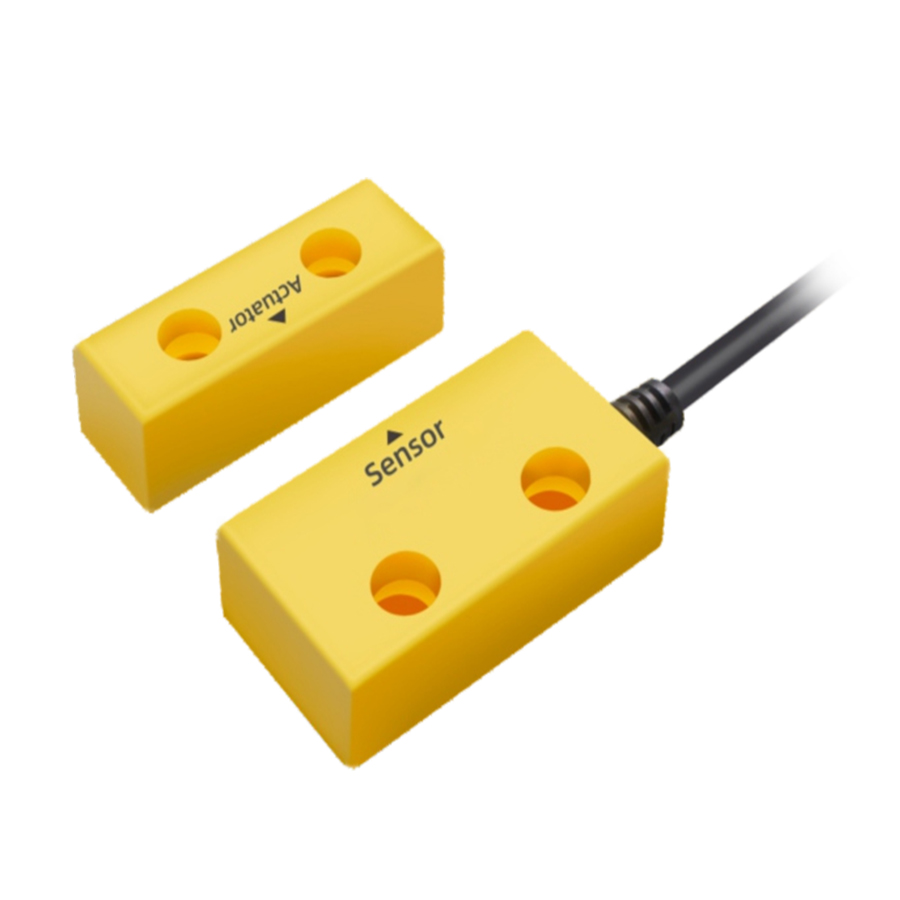
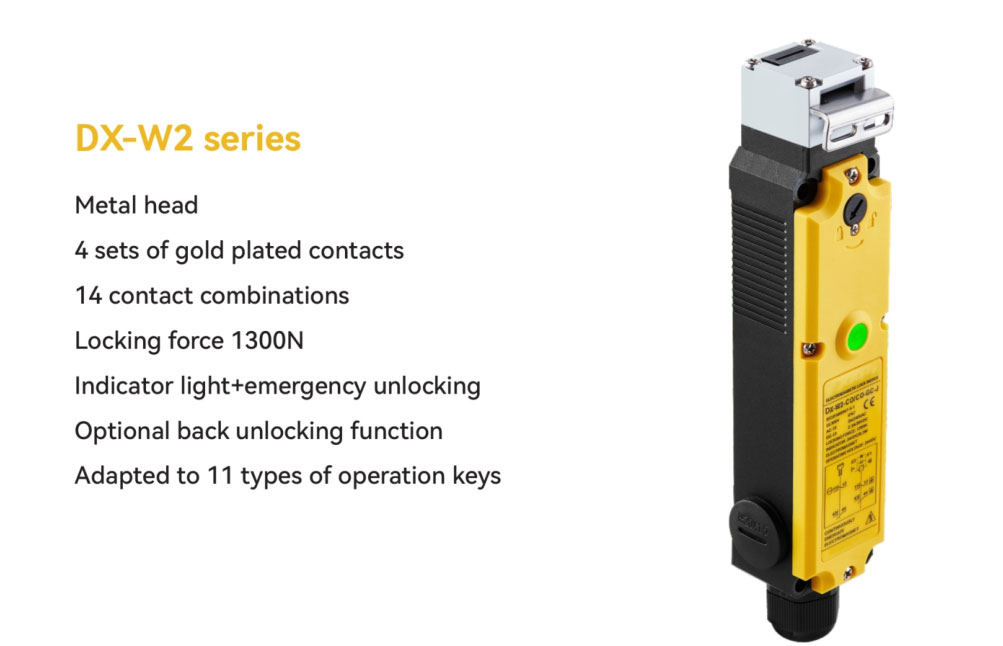
DAIDISIKE splits the same way the competitors do. The DX-R1 is the monitoring-only device (magnetic coded, ISO 14119 Type 4), equivalent to Pizzato's unlocked ST coded sensors. The DX-W2 and DX-D6 are the electromagnetic guard-locking devices (holding force up to 1300 N, IEC 60947-5-1, IP67), and the DXL-B safety door bolt is the mechanical bolt-style retention companion for double-leaf doors.
What is the DAIDISIKE equivalent of a Pizzato ST RFID sensor?
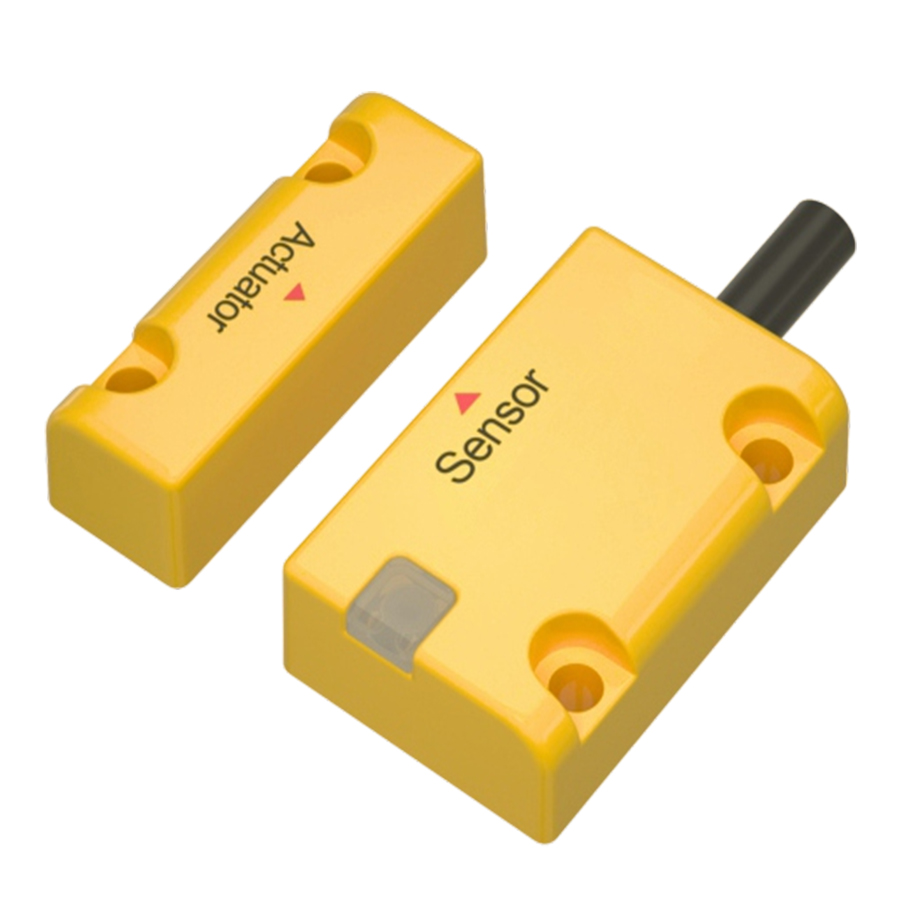
The DX-R1 matches the ST on non-contact, ISO 14119 Type 4, coded operation; the difference is the coding technology (coded magnetic vs RFID) and the certificate. Pizzato's ST D series is an RFID-coded non-contact safety sensor to ISO 14119 Type 4, rated IP67, offered with low-coding (D0T) and high-coding (D1T) actuators; the ST H series is the high-coding RFID variant. RFID lets the sensor read a unique transponder code from the actuator, which is why Pizzato can offer the low/high coding split directly in the part number.
The DAIDISIKE DX-R1 is a coded-magnetic non-contact switch built to ISO 14119 Type 4 — the same classification (non-contact, coded, high manipulation resistance) reached through a coded magnetic actuator rather than an RFID transponder. For ordinary guard-door monitoring the practical behaviour is identical: present the correct coded actuator and the safety outputs close; remove it and they open. Choose the ST when you specifically need a very large number of unique RFID codes or in-field teach-in pairing; choose the DX-R1 when you want a robust, lower-cost route to Type 4 coded monitoring.
What replaces the locking Pizzato NS, NG, FS and FG switches?
For light and medium guard doors, the DX-W2 (up to 1300 N) is the locking equivalent; for the heavy NG class (~9750 N) there is no DAIDISIKE parity product — that stays Pizzato. Pizzato's locking family spans several technologies. The NS series is an RFID safety switch with an electromagnet/solenoid and a separate actuator and lock, rated Category 4 / SIL 3 / PL e. The NG series is the heavy RFID guard-locking switch with a solenoid, a published holding force around 9750 N, two safety inputs and two outputs, up to 32 units in series and an F31 unique-coded actuator. The NX series is the compact locking RFID switch (Pizzato markets it as the world's smallest at 30 × 30 × 94.5 mm). The mechanical FS (thermoplastic housing, M20×1.5, 24 Vac/dc, IP67) and FG (metal housing, rotating head, IP67, with an EN 81 lift-door variant) are separate-actuator safety switches with a solenoid lock, while the FD is the metal-body separate-actuator switch without a lock.
The DAIDISIKE DX-W2 is an electromagnetic guard-locking switch with a published holding force up to 1300 N, separate actuator, built to IEC 60947-5-1 and IP67. It is the right tool against the FS, FG and NS on light-to-medium doors — the same locking job, the same separate-actuator architecture, at a factory-direct price. The honest guardrail: do not spec the DX-W2 against the NG's 9750 N or against doors where a high foreseeable manual force applies; match the holding force to the door (see the next section), and where a TUV certificate is mandated note that DAIDISIKE is CE self-declared with TUV available per order, whereas Pizzato FS/FG/NS/NG carry standing TUV approval.
What is the DAIDISIKE answer to Fortress tGard and amGard?
Segment by use case, not by spec parity: DX-W2 covers tGard-class light-door locking; the amGardpro / amGardS40 heavy 10,000 N class has no DAIDISIKE equivalent. Fortress tGard is a configurable interlock that combines guard monitoring and solenoid guard locking with an integrated control station — e-stops, buttons and indicators in one modular unit of up to 10 modules — with a maximum locking force around 2500 N, IP65, rated TUV Category 3 / PL d. Fortress amGardpro and amGardS40 are the heavy-duty guard-locking switches with a retention force of about 10,000 N, rated TUV Category 4 / PL e. Fortress mGard is the trapped-key / key-transfer interlock line.
DAIDISIKE's DX-W2 competes against the tGard only on the locking function for light-to-medium doors, at lower cost — it does not replicate tGard's integrated control-station modularity, and the DX-W2's 1300 N is below tGard's 2500 N, so confirm the door's foreseeable force first. Against amGardpro / amGardS40 at 10,000 N there is no parity product — those heavy doors stay Fortress. The clean way to read it: DAIDISIKE plays in the light/medium door segment on price, MOQ 1 and 3–15 day lead time, and openly cedes the heavy and integrated-control segments.
How much holding force does the door actually need?
Usually far less than the headline 9750 N / 10,000 N figures — the requirement is set by the foreseeable manual force on the door, not the machine's power. Under ISO 14119 the guard-locking holding force you must provide is governed by the force a person can foreseeably apply to the door. The standard references a 1000 N foreseeable manual force as a common design basis for medium guard doors. A light hinged or sliding sheet-metal guard that an operator might pull or lean on is comfortably inside the few-hundred-newton-to-1300 N envelope; the very high retention products exist for large heavy doors, pneumatically assisted doors, or where deliberate defeat with tools is foreseeable.
That is exactly why the DX-W2's up-to-1300 N rating is a serviceable number for the majority of light and medium guard doors — it sits at or above the 1000 N common design basis — while the Pizzato NG and Fortress amGard heavy products are the correct tool for the genuinely heavy cases. Specify on the door, not on the largest number you can find.
Cross-reference table: Pizzato / Fortress → DAIDISIKE DX
A starting map from public specs, not a drop-in part number. Always confirm against your installed unit's datasheet and a fresh ISO 14119 / ISO 13855 assessment.
| Competitor device | Function | Key published spec | DAIDISIKE match |
|---|---|---|---|
| Pizzato ST D / ST H | RFID coded, no lock (monitoring) | ISO 14119 Type 4; IP67; D0T low / D1T high coding | DX-R1 (magnetic coded, ISO 14119 Type 4) |
| Pizzato NS | RFID + solenoid, separate actuator + lock | Cat 4 / SIL 3 / PL e | DX-W2 (light/medium doors; ≤1300 N) |
| Pizzato NG | Heavy RFID guard locking | ~9750 N hold; 2 in / 2 out; up to 32 in series | No parity product — stays Pizzato (heavy) |
| Pizzato FS / FG | Mechanical, separate actuator + solenoid lock | IP67; FS thermoplastic, FG metal/rotating head | DX-W2 / DX-D6 (light/medium locking) |
| Pizzato FD | Metal-body separate actuator, no lock | Interlock without locking | DX-R1 / DX-D-series (monitoring) |
| Fortress tGard | Guard locking + integrated control station | ~2500 N; IP65; TUV Cat 3 / PL d; up to 10 modules | DX-W2 (locking only; no control-station module) |
| Fortress amGardpro / amGardS40 | Heavy-duty guard locking | ~10,000 N retention; TUV Cat 4 / PL e | No parity product — stays Fortress (heavy) |
| Fortress mGard | Trapped-key / key-transfer interlock | Mechanical key transfer | DXL-B door bolt (bolt-style retention companion) |
Is naming these brands legal, and how is the comparison kept honest?
Naming a competitor's product to describe a compatible alternative is nominative reference and is legitimate; the comparison stays honest by using only each vendor's published specs and by stating the limits. We reference Pizzato and Fortress by name to tell you what the DAIDISIKE equivalent is — normal, lawful comparison, with no implied partnership or endorsement. What we deliberately do not do: we don't reproduce their manuals, use their logos, or claim parity we can't back. The 1300 N DX-W2 is not presented as an NG (~9750 N) or amGard (10,000 N) substitute, and DAIDISIKE's CE self-declaration with TUV-per-order is stated plainly against those ranges' standing TUV approval. Every competitor figure above is from the manufacturer's own public specifications; the DAIDISIKE figures are from our spec sheets.
Send us the door type, the run-down time, the required ISO 14119 type and coding level, and your output scheme, and we will tell you the DX-R1, DX-W2 or DX-D6 that matches — or tell you plainly to keep a heavy Pizzato NG or Fortress amGard. Our wider method and the other brand cross-references live in the brand replacement & compatibility guide, and there is a worked door-lock example in our double-leaf guard-door case study.
Sources & specifications cited
- Pizzato Elettrica — safety devices (ST, NS, NG, NX, FS, FG, FD) — RFID coded sensors, guard-locking switches, ISO 14119 Type 4.
- Fortress Interlocks — tGard, amGardpro, amGardS40, mGard — guard locking, retention force, TUV category ratings.
- ISO 14119:2013 — interlocking devices associated with guards; type classification (Type 1–4), coding levels, foreseeable manual force.
- IEC 60947-5-1 — control circuit devices and switching elements; basis for the DAIDISIKE DX-W2 contact rating.