The application: why a pallet-exit opening is the hard one to guard
Picture the end of a packaging line. Cases come in, a palletizer stacks them, and finished pallets ride out of the cell on a powered conveyor through an opening in the perimeter guarding. That opening is a genuine conflict of duties. It must be open enough for a 1200 mm pallet to leave several times an hour, and it must be closed enough that a person cannot walk into the stacking robot through the same gap. You cannot solve that with a fixed fence — the pallet has to get out — and you cannot solve it with a plain light curtain, because a plain curtain would stop the line on every pallet. This is the textbook case for muting: an electro-sensitive guard that knows the difference between the load it is supposed to let pass and the human it is supposed to stop.
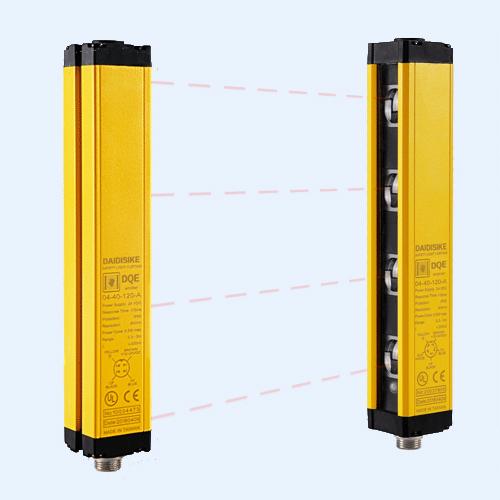
The representative cell here uses a DQC light curtain across the exit. The DQC is an IEC 61496 Type 4 active opto-electronic protective device — the highest test/fault class in that standard for this kind of sensor — so it is the right detection element for a hazard where a guard failure is not tolerable. The muting logic and the four sensors decide when that detection is allowed to stand down, and a DA31 safety relay turns a tripped curtain into an actual stop of the palletizer.
What exactly is muting, and what does IEC/TS 62046 require?
Muting is the automatic, temporary, monitored suspension of a protective function so an expected object can pass. It is not a bypass switch and it is not a maintenance override — it is a designed, sensor-driven decision that the thing crossing the curtain right now is the authorised pallet, valid only while a strict pattern holds. IEC/TS 62046 (the technical specification on the application of protective equipment to detect the presence of persons) sets out what a safe muting arrangement looks like. The core requirements an integrator has to meet:
- Automatic — muting is initiated by the sensors and the process, never by an operator pressing a button.
- Two or more independent signals — muting must depend on at least two independent sensor signals so no single sensor (or single fault) can mute the curtain.
- Monitored timeout — a bounded maximum muting time, commonly 4 s; if the pallet has not cleared and ended the condition, muting drops and the curtain protects again.
- Monitored muting lamp — an indicator that shows the curtain is muted, itself monitored so a failed lamp is a fault.
- Sense the load, not (just) the pallet — the geometry must key on the actual load passing, so the arrangement cannot be fooled by, say, an empty pallet or a hand at pallet height.
One number to hold onto: the 4 s timeout and the muting geometry figures are IEC/TS 62046 values, not DAIDISIKE product specs. They describe how to build the muting function; the DQC curtain and DA31 relay are the hardware you build it from. Don't quote them off a datasheet — derive them from your real pallet transit and your risk assessment.

Why four sensors and not two on this exit?
Two-sensor muting only suits a strictly one-way exit. With two sensors you can establish direction — object entered from the line side, not the operator side — but the window you have to distinguish “pallet” from “person” is thin, and it assumes traffic only ever moves one way. The moment the exit is bidirectional, or the risk is high enough that you want the load's geometry to be part of the proof, two sensors are not enough.
Four sensors — two inside the curtain, two outside — give you a real sequence to validate. A legitimate pallet is a known size and it travels at conveyor speed, so it crosses the four beams in a predictable order and within predictable time gaps. The muting logic only arms when that order and those gaps are satisfied; the instant the sequence is wrong — beams tripped in the wrong order, or a gap too long or too short — muting cancels and the curtain is live again. A person walking up to the opening does not reproduce a pallet's four-sensor signature, so they cannot mute the curtain by accident. That is the whole point: the sequence is the authentication. IEC/TS 62046's “two or more independent signals” is the floor; four sensors are the practical way to make a bidirectional or higher-risk pallet-exit robust.
How do you stop a person from muting the curtain?
The protection against accidental or deliberate human muting is geometry plus timing plus monitoring, all from IEC/TS 62046:
- Spacing limits. The technical specification gives representative sensor-spacing figures — for example d1 and d3 under 200 mm and d2 over 250 mm — so the active geometry matches a pallet, not a human stride.
- The 500 mm rule. A body of about 500 mm must not be able to mute the curtain. If your layout would let a 500 mm-wide object create the muting condition, the layout is unsafe and must change.
- Valid timed sequence. Sensors must trip in the right order within the permitted time gaps; out-of-order or out-of-time = no muting.
- Monitored 4 s timeout. Muting cannot persist beyond the bounded window, so a jammed pallet or a misread cannot leave the opening blind indefinitely.
- Monitored muting lamp. The muted state is visible and the indicator itself is supervised.
Stack those together and muting stops being a hole in the guard and becomes a narrow, supervised, self-cancelling window that only the real pallet can open. The figures above are IEC/TS 62046 application values — confirm the exact spacing and timing for your pallet and conveyor against the current specification and your risk assessment; do not treat them as DAIDISIKE hardware ratings.
Does the light curtain give you PLe/Category 4 — or does the whole chain?
The whole chain does. A curtain alone has no Performance Level. This trips up a lot of buyers: they see “Type 4” on the curtain and assume they have PLe. Type 4 is the IEC 61496 test/fault class of the sensing device — it tells you how robust the curtain is against its own faults. The Performance Level (PLe) and Category 4 under ISO 13849-1 belong to the complete safety function: detect the person (the DQC curtain), evaluate the signal, and remove power from the hazard. You only earn PLe/Cat 4 if the evaluation and output side is built to match.
That output side is the DA31 safety relay. It supplies the architecture with dual-channel, force-guided (positively-guided) contacts and External Device Monitoring (EDM), so a welded output contactor or a single channel fault is detected and the function still reaches the safe state — that fault-tolerance plus diagnostic coverage is what Category 4 demands. Re-closing the opening or ending a mute must not restart the palletizer on its own; the relay's reset and EDM enforce a deliberate, monitored restart. Assess the full chain — curtain, muting logic, relay, contactors — to ISO 13849-1 (or IEC 62061); the PL is a property of that chain, never of the curtain label.

How do you set the safety distance? ISO 13855: S = K·T + C
Muting decides when the curtain may stand down; it does nothing to the distance the curtain needs when it is live. That distance comes from ISO 13855 and its minimum-distance formula:
- K — approach speed. 2000 mm/s for a hand/arm approach; you may use 1600 mm/s where the resulting distance S is at least 500 mm.
- T — total stopping time. The curtain's response time plus the DA31's response plus the palletizer's machine stopping time. Measure the real overall stopping performance; don't guess.
- C — intrusion distance. A term that depends on the curtain's detection capability (resolution) — finer resolution, smaller C.
Mount the curtain at least S back from the hazard so a hand cannot reach the danger zone before motion has stopped. If you want to work a real number for your machine, run our ISO 13855 safety-distance guide. When the curtain is not muted, it must still deliver this full distance — muting never reduces S.
The muting-to-run sequence, step by step
Putting the cell together, here is how the protective and muting functions interact on a normal pallet cycle:
- Curtain live. Any beam break with no valid muting condition → the DA31 commands a stop of the palletizer.
- A finished pallet reaches the exit and trips the outer/inner muting sensor pairs in the valid order within the time window.
- Muting arms; the monitored muting lamp lights; the curtain stands down for the pallet only.
- The pallet clears; the sensors release in sequence; muting ends and the curtain is live again — all inside the 4 s timeout.
- If the sequence is ever broken, or the timeout expires, muting drops immediately and the DA31 holds the machine in the safe state until a deliberate reset (with EDM) allows a restart.
Where a DLD LiDAR fits — and where it does not
Customers often ask whether a laser scanner / LiDAR could replace the curtain here. Be precise about this. DAIDISIKE's DLD-series LiDAR is a 2D time-of-flight obstacle / area sensor — built for AGV/AMR navigation, obstacle avoidance and non-safety perimeter detection. It is not a type-rated functional-safety scanner (it is not an IEC 61496-3 Type 3 device) and it is not a drop-in replacement for a safety function. On this palletizing cell the protective stop is delivered by the DQC Type 4 light curtain plus the DA31 relay, full stop.
What a DLD can add is situational awareness: an area-warning or slow-down zone around the palletizer footprint, flagging that someone is approaching the cell before they ever reach the guarded opening. That is a useful non-safety layer on top of — never instead of — the rated muting curtain. If your application genuinely needs a safety-rated area scanner (for AGV personnel detection, say), that is a different, type-3-certified product class; we'll tell you so rather than overselling the DLD. See the DLD LiDAR / area-sensor page for the honest role boundary.
Bill of safety functions for the cell
| Element | Part / standard | Role in the function |
|---|---|---|
| Detection (input) | DQC light curtain — IEC 61496 Type 4 | Senses a person at the pallet-exit opening; the electro-sensitive protective device |
| Muting logic | 4-sensor muting per IEC/TS 62046 | Two inside + two outside; valid timed sequence; monitored 4 s timeout; monitored lamp; senses the load |
| Evaluation + output (logic) | DA31 safety relay — ISO 13849-1 | Dual-channel, force-guided contacts + EDM; supplies the PLe / Category 4 of the chain; commands the stop |
| Distance | ISO 13855 — S = K·T + C | Sets how far back the curtain mounts from the palletizer hazard |
| Optional awareness layer | DLD-series LiDAR (NON-safety) | Area-warning / slow-down only; not a safety function, not a curtain replacement |
Selection & commissioning checklist
- Pick four-sensor muting for any bidirectional or higher-risk pallet-exit; reserve two-sensor muting for a strictly one-way exit.
- Validate the geometry against a person, not just the pallet — apply the IEC/TS 62046 spacing limits and the 500 mm rule.
- Size the muting timeout from real pallet transit time with margin; the 4 s figure is an IEC/TS 62046 reference, not a target to copy blindly.
- Fit and monitor a muting lamp so the muted state is visible and supervised.
- Calculate S to ISO 13855 with the real total stopping time, and confirm the live curtain delivers it.
- Wire the stop through a DA31 with EDM and a deliberate manual reset; assess the whole chain to ISO 13849-1 for PLe / Cat 4.
- Keep LiDAR honest — use a DLD only as a non-safety awareness layer, never as the protective stop.
The outcome (representative)
In a cell built this way, the pallet-exit opening does both jobs at once: a finished pallet trips the four-sensor sequence and leaves on the conveyor with the line running, while anyone stepping into the opening out-of-sequence breaks the curtain and the DA31 stops the palletizer. Muting is automatic, bounded by a monitored timeout, indicated by a monitored lamp, and built to defeat a human silhouette — and the protective stop carries PLe / Category 4 because the whole chain, not the curtain alone, was designed to. That is the engineering behind a throughput-friendly, genuinely safe end-of-line cell.
This is a representative engineering application, not a specific named customer or project; the standards, products and design approach are real, a particular installation is not claimed.