
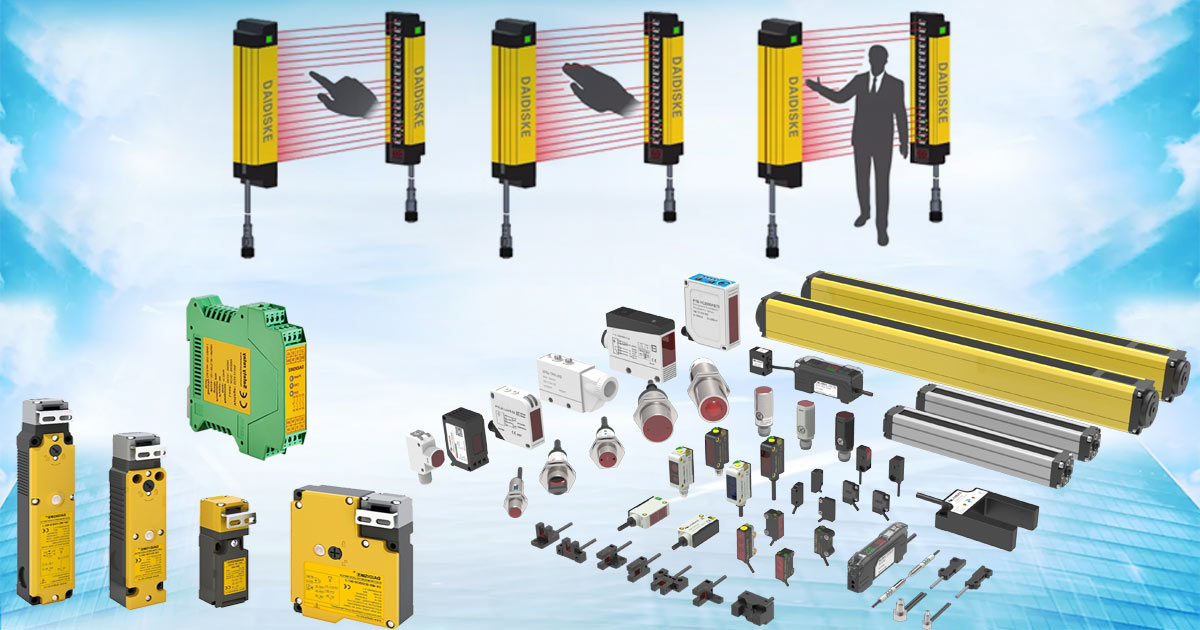
Buyers arrive at this product under three different names, and that alone causes half the confusion. Leuze, ReeR and Banner mostly say measuring light curtain; SICK calls it a measuring automation light grid (the MLG family); Banner also markets a measuring array and a light screen. Same device, three search terms, one decision. Whatever the label on your drawing, the questions below are the ones that decide which unit you actually buy.
One honest line first, because it saves a dangerous mistake: a measuring light curtain measures, it does not guard people. If your job is to stop a machine when a hand reaches in, you need a certified safety curtain, not a measurement grid. We'll come back to that distinction — it is the single most-searched question in this category — but keep it in mind through everything below.
What is a measuring light curtain, and how does it work?
It is a through-beam grid: an emitter bar and a receiver bar with a row of evenly spaced infrared beams. An object between them blocks some beams; the electronics read the blocked-beam pattern and report a value. The beams are scanned in sequence, so at every scan the grid has a one-dimensional picture of what occupies the field. From that picture the controller derives whatever you configured: the first-to-last blocked beam gives height or width; a blocked island surrounded by clear beams is a hole or gap; the moving edge of a web gives running width and center; sampling the profile as a part travels through gives its contour. The finer the beam spacing, the smaller the feature the grid can resolve.
That is the whole principle, and it is identical whether the box says measuring light curtain, measuring light grid or measuring array. The DAIDISIKE DQL measurement light curtain is built on it, with resolution from 1.25 mm and a measurement output set (RS-485 Modbus-RTU, 4–20 mA, 0–10 V) chosen for direct PLC and analog-loop integration.
Measuring light curtain vs safety light curtain — what is the difference?
They share the optics but answer different questions: a safety curtain is a certified protective device that stops a machine; a measuring curtain is an automation sensor that reports data. A safety light curtain is built to IEC 61496 (Type 2 or Type 4), with dual-channel OSSD outputs, continuous self-checking and a rated performance level (PL/SIL) — its entire reason to exist is to guard people. A measuring light curtain has no such certification obligation; it is optimized to output a number quickly and cheaply. The practical consequence is the guardrail below: you cannot use a measurement grid to protect a person.
| Aspect | Measuring light curtain (e.g. DQL) | Safety light curtain (e.g. DQC / DQT4 / DQA) |
|---|---|---|
| Primary job | Report height / width / profile / count (data) | Stop the machine when a person intrudes |
| Certification | Automation sensor — not a certified guard | IEC 61496 Type 2 / Type 4, ISO 13849-1 PL |
| Outputs | DQL: RS-485 Modbus-RTU, 4–20 mA, 0–10 V (DQM: dual-channel NPN/PNP) | Dual-channel OSSD with EDM |
| Personnel protection? | No — never wire as the safety device | Yes — that is its rated function |
| DAIDISIKE both-in-one | DQM — a measurement light curtain that is also safety-rated, for applications that genuinely need both | |
So the routing is simple. Pure measurement → DQL. Pure protection → a certified safety curtain such as the DQC Type 4 hand guard, the DQT4 (Type 4 / PL e) or the DQA finger/hand curtain. Genuinely need measurement and a safety-rated stop in one device → the DQM measurement safety light curtain.
Axis 1 — resolution and beam spacing (the number-one selection spec)
The smallest feature you must detect sets the maximum beam spacing. Pick the coarsest spacing that still catches it; over-specifying resolution is the most common and most expensive mistake. Beam spacing is the center-to-center distance between adjacent beams; resolution is the finest detail the grid can resolve, which that spacing largely sets. The DAIDISIKE DQL is available from 1.25 mm resolution — finer than the 2.5 mm edge resolution Banner headlines on the EZ-Array — so if your search started with “2.5 mm resolution measuring light curtain,” the DQL clears that benchmark directly. (The safety-rated DQM starts at 2.5 mm.)
For reference, here is how the resolution / beam-spacing axis looks across the families buyers compare. These figures are from each vendor's own public datasheets and are quoted only to orient the selection, not to copy anything.
| Family | Resolution / beam spacing | Range / length (per vendor specs) | Notes |
|---|---|---|---|
| DAIDISIKE DQL | From 1.25 mm | Per ordered build | Measurement-only; RS-485 Modbus-RTU, 4–20 mA, 0–10 V |
| DAIDISIKE DQM | From 2.5 mm | Per ordered build | Measurement + safety-rated; dual-channel NPN/PNP |
| SICK MLG-2 | 5 / 10 / 25 / 50 mm beam separation | 2 / 3 / 5 / 8.5 / 14.5 m | Prime/Pro/Top; cross-beam + High accuracy detects down to 2 mm |
| SICK MLG-2 WebChecker | Fine sub-mm edge resolution | — | Running-edge, width & center measurement |
| Banner A-GAGE EZ-Array | 2.5 mm edge resolution; detects 5 mm objects | 4 m range; heights 150–2400 mm | Multiple measurement modes; analog + discrete + serial; IO-Link, Modbus-RTU |
| Banner MINI-ARRAY | 9.5 mm or 19.1 mm beam spacing | Lengths 150–1830 mm | 19.1 mm spacing optimized for vehicle separation |
| Leuze CML 700i / 720 | Per ordered build | Up to 6 m; M12 | CANopen, IO-Link, RS-485, PROFIBUS, PROFINET; built-in display |
The takeaway: SICK's MLG-2 spans 5–50 mm beam separation (with a cross-beam High-accuracy mode reaching down to 2 mm detection), Banner's EZ-Array headlines 2.5 mm edge resolution, and the MINI-ARRAY's 19.1 mm spacing is a vehicle-separation choice. The DQL reaching 1.25 mm sits at the fine end of that spread — enough for small-part and edge work — while still letting you order a coarser, cheaper build when your smallest feature is large.
Axis 2 — output and interface (NPN/PNP, 4–20 mA, 0–10 V, Modbus-RTU)
How the measured value reaches your control system is the second decisive spec — and it is where DAIDISIKE's lineup is deliberately different from the incumbents. The big brands push IO-Link and fieldbus: Leuze CML 700i carries CANopen, IO-Link, RS-485, PROFIBUS and PROFINET; Banner's EZ-Array adds analog and serial including Modbus-RTU. Those are excellent if your plant is already built around that fieldbus. But a large share of buyers just want the value into a PLC analog card or an existing 4–20 mA loop without buying a gateway or a fieldbus master.
That is exactly the DQL/DQM wedge, and the two units divide the work. The DQL exposes RS-485 Modbus-RTU for full data and configuration, 4–20 mA for the classic analog loop, and 0–10 V for a PLC analog input. The DQM exposes dual-channel NPN/PNP discrete outputs (present/absent, count, or a safety stop into a relay or PLC input). If your search was a long-tail like “Modbus RTU light curtain,” “4–20 mA output light curtain” or “0–10 V analog output light curtain,” the DQL is built around those outputs — the cheaper, PLC-direct, analog-loop path rather than a fieldbus dependency.
Which measurement task — height, width, diameter, profile, counting, holes, edges?
Most named long-tail applications are just different reads of the same blocked-beam pattern. Here is how the common tasks map. A measuring light grid is genuinely versatile because once it knows which beams are blocked, software decides what that means.
| Measurement task | What the grid reads | Typical use |
|---|---|---|
| Height / width measurement | First-to-last blocked beam in the field | Online dimension inspection on a conveyor |
| Diameter sizing | Blocked span across a round part | Bar, tube, roll diameter checking |
| Contour / profile detection | Blocked pattern sampled as the part travels | Shape / protrusion / pallet-overhang checks |
| Object / parts counting | Blocked-then-clear transitions | Counting parts on a conveyor |
| Hole / gap detection | Clear island inside a blocked region | Missing-feature / gap monitoring |
| Edge detection & center positioning | Running edge position of a moving web | Edge guiding, web-width & center control |
| Pallet / protrusion monitoring | Beams blocked outside the allowed envelope | Detecting overhang before storage/transfer |
These are the same use-cases the incumbents publish: SICK markets the MLG-2 for height measurement, pallet detection and protrusion monitoring, and the MLG-2 WebChecker specifically for running-edge, width and center measurement on paper, film and packaging webs; Banner's EZ-Array exposes multiple measurement modes for exactly this spread. The DQL covers the same task list, and where a build needs vehicle separation rather than part measurement, that maps to the DQLV — the same niche Banner's 19.1 mm MINI-ARRAY is optimized for.
SICK MLG, Banner EZ-Array or Leuze CML alternative — where does DAIDISIKE fit?
DAIDISIKE is the value-OEM alternative: the same resolution and measurement-mode envelope, with the PLC-direct output set, at OEM pricing and MOQ 1. If you are searching “SICK MLG alternative,” “Banner EZ-Array alternative” or “Leuze CML alternative,” the honest pitch is this: the incumbents are excellent and we reference them only to describe compatibility. DAIDISIKE matches the fine- resolution figure (DQL from 1.25 mm, DQM from 2.5 mm) and the standard measurement tasks, and leads with the DQL's Modbus-RTU + 4–20 mA + 0–10 V analog outputs (and the DQM's dual-channel NPN/PNP) that suit a PLC-direct or analog-loop integration. As a Chinese OEM/ODM manufacturer (est. 2013, 3000 m² factory), we ship at MOQ 1 set, a 3–15 day lead time, and export to 20+ countries — the same model behind our Autonics, Panasonic and P+F/IFM alternative pages.
How to choose — the short checklist
Resolution → output → size/range → measurement-only vs safety. In that order. Walk it once and the model picks itself:
- Smallest feature? Sets the maximum beam spacing / resolution. From 1.25 mm on the DQL, from 2.5 mm on the DQM.
- How does the value reach the PLC? DQL: RS-485 Modbus-RTU, 4–20 mA or 0–10 V analog; DQM: dual-channel NPN/PNP — pick the unit whose outputs match, so no gateway needed.
- Measuring height/length and range between emitter and receiver, per your conveyor or opening.
- Response time fast enough for your line speed and count rate.
- Measurement-only or also safety? DQL for data; DQM when you also need a safety-rated stop; a certified Type 4 curtain (DQC / DQT4 / DQA) when the job is purely guarding people.
Send those five answers to our engineers on +86 15218909599 (phone / WhatsApp) or via the contact page, and we will return a matched DQL, DQM or DQLV — or tell you plainly if your job needs a certified safety curtain instead. The full measurement-grating range is on the detection & measurement grating page.
Sources & specifications cited
- SICK — MLG-2 measuring automation light grid & WebChecker — 5/10/25/50 mm beam separation; ranges 2–14.5 m; cross-beam High accuracy to 2 mm; WebChecker for running-edge, width & center measurement.
- Banner Engineering — A-GAGE EZ-Array & MINI-ARRAY — EZ-Array 2.5 mm edge resolution, detects 5 mm, 4 m, multiple measurement modes; MINI-ARRAY 9.5/19.1 mm, vehicle separation.
- Leuze — CML 700i / CML 720 measuring light curtains — CANopen, IO-Link, RS-485, PROFIBUS, PROFINET; up to 6 m; built-in display.