
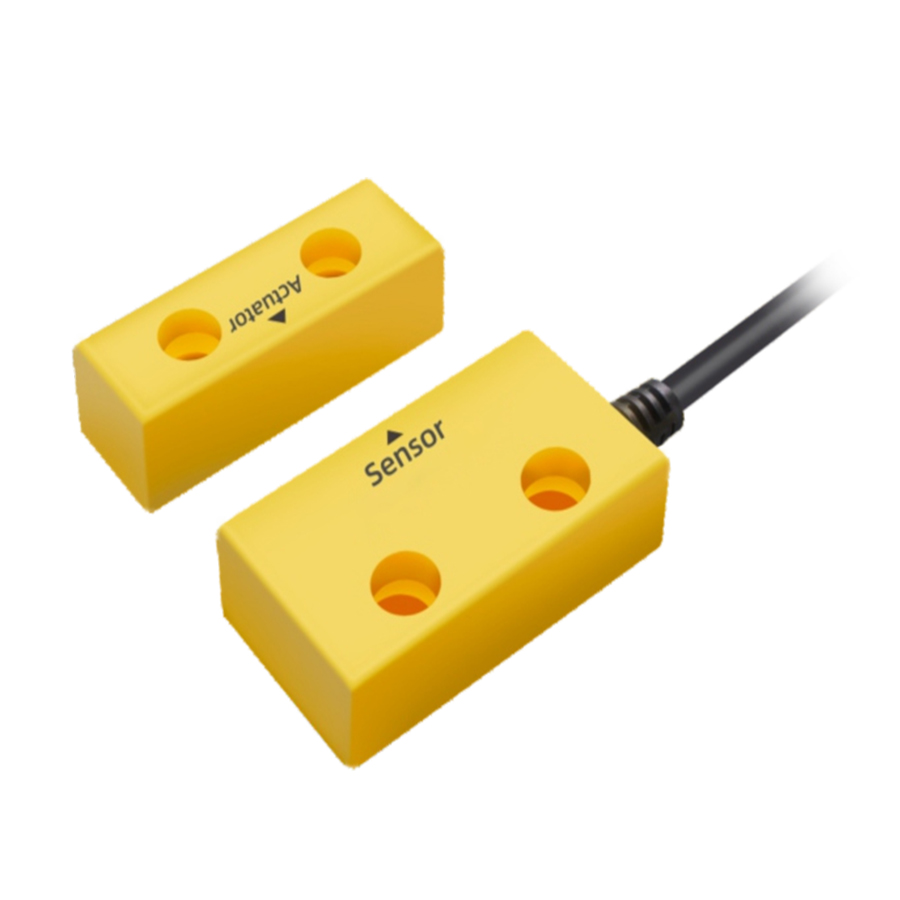
Wire up a guard door interlock or a light curtain the traditional way and you count conductors: two OSSD signals, 0 V and 24 V, frequently another pair for EDM and reset, sometimes muting and status on top. Each lands on a safety input card. It works, it is well understood, and it has been the shape of machine safety for thirty years. The cost is in the harness — the wiring, the labelling, the fault-finding when something opens a channel and the device simply goes to its safe state without telling you why.
IO-Link Safety is the attempt to fix that without giving up any safety integrity. The idea is simple to state and was hard to standardise: run the safe signals and a diagnostic channel down one IO-Link cable, point-to-point, and still reach the top of the integrity scale. As of 2026 the standard is published, the test specification is out, and the first real devices are landing. Worth understanding properly before the marketing arrives.
What exactly is IO-Link Safety?
IO-Link Safety is the functional-safety extension of IO-Link — SDCI, the single-drop digital communication interface. The base technology is standardised as IEC 61131-9; the safety layer is standardised worldwide as IEC 61139-2:2022, titled “Industrial networks — Single-drop digital communication interface — Part 2: Functional safety extensions.” That document is the thing to cite. It specifies the extensions to the SDCI of IEC 61131-9 for functional safety, and it is not a single feature but a small stack:
- a standardised OSSDe interface for redundant switching signals;
- a lean functional-safety communication protocol implemented as a “black channel” per IEC 61784-3:2021;
- protocol-management functions for configuration and parameterisation;
- IODD extensions for functional safety; and
- a Device Tool Interface (DTI) for dedicated engineering tools.
The headline number engineers care about: IO-Link Safety supports functional safety up to SIL 3 (per IEC 61508 / IEC 62061) and PL e, Category 4 (per EN ISO 13849-1) — the highest integrity and performance levels a machine safety function normally needs. This is not a watered-down digital convenience layer. It is a full safety transport.
One more property that matters commercially: it is fieldbus-independent and vendor-independent. A safety light curtain from one maker and a safety interlock from another can sit on the same IO-Link Safety infrastructure and interoperate, because the safety behaviour lives in the open standard, not in a proprietary protocol. That is the difference between an open extension and a closed ecosystem.
How is IO-Link Safety different from hardwired safety I/O?
Short answer: same integrity, one connector instead of a harness, and the device can talk back. A single M12 IO-Link Safety cable replaces the traditional multi-wire hardwired safety circuit and carries both the safe switching signals and bidirectional diagnostic and parameter data. The wiring, installation effort and cost drop; the diagnostic data can be read directly in the PLC or shown on an HMI.
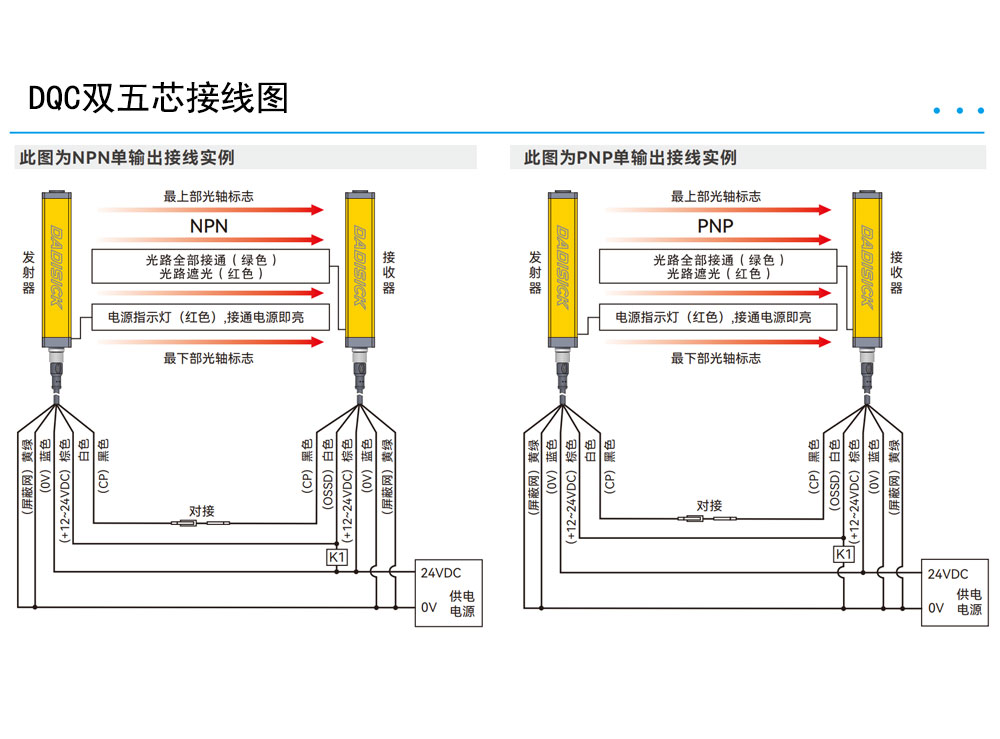
Put the two side by side and the contrast is concrete. A hardwired light curtain gives you two OSSD lines, power, and whatever extra conductors the application needs — and when it trips, all you know is that it tripped. An IO-Link Safety light curtain gives you the same dual-channel safe signal over OSSDe, plus a digital channel that can report exactly what is happening: which beam is blocked, marginal alignment, contamination, supply voltage, temperature. The first shipping devices make this tangible — one announced interlock reports supply voltage, temperature and RFID signal quality as live diagnostic data. On a hardwired device, none of that ever leaves the terminal box.
What is OSSDe and how does it protect the migration path?
OSSDe — “OSSD equivalent,” or extended OSSD — is the part that keeps this from being a clean break with everything you already own. Conventional non-contact protective devices like light curtains output safe switching signals on a pair of OSSDs. OSSDe extends that: safe signal transmission on pin 4 is supplemented by an additional signal path on pin 2, and both paths — OSSD1e and OSSD2e — carry the safe signal together on two independent channels, fail-safe.
Why that design choice is smart: it builds on the dual-channel OSSD principle the entire installed base of safety sensors already relies on, rather than inventing a new electrical paradigm. So OSSDe is the bridge. It gives a defined compatibility and migration route from today's OSSD-type light curtains and interlocks toward IO-Link Safety, instead of telling a plant to rip out and replace. Standards that respect the installed base get adopted. Ones that demand a forklift upgrade tend to stall.
Single M12 vs multi-wire — what actually changes on the cable?
The physical layer is deliberately ordinary, and that is the point. IO-Link Safety is a point-to-point protocol — one device per master port — over standard unscreened three- or five-conductor cable with M12 connectors, with a maximum cable length of 20 metres, identical to the standard IO-Link physical layer. Baud rates are the familiar IO-Link set: 4.8 kbit/s (COM1), 38.4 kbit/s (COM2) or 230.4 kbit/s (COM3). No new connector family, no shielding ritual.
The cleverness is in the protocol, not the copper. Because IO-Link Safety is point-to-point rather than a fieldbus, its functional-safety communication protocol is simpler than the safety protocols designed for fieldbus systems — there is no network arbitration to make safe, just one link between a device and a master. The safety layer runs as a black channel over that link per IEC 61784-3:2021, which means the transmission medium itself need not be safety-rated; the protocol catches corruption, loss, delay and misrouting end to end.
One more practical capability: mixed mode. IO-Link Safety can transmit safety-related and standard, non-safety data over the same connection at the same time. A device can stream process or condition data right next to its safe signal, on the same cable, without a second run.
How does device replacement and parameterisation work?
IO-Link Safety uses IODD-based parameterisation — the safety device description is an extension of the ordinary IO-Link IODD — together with a data-storage / offline-configuration function aimed at device replacement and series production. In practice that means a replacement device can pull its parameters automatically rather than being re-taught by hand, and a production line of identical machines can be configured from one master parameter set. The supporting documents come from the IO-Link Community, which publishes the IO-Link Safety System Extensions V1.1.5 and the IO-Link Safety Test Specification V1.1.5 (the 2025 package), alongside the original 2018 System Description. The test specification is the part that turns “supports the standard” into “certified to it.”
Are there real IO-Link Safety products in 2026?
Yes, and this is the news that makes the topic timely rather than theoretical. Schmersal announced the first IO-Link Safety products at SPS 2025, in a press release dated 25 November 2025: the AZM42 solenoid interlock and the RSS362 non-contact RFID safety sensor, with planned market launch toward the end of the first half of 2026. Both integrate via standard three-wire M12 cables and meet PL e (EN ISO 13849-1) and SIL 3 (IEC 61508 / IEC 62061). The AZM42 provides comprehensive real-time diagnostics — supply voltage, temperature, RFID signal quality — while the RSS362 adds intelligent diagnostics and secure bidirectional communication.
Crucially, this is not one vendor going it alone. Pilz, Phoenix Contact, Balluff and Fortress Safety (tGard) are among the other vendors publicly developing or offering IO-Link Safety products. A standard with several suppliers building to it is a standard with a future; a “standard” with one is a product. IO-Link Safety is the former.
Where does DAIDISIKE fit in this?
Plainly: not yet, and we will not pretend otherwise. DAIDISIKE does not currently offer an IO-Link Safety-certified product. Our Type 4 light curtains such as the DQC hand-protection curtain and non-contact interlocks such as the DX-R1 magnetic-coded safety switch are conventional OSSD devices today — which, thanks to the OSSDe design, sit on exactly the migration path this standard was built around. We are watching IEC 61139-2 and the IO-Link Community test specification closely. When we ship an IO-Link Safety device, it will be because it is certified, not because the term is fashionable. This article is a technical explainer of an open standard, nothing more.
Is IO-Link Safety hype or substance?
Substance, with a caveat about timing. The substance: it is a published international standard (IEC 61139-2:2022), it reaches SIL 3 / PL e, it runs on ordinary M12 cable, it preserves the OSSD installed base through OSSDe, and it now has certified products from a real spread of vendors. Those are not marketing claims; they are standard numbers and shipping dates. The caveat: in mid-2026 this is the beginning of the rollout, not the middle. The first devices are interlocks and RFID sensors; the catalogue is thin; masters and PLC support are still maturing. So the honest position is to specify it where the diagnostics and reduced wiring genuinely pay — and to keep building reliable OSSD machines everywhere else until the ecosystem fills out. The direction is clear. The calendar just needs a little patience.