
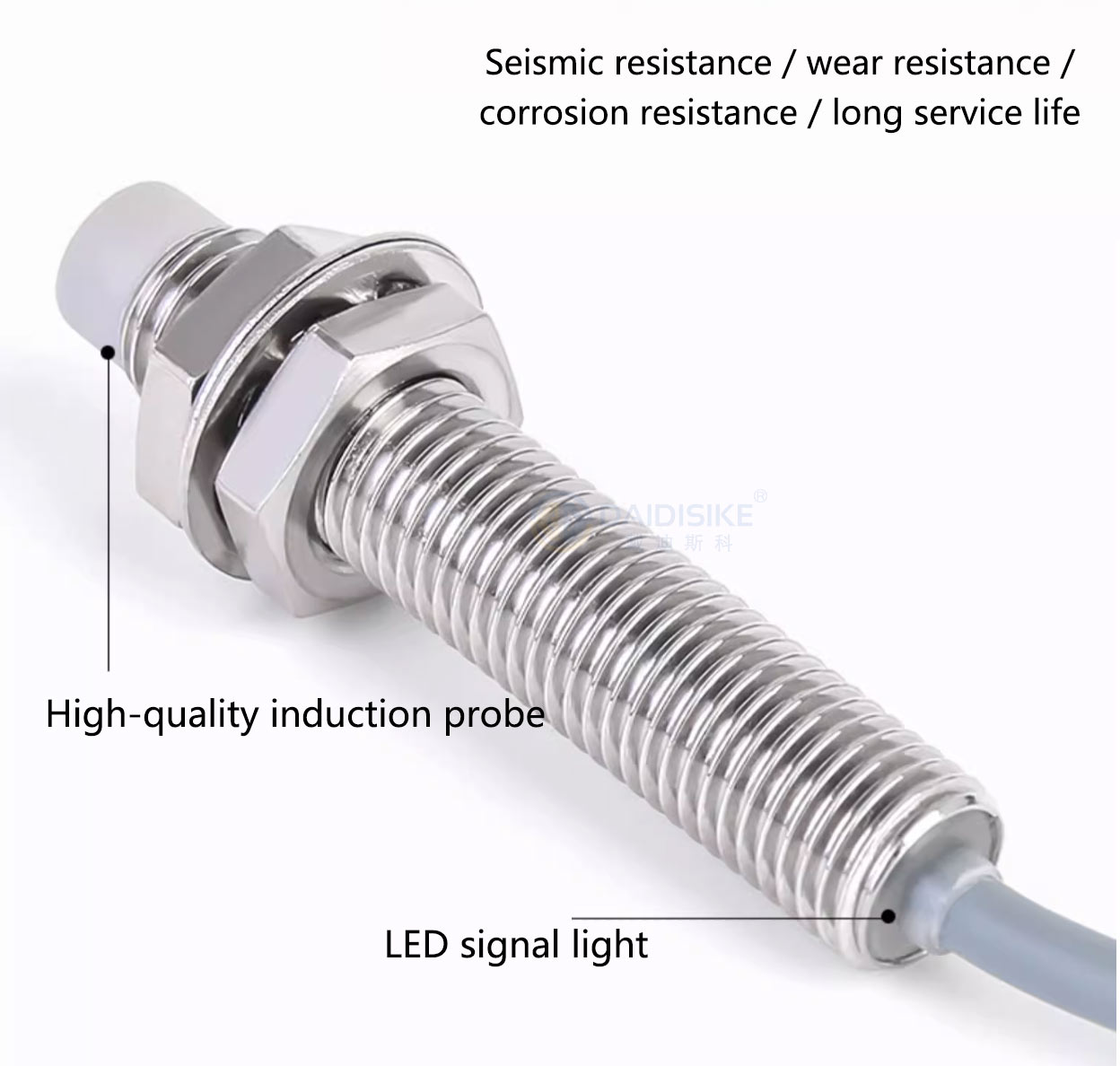
Spend a day commissioning a line and you will wire dozens of inductive proximity switches — end-of-stroke on cylinders, part-present on fixtures, home position on indexers. They are cheap, they are everywhere, and for thirty years the only real decision was thread size, sensing distance and whether the customer's PLC wanted PNP or NPN. That comfortable boredom is over. The device itself looks the same as it did in 2010, but what happens behind the third wire has changed enough that an engineer specifying a sensor in 2026 ought to ask different questions.
Here is the honest read on what is actually moving — and, just as important, what is being oversold.
What is driving the proximity sensor market in 2026?
Four threads, in rough order of how much they should change your next purchase order: IO-Link going from “nice option” to default digital layer; Single-Pair Ethernet finally arriving at the field; factor-1 sensing becoming affordable enough to standardise on; and miniaturisation pushing real performance into M8 and even M5 bodies. None of these is a brand-new invention. What is new is that they have all crossed the line from datasheet curiosity to something you can buy off the shelf and have to reason about.
How is IO-Link changing inductive proximity sensors?
IO-Link is the one that actually matters for most plants. It is standardised as IEC 61131-9 — the SDCI, or single-drop digital communication interface — and the adoption curve has gone vertical. The IO-Link community counted roughly 51.6 million installed nodes at the end of 2024, added about 9.7 million in 2025, and crossed 71 million total, with Europe the single largest region at around a third of the installed base. When a technology is shipping at that rate, it is no longer a bet; it is the substrate.
What IO-Link does on an inductive sensor is take the same third wire that used to carry a simple on/off and run a bidirectional digital conversation over it, up to 230.4 kbit/s (the COM2 rate), point-to-point to an IO-Link master port. Three things fall out of that:
- Diagnostics. Instead of silently dropping its output when a target drifts to the edge of range or the face fouls, the sensor reports it — short-circuit, marginal switching reserve, over-temperature. Maintenance stops guessing.
- Parameterisation. Switch point, output logic (NO/NC), filter time and sometimes the sensing window are set from the controller and live in the PLC project. Swap a failed sensor and the replacement pulls its configuration on power-up — no DIP switches, no teach button, no climbing into the fixture.
- Process data beyond on/off. Many IO-Link inductive sensors now report a measured distance value, not just a threshold crossing, which quietly turns a switch into a coarse measuring device for things like clamp wear or stack height.
The detail that made IO-Link spread so fast is unglamorous: it runs over standard unscreened M8/M12 sensor cable up to 20 m. You wire an IO-Link sensor exactly like a plain three-wire one; only the master port is different. No new cable, no shielding ritual. That backward compatibility is the whole game.
What is Single-Pair Ethernet and is it ready for sensors?
Single-Pair Ethernet (SPE) is the longer-horizon story, and it is easy to over-hype, so let me be precise. For the field level the relevant flavour is 10BASE-T1L, standardised in IEEE 802.3cg: 10 Mbit/s full-duplex over a single twisted pair, reach up to 1000 m, with power delivered on the same pair via PoDL (Power over Data Line). The industrial connector has settled on IEC 63171-6 — the T1 Industrial mating face backed by the major connector houses. The first field sensors with an SPE interface were slated to launch in 2026.
The appeal is genuine: end-to-end IP from the sensor all the way to the controller and the cloud, with no protocol gateway in between, over a thin two-wire cable that can run a kilometre. For a sprawling conveyor system or a water-treatment plant, that reach is hard to beat.
But be clear-eyed about where SPE fits in 2026. It is not a drop-in for the millions of cheap discrete prox switches on a typical machine. SPE needs its own single-pair cable and the IEC 63171-6 connector — so adopting it is a cabling decision, not a swap of a master port the way IO-Link is. The economics only work where the distance or the bandwidth genuinely earns the new infrastructure: long runs, measuring sensors, process instruments. For the end-of-stroke switch on a pneumatic cylinder, IO-Link will remain the right answer for years. My read: SPE and IO-Link are complementary through this decade, not competitors, and anyone telling you SPE replaces IO-Link in 2026 is selling cable.
What is factor-1 sensing and is it worth the premium?
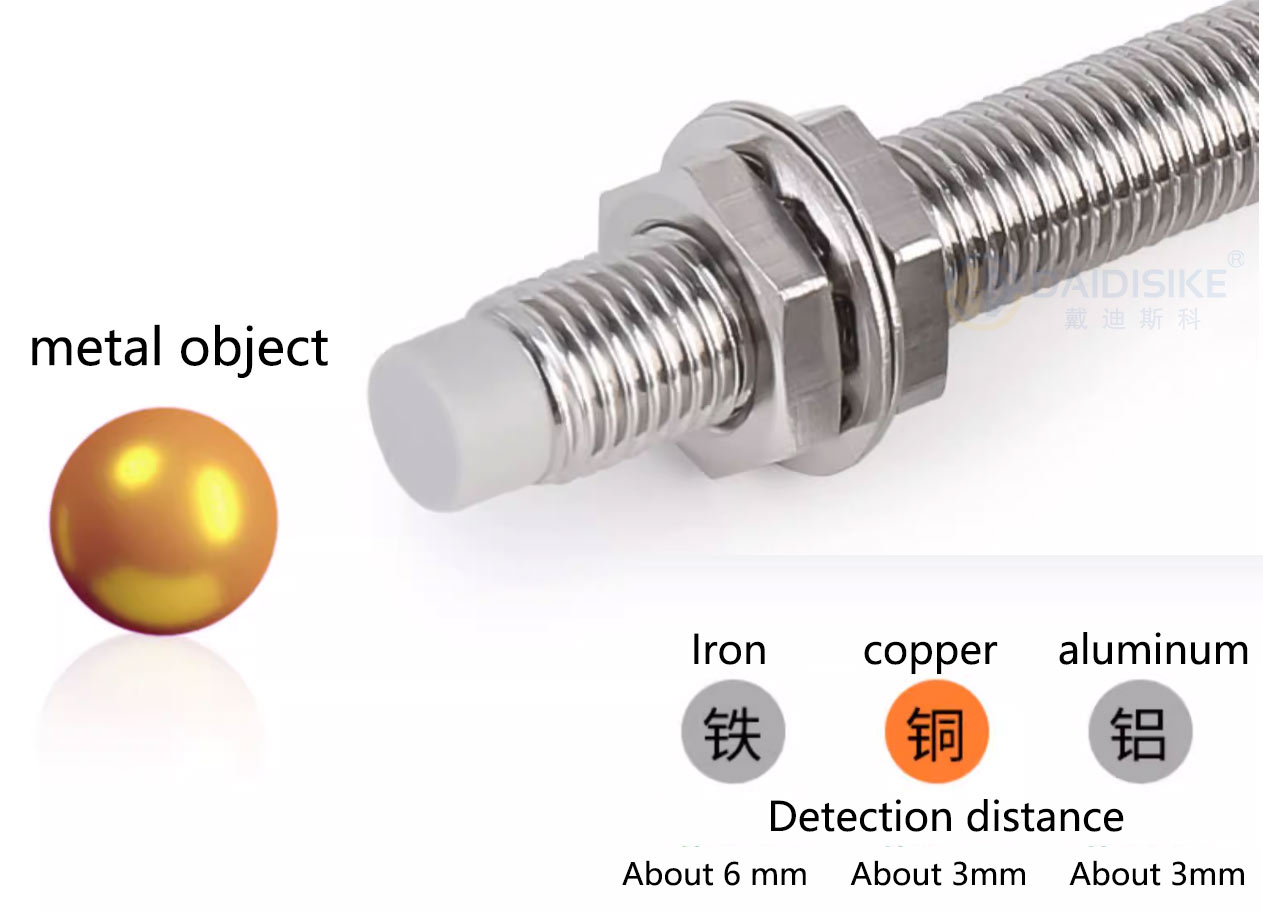
A normal inductive sensor cheats: it is tuned for mild steel, and it loses range on everything else. Point one at aluminium or brass and the rated sensing distance collapses to roughly 0.3–0.5 of the steel figure — the so-called reduction factor. For decades you simply de-rated the spec and moved on.
A factor-1 sensor removes that penalty. Using microcontroller compensation and usually a ferrite-free coil, it gives the same switching distance on steel, stainless, aluminium, brass and copper — a reduction factor of 1, hence the name. The same coreless construction also makes it largely immune to the brutal electromagnetic fields around resistance and MF (medium-frequency) welding, which is exactly where ordinary sensors false-trip and die. That combination — equal range on any metal plus weld-field immunity — is why factor-1 sensors became the default in automotive body-in-white cells.
Here is the engineering judgement, though: do not reflexively specify factor-1 everywhere. If your target is a fixed mild-steel cam in a clean cell, a standard sensor is cheaper and exactly correct. Factor-1 earns its premium where the target metal varies, where it is non-ferrous, or where there is a weld field nearby. Pay for it when the physics demands it, not because the word sounds advanced.
How small can you go — and what does miniaturisation cost you?
The fourth thread is mechanical. IO-Link COM2 now fits comfortably in an M8 barrel, and miniature M5, M6 and M8 sensors with IO-Link, extended sensing ranges and flush-mountable faces are ordinary catalogue items, not specials. That matters wherever mounting space is contested: robot end-effectors, 3C electronics assembly, small pneumatic grippers, dense tooling plates.
The trade-off is honest physics. A smaller coil sees a shorter distance. DAIDISIKE's own three-wire DC range steps through the familiar sizes — M8 at a short rated range, then M12, M18 and M30 with progressively longer sensing distances — precisely because the physics does not let you have a long range in a tiny body. Size the housing to the target gap first, then to the available hole. If the gap is large, do not force an M8 in just because the bracket is small; step up to an M12 or M18. Our M8-vs-M12 selection guide works through that trade-off in detail.
PNP or NPN, and what about harsh-environment housings?
Two perennial spec-sheet questions that have quietly settled. On output polarity: for new European and most global machinery, default to PNP (sourcing). In a grounded-negative system PNP is the safer failure mode — a signal-to-frame short de-energises the input rather than spuriously asserting it — and it is what modern sinking PLC input cards expect. NPN (sinking) is not dead; it persists in legacy Asian-built machinery and older controllers. But for a clean-sheet design, PNP is the sensible default. Always confirm against your input card's common polarity before you order — the full reasoning, with wiring diagrams, is in our PNP-vs-NPN wiring guide.
On environment: the bar has moved from IP67 to IP69K for any sensor that meets a high-pressure, high-temperature washdown — food, beverage, pharma. IP67 (dust-tight, temporary immersion) is still fine for general machine builds; IP69K adds survival under close-range 80°C, 80–100 bar steam-jet cleaning. Specify to the cleaning regime, not the brochure: paying for IP69K on a dry assembly cell is wasted money, and skipping it on a daily-washdown line is a guaranteed warranty claim.
What should an engineer actually do about this in 2026?
Short version. For any new machine where diagnostics or fast changeover matter, specify IO-Link as the default and treat plain switching outputs as the exception — the price gap is small and shrinking, and the wiring is identical. Reserve SPE for the genuinely long runs and the measuring/process sensors where its reach and bandwidth pay for the new cable; do not let anyone sell it to you as an IO-Link replacement yet. Reach for factor-1 only where the metal varies or a weld field is present. Choose the smallest housing that still clears your target gap, and match IP rating to the actual cleaning regime. None of that is exotic. It is just what a current, thoughtful proximity-sensor specification looks like — instead of copying the part number off the machine you built in 2015.
Related reading
DAIDISIKE M8 Inductive Proximity Switch
Compact three-wire DC inductive switch for tight fixtures and short target gaps.
DAIDISIKE M12 Metal Inductive Proximity Switch
The workhorse size — longer range than M8, PNP/NPN, NO/NC variants.
Single-Pair Ethernet for Sensors (2026)
10BASE-T1L, IEC 63171-6 and where SPE actually pays off at the field level.