
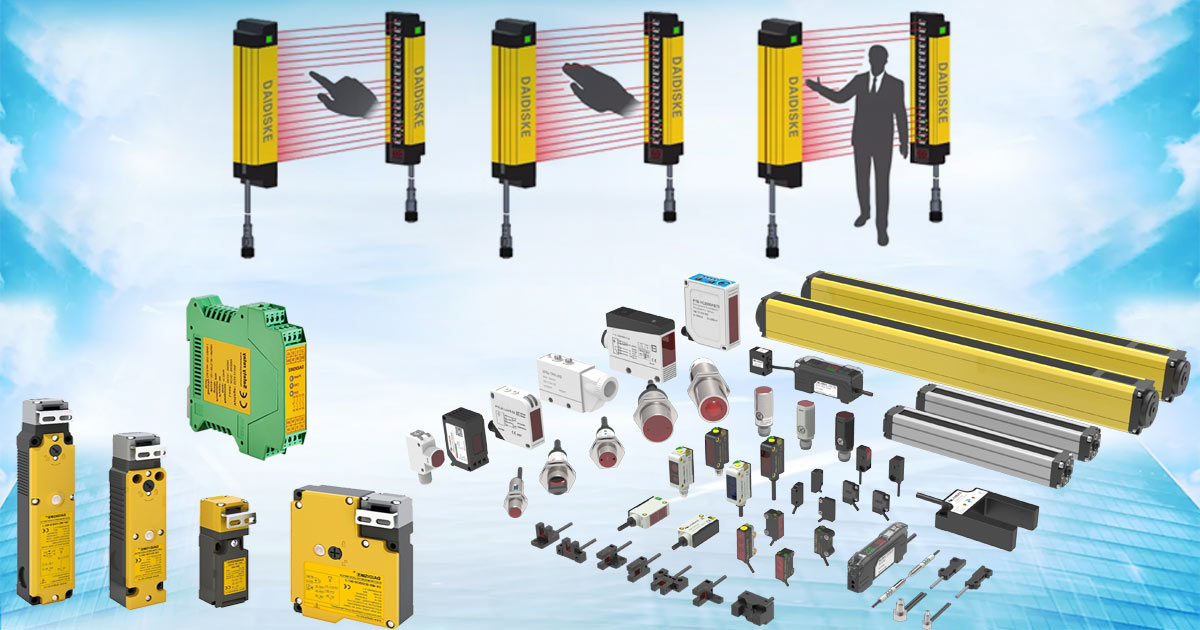
We keep cross-reference notes for the brands customers most often arrive with on safety door switches — and after the light-curtain brands, the two names that come up the most are Euchner and Schmersal. So here is the same treatment we give the curtains, built the same way: from each manufacturer's own published specifications, not from anyone's manual, and with no invented part numbers.
One blunt point before the detail. A “replacement” for a safety interlock is not a part number you look up and drop in. It is a match on a handful of facts — ISO 14119 type and coding level, whether guard locking is required (and if so, the holding force and power-to-lock vs power-to-unlock principle), the PL / SIL target, the output and series-wiring scheme — followed by a fresh risk-assessment check. Get those right and the swap is sound. Get them wrong and no badge change makes it safe. Everything below is about getting them right.
How is a safety door switch chosen? The three questions that decide it
Before any brand cross-reference, three facts decide which DAIDISIKE product you land on: is it coded non-contact, mechanical, or guard-locking? ISO 14119 — the standard for interlocking devices associated with guards — is the spine of this whole exercise. It tells you the type (1/2 mechanical, 3/4 non-contact), the coding level (low 1–9 codes, medium 10–1000, high over 1000), and whether the device locks the guard or just senses it. Sort your installed switch into one of three buckets and the rest follows.
- Coded non-contact, no lock (Type 4) — Euchner CES-AR, Schmersal RSS16 / RSS36 / RSS260 / CSS. These map to the DAIDISIKE DX-R1.
- Mechanical tongue, coded (Type 2) — Schmersal AZ16, AZ17. These map to a mechanical tongue interlock such as the DAIDISIKE DX-D6.
- Guard-locking interlock — Euchner MGB / CET / CTP, Schmersal AZM200 / AZM400. These are a door signal plus a lock: the DX-R1 (or a tongue switch) handles the position signal, while a DX-series lock and a DA31 safety relay handle the locking and its monitoring.
What replaces a Euchner CES coded non-contact switch?
The DX-R1 matches the Euchner CES on its core role — ISO 14119 Type 4 coded non-contact door interlocking at PL e — with magnetic coding in place of the CES transponder coding. Euchner's CES-AR is an RFID/transponder coded, non-contact safety switch with no integrated lock, rated to ISO 14119 Type 4 and capable of Category 4 / PL e. It is the workhorse for guard doors where you want a wear-free, hard-to-defeat interlock and the machine stops fast enough that you do not need to hold the door shut.
The DAIDISIKE DX-R1 is built for exactly that role: a coded non-contact safety switch to ISO 14119 Type 4, with the same wear-free, misalignment-tolerant behaviour, suitable for series connection on multi-door cells. The honest difference is the coding technology — DX-R1 uses coded magnetic switching where the CES uses RFID. If the original risk assessment specifically required high-level RFID coding (over 1000 codes), tell us, and we will say plainly whether the DX-R1 meets your case rather than assuming it does. For most general guard-door duty at Type 4, it is a direct functional swap at a fraction of the European price.
What replaces a Schmersal RSS16, RSS36, RSS260 or CSS?
The DX-R1 is the like-for-like functional rival to the Schmersal RSS family — ISO 14119 Type 4 coded non-contact — with the same series-wiring use and a far lower landed cost. Schmersal's RSS16 is a compact RFID High-coded (over 1000 codes) non-contact switch to Type 4, PL e; the RSS36 adds individually-coded (teach-in) High coding; the compact RSS260 is the volume part, RFID coded, supporting series connection of up to 31 switches and sold as a premium-priced European compact coded switch. The CSS Coded Safety Sensor uses a pulse-echo principle, also Type 4 and High coded.
All four are coded non-contact Type 4 switches, which is precisely the DX-R1's class. The DX-R1 covers the door-position interlock and supports series connection for multi-door cells — match the coding level and confirm the diagnostic coverage for your safety controller, and you have a working replacement. Where Schmersal's RFID High coding (over 1000 codes) was a hard requirement of the risk assessment, that is the one thing to verify rather than assume. The cost gap is the headline: DAIDISIKE is a Chinese OEM/ODM manufacturer shipping at MOQ 1 with a 3–15 day lead time, so a switch that functionally rivals an RSS260 comes in well under European-brand pricing.
What replaces a Euchner MGB, CET or Schmersal AZM200 / AZM400 guard lock?
Guard-locking jobs are a door signal plus a lock: the DX-R1 (or a tongue switch) provides the position signal, and a DX-series lock with a DA31 safety relay provides the holding and monitoring. These are the heavyweights. Euchner's MGB (Multifunctional Gate Box) combines an interlock with guard-locking, RFID coding and an escape release, reaching SIL 3; the MGB2 generation offers a locking force around 2000 N on a power-to-unlock principle. The CET is a transponder-coded switch with guard locking, and the CTP/CTM are its compact transponder guard-locking siblings. On the Schmersal side, the AZM200 / AZM201 is a non-contact solenoid guard-locking interlock, and the AZM400 is the high-force flagship — an RFID solenoid-bolt design that is bistable (latching, pulse-switched), develops about 10,000 N of holding force, and reaches PL e with selectable ST/ST2 behaviour.
DAIDISIKE addresses guard-locking duty as a combination rather than a single magic part, because that is what it physically is. The DX-R1 gives you the Type 4 coded door-position signal; a DX-series lock holds the guard; and the DA31 safety relay (PL e / SIL 3, force-guided contacts, EDM, response under 30 ms) monitors the loop and controls the contactors. A good real-world starting point is our combined DA31-B + DX-R1-B safety set — the relay-plus-switch pairing that anchors a guard-door circuit. For an MGB- or AZM400-class job, the two numbers we need are the required holding force and the power-to-lock vs power-to-unlock principle; with those we size the DX-series lock correctly rather than guessing. We do not publish invented DX lock specifications — only the DX-R1, DX-D6 and the DX-series are catalogued, so a guard-lock build is quoted to your requirement, not pulled from a fictional cross table.
What replaces a Schmersal AZ16 or AZ17 tongue switch?
AZ16 and AZ17 are Type 2 mechanical tongue switches — they map to a mechanical tongue interlock such as the DAIDISIKE DX-D6, not to the non-contact DX-R1. The Schmersal AZ16 is the established mechanical tongue-actuated switch with positive-opening contacts; the AZ17 is its compact sibling for tight mounting. Both are coded mechanical (ISO 14119 Type 2). Because they actuate through a physical tongue, their natural DAIDISIKE counterpart is a mechanical tongue interlock (DX-D6 / DX-series), which keeps the same install logic and positive-opening behaviour.
That said, if you are refreshing a line anyway, a tongue switch is the one place worth considering an upgrade rather than a like-for-like swap: moving from a Type 2 mechanical tongue to a Type 4 coded non-contact DX-R1 removes the mechanical wear point and the door-alignment fuss. Treat that as a design change with its own risk assessment, not a drop-in.
Cross-reference: which DAIDISIKE product matches which?
DX-R1 for coded non-contact Type 4 (CES, RSS, CSS); a tongue interlock for mechanical Type 2 (AZ16/AZ17); DX-R1 + DX-series lock + DA31 for guard-locking (MGB/CET/AZM). This table is a starting map from public specifications, not a drop-in part number. Always confirm against the original unit's datasheet and your machine's risk assessment.
| Original switch / interlock | ISO 14119 class | Function | DAIDISIKE match |
|---|---|---|---|
| Euchner CES-AR | Type 4 coded non-contact (RFID) | Door interlock, no lock, PL e | DX-R1 (magnetic coded) |
| Euchner CET / CTP / CTM | Type 4 transponder + guard locking | Interlock with guard locking | DX-R1 + DX-series lock + DA31 |
| Euchner MGB / MGB2 | Type 4 RFID + guard locking, SIL 3 | Locking ~2000 N, power-to-unlock, escape release | DX-R1 + DX-series lock + DA31 (confirm force) |
| Schmersal RSS16 / RSS36 | Type 4 RFID High coded (>1000) | Compact coded non-contact, PL e | DX-R1 (confirm coding level) |
| Schmersal RSS260 | Type 4 RFID coded | Compact, daisy-chain up to 31, premium-priced European switch | DX-R1 (series-capable, lower cost) |
| Schmersal CSS | Type 4 High coded (pulse-echo) | Coded non-contact sensor | DX-R1 |
| Schmersal AZM200 / AZM201 | Non-contact solenoid guard locking | Guard-locking interlock | DX-R1 + DX-series lock + DA31 |
| Schmersal AZM400 | RFID solenoid bolt, bistable, PL e | ~10,000 N holding, ST/ST2 | DX-R1 + DX-series lock + DA31 (confirm force) |
| Schmersal AZ16 / AZ17 | Type 2 mechanical tongue, coded | Positive-opening tongue interlock | DX-D6 mechanical tongue interlock |
The pattern is consistent: the German families split into three roles — coded non-contact sensing, mechanical tongue sensing, and guard locking — and DAIDISIKE answers each with a real, catalogued product rather than a fabricated part number. Where a holding force or coding level was load-bearing in the original assessment, that becomes the one thing to confirm. The method is the same one we use for the light-curtain brands; the wider set lives in the brand replacement & compatibility guide.
Why source the DX-R1 from DAIDISIKE — and is the comparison honest?
Naming Euchner and Schmersal to describe a compatible alternative is nominative reference and is legitimate; the comparison stays honest by using only each vendor's published specs and only catalogued DAIDISIKE products. We reference Euchner (CES, CET, CTP, MGB) and Schmersal (RSS, CSS, AZM, AZ16, AZ17) by name to tell you what the DAIDISIKE equivalent is — that is normal, lawful comparison. What we deliberately do not do: we do not reproduce their manuals, use their trademarks or logos as our own, or quote a parameter we cannot confirm from their public datasheet. And we do not invent DX-series part numbers or lock specifications to fill a table; the DX-R1, DX-D6 and DX-series are the published parts, so a guard-lock build is quoted to your requirement.
The commercial case is straightforward. DAIDISIKE (Foshan DAIDISIKE Optoelectronics Technology Co., Ltd., established 2013) is a Chinese OEM/ODM manufacturer of industrial safety sensors with a 3000 m² factory, exporting to 20+ countries. Orders ship at MOQ 1 with a 3–15 day lead time, and the DX-R1 carries CE (self-declared) and is built to IEC / ISO 14119 Type 4 — with TUV available per order. That combination — a functionally equivalent Type 4 coded interlock, no minimum-order barrier, and OEM/ODM flexibility — is what beats premium German pricing like the RSS260 without cutting the safety class.
Send us the original model, the ISO 14119 type/coding level, your PL/SIL target, the output/series scheme and — for locks — the holding force and power-to-lock/unlock principle. Our engineers return a matched DX-R1, DX-D6 or DX-series build, or tell you plainly if it does not fit.
Contact DAIDISIKE · Phone / WhatsApp +86 15218909599
Sources & specifications cited
- Euchner — safety engineering (CES, CET, CTP, MGB) — transponder/RFID coded switches, MGB guard locking, ISO 14119 Type 4.
- Schmersal — safety switchgear (RSS, CSS, AZM200, AZM400, AZ16, AZ17) — RFID High coded non-contact switches, solenoid guard locking, tongue switches.
- ISO 14119 — Safety of machinery: interlocking devices associated with guards (types, coding levels, fault masking with ISO/TR 24119).