
We keep cross-reference notes for the brands customers most often arrive with. On safety relays that means Allen-Bradley, because Rockwell itself keeps pushing buyers up its own ladder — from the older Minotaur MSR line to the Guardmaster GSR, and from fixed relays toward the software-configurable 440C-CR30. Every one of those migration prompts is also a moment to ask: do you actually need a premium modular system, or a single-function relay that does the one job cleanly? This page answers that, built the same way we do every cross-reference — from each manufacturer's public specifications, never their manual or logo.
One honest framing before the detail. A “replacement” for a safety relay is not a part number you look up and drop in. It is a match on the safety function (E-stop / gate / two-hand / light-curtain OSSD), the input structure (single vs dual channel, 1NC / 2NC / 2× PNP), the number of safety contacts you need, the reset behaviour (auto / manual / monitored-manual), EDM, and the performance level. When those line up, a single-function DA31 stands in cleanly for a single-function GSR SI/CI or MSR126/127. When you need combinational logic across many zones, no relay swap makes that happen — that is a controller's job. Everything below is about getting that distinction right.
What is the DAIDISIKE equivalent of an Allen-Bradley Guardmaster GSR relay?
For single-function GSR SI and CI relays, the DA31 is the direct match; for the modular DI / expansion side of the GSR system, match by function or step up to a controller. The Allen-Bradley Guardmaster GSR (Bulletin 440R) is a modular 22.5mm DIN family rated up to PL e / Category 4 (ISO 13849-1) and SIL CL3 (IEC 62061), with a rotary switch for auto / manual / monitored-manual reset and AND/OR logic. The single-input SI (440R-S12R2) gives 2 N.O. immediate safety outputs plus 1 N.C. solid-state auxiliary and accepts E-stop, interlock, mat and OSSD light-curtain inputs. The CI (440R-S13R2) provides 3 safety contacts + 1 auxiliary and is drop-in compatible with legacy MSR127 monitoring. The dual-input DI (440R-D22R2) has two universal inputs, 2 N.O. safety outputs + 1 N.C. aux, and supports OSSD and single-wire safety I/O at about 2.5 W.
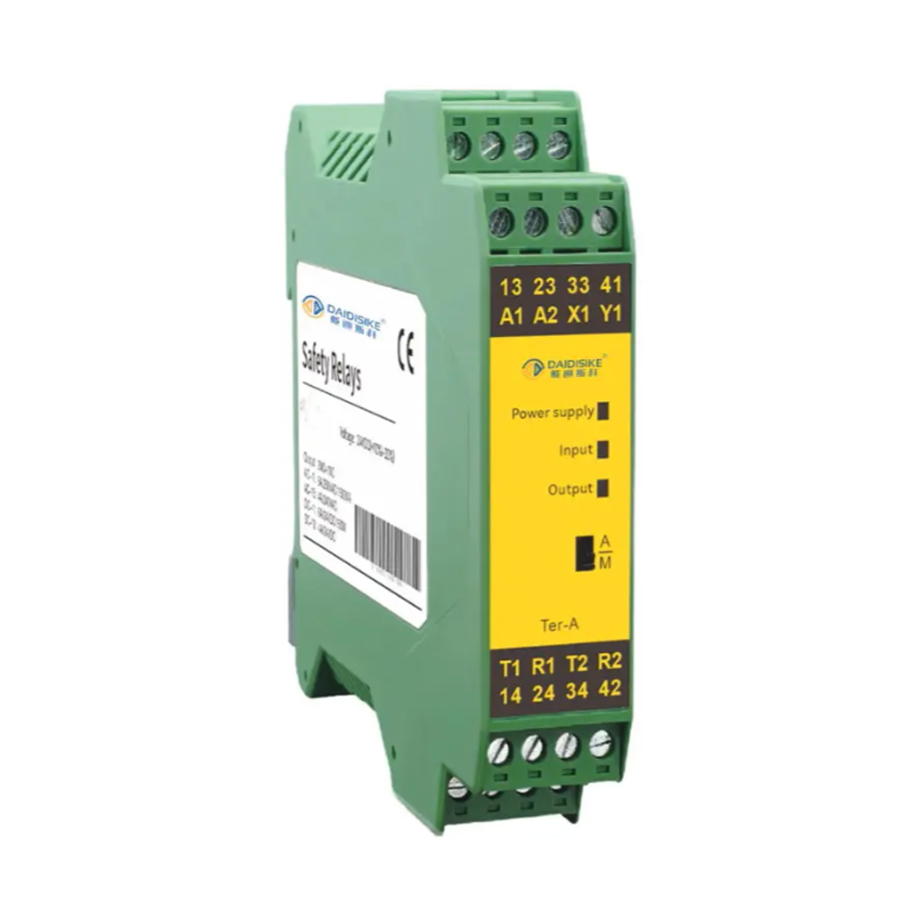
The DAIDISIKE DA31 lines up with the SI and CI single-function role: 24V DC, dual-channel input, 3NO+1NC safety contacts, EDM, force-guided (positively-guided) contacts, up to PL e / SIL 3, in the same 22.5mm DIN footprint, with a release response under 30 ms. Where the GSR system goes beyond a single relay — AND/OR combination of multiple GSR blocks, or the EM / EMD output-expansion modules that add safety contacts while holding SIL 3 / PL e — the single-function DA31 does not replicate that modular logic. Match the DA31 to the per-function GSR; for the combinational and expansion side, see the controller section below.
What can replace an Allen-Bradley Minotaur MSR127 (440R-N23126)?
The DA31 is functionally comparable to the MSR127 within its single-function envelope: dual-channel, 3 safety contacts + 1 aux, EDM, up to PL e / SIL 3. The Allen-Bradley Minotaur MSR127 (catalog 440R-N23126) is a 24V AC/DC dual-channel relay with 3 N.O. safety outputs + 1 N.C. auxiliary, accepting 1NC, 2NC or 2× PNP (OSSD light-curtain) inputs, rated to Category 4 per EN 954-1, IP40, −5…+55 °C. The MSR127RP is monitored-manual-reset; the MSR127TP is auto / manual. The compact MSR126R / MSR126T is a related single-function relay (Stop category 0, cross-fault monitoring, Category 4, 3 N.O. safety + 1 N.C. aux, cULus / CE / UKCA marked).
On the DAIDISIKE side, the DA31 matches the MSR127/126 single-function core: dual-channel input, 3NO+1NC, EDM, force-guided contacts, up to PL e / SIL 3, 22.5mm DIN. The MSR127 is the high-volume cross-reference term precisely because Rockwell directs MSR buyers to migrate — which makes it a natural moment to weigh a value single-function relay instead. The honest caveats: confirm the original's input type (1NC vs 2NC vs OSSD/PNP) and reset mode, and note the DA31's own housing protection rating from its datasheet rather than assuming the MSR127's IP40 figure — we never transplant a competitor's numbers onto the DA31.
Cross-reference table: Allen-Bradley & Pilz single-function relays to the DA31
This is a function-level map from public specs, not a guaranteed drop-in part number. Always confirm against the original unit's datasheet — input type, reset mode, contact rating and connector. DA31 figures are from DAIDISIKE's own published spec sheet.
| Competitor relay | Headline class | Safety outputs (published) | DA31 cross-reference |
|---|---|---|---|
| AB Guardmaster GSR SI (440R-S12R2) | Up to PL e / SIL 3, 22.5mm DIN | 2 N.O. + 1 N.C. solid-state aux | DA31 (single-function; 3NO+1NC) |
| AB Guardmaster GSR CI (440R-S13R2) | Up to PL e / SIL 3; MSR127-compatible | 3 safety contacts + 1 aux | DA31 (direct 3NO+1NC match) |
| AB Guardmaster GSR DI (440R-D22R2) | SIL 3 / PL e; 2 universal inputs | 2 N.O. + 1 N.C. solid-state aux | DA31 per single input; logic = controller |
| AB Minotaur MSR127 (440R-N23126) | Cat 4 (EN 954-1); 24V AC/DC | 3 N.O. safety + 1 N.C. aux | DA31 (3NO+1NC; confirm input/reset) |
| AB Minotaur MSR126R / MSR126T | Cat 4; Stop category 0 | 3 N.O. safety + 1 N.C. aux | DA31 (single-function match) |
| Pilz PNOZ S3 (PNOZsigma) | Up to PL e / Cat 4, SIL 3; 17.5mm | 2 N.O. + 1 semiconductor output | DA31 (E-stop / gate; note width/outputs) |
Is the 440C-CR30 a relay, and when do you need a controller instead?
The Guardmaster 440C-CR30 is a software-configurable safety controller, not a single-function relay — reach for it (or a safety PLC) only when function count and logic justify the programming. The Allen-Bradley Guardmaster 440C-CR30 (440C-CR30-22BBB) carries 22 on-board safety I/O (6 configurable), runs on 24V DC (20.4–26.4 V) at about 5.28 W, is rated up to PL e / Category 4 / SIL CL3, is programmed in Connected Components Workbench (CCW), expands with Micro800 plug-ins, and has USB + RS-232. It exists to combine many E-stops, gates and light curtains with logic in one device — a job no single-function relay can do.
So the DA31 is not a CR30 replacement, and we will not pretend it is. The relevant question is the other way round: are you reaching for a CR30 (or a safety PLC like GuardLogix) for a job that is really one to three independent safety functions? If so, several DA31 single-function relays — one on the E-stop, one on the gate, one watching the light-curtain OSSDs — are faster to wire, cheaper, and need no software. The controller earns its place once you are combining many zones, muting, or sequencing. We walk through that exact decision in our safety relay vs safety PLC selection guide.
How does the DA31 compare to a Pilz PNOZ S3 (and Siemens 3SK / Schneider Preventa)?
On the E-stop / safety-gate single-function role, the DA31 is a cross-shop alternative to the Pilz PNOZ S3, Siemens 3SK and Schneider Preventa relays — match by function and confirm outputs. The Pilz PNOZ S3 (PNOZsigma family) is a 24V DC relay with 2 N.O. safety contacts + 1 semiconductor output, positive-guided relays, dual-channel with cross-short detection, for E-stop and safety-gate monitoring, up to PL e / Category 4 and SIL 3, in a narrow 17.5mm body. Siemens SIRIUS 3SK relays cover E-stop / guard-door monitoring up to SIL 3 and PL e without programming, modular and expandable. The Schneider Electric Preventa (XPS) range offers single-function E-stop / safety-gate relays up to PL e / SIL 3 (confirm the exact XPS model's specs before citing numbers — we do not).
The DA31 sits in the same single-function class with up to PL e / SIL 3, EDM and force-guided contacts — with the practical difference that it offers 3NO+1NC safety contacts, useful when you need three switched safety circuits where a PNOZ S3 gives two N.O. plus a semiconductor output. Two honest notes: the PNOZ S3's 17.5mm width is narrower than the DA31's 22.5mm body, and contact counts differ — so match on the number of safety circuits your machine actually needs, not on the brand. For E-stop, safety-door interlock or two-hand-control loops at PL e, all four are interchangeable at the function level.
Which DA31 input fits a Type 4 light curtain or a safety gate?
The DA31 accepts the dual OSSD outputs of a Type 4 safety light curtain, and equally an E-stop, a safety-gate interlock, or a two-hand control — one function per relay. For light-curtain monitoring, you wire the curtain's two OSSD (PNP) safety outputs into the DA31's dual-channel input; the relay watches both, detects a cross-fault, and drops its 3NO safety contacts to the contactors, with EDM confirming the contactors actually opened. This is the same role the Allen-Bradley GSR “GLP” light-curtain monitoring variant or an MSR127 with 2× PNP input plays. Pair the DA31 with a DAIDISIKE Type 4 curtain such as the DQC hand-guard or the DQT4 Type 4 curtain, or with the DX-R1 non-contact safety switch on a guard door, and you have a complete PL e guarding chain from one supplier.
Why source a Guardmaster equivalent from a China OEM?
For single-function relays, the DA31 gives the same PL e / SIL 3 safety core at MOQ 1 piece and a 3–15 day lead time, direct from the manufacturer. Across Southeast Asia — Malaysia, Singapore, Thailand, Indonesia, the Philippines, Vietnam — safety relays are largely sold through brand resellers carrying premium lines. A China-OEM single-function relay is the value differentiator against those incumbents: the DAIDISIKE DA31 is built to up to PL e / Category 4 (ISO 13849-1) and SIL CL3 (IEC 62061), with dual-channel input, 3NO+1NC, EDM and force-guided contacts, and DAIDISIKE ships it at MOQ 1, with 3–15 day lead times, exporting to 20+ countries. For a single E-stop, gate-interlock or light-curtain monitoring job, that is a real saving over a premium-priced Guardmaster or MSR through a distributor — without giving up the safety rating.
Send us the safety function, input type (1NC / 2NC / OSSD-PNP), reset mode and contact count off your installed relay, and our engineering team will confirm the DA31 match — or tell you plainly when a controller is the right call.
Contact DAIDISIKE — +86 15218909599Is naming these brands legal, and how do you keep the comparison honest?
Naming a competitor's product to describe a compatible alternative is nominative reference and is legitimate; the comparison stays honest by using only each vendor's published specs. We reference Allen-Bradley, Guardmaster, Minotaur, Pilz, Siemens and Schneider by name to tell you what the DAIDISIKE equivalent is — that is normal, lawful comparison, with no implied partnership or endorsement. What we deliberately do not do: we don't reproduce their manuals, we don't use their trademarks or logos as our own, and we don't quote a parameter we can't confirm from their public datasheet — which is exactly why we say “confirm the exact XPS model” rather than inventing a Preventa figure. Every DA31 number here is from DAIDISIKE's own spec sheet; every competitor number is from that vendor's own published specification.
Sources & specifications cited
- Rockwell Automation — Guardmaster GSR (Bulletin 440R) safety relays — SI / CI / DI, up to PL e / SIL 3, 22.5mm DIN.
- Rockwell Automation — Minotaur MSR127 / MSR126 safety relays — 440R-N23126, 3 N.O. + 1 N.C., Cat 4.
- Rockwell Automation — Guardmaster 440C-CR30 configurable safety relay / controller — 22 safety I/O, CCW-programmed, up to PL e / SIL CL3.
- Pilz — PNOZ S3 (PNOZsigma) safety relay — 2 N.O. + 1 semiconductor, up to PL e / SIL 3, 17.5mm.
- DAIDISIKE — DA31 Safety Relay Module specification — 24V DC, 3NO+1NC, EDM, force-guided, <30 ms, 22.5mm DIN.