
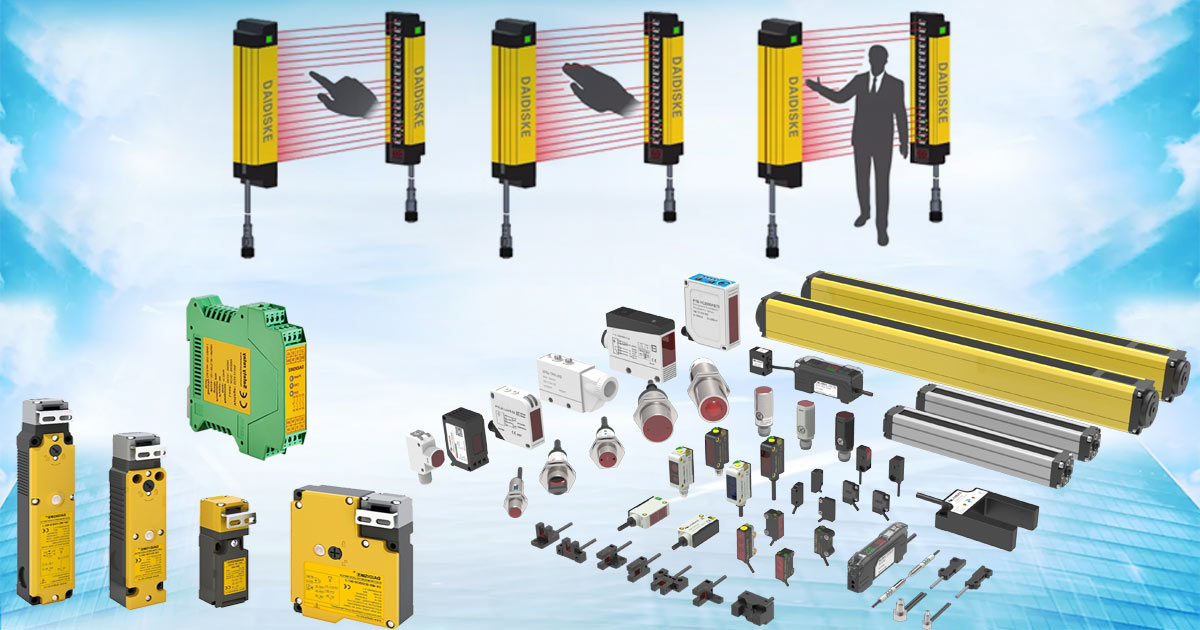
Most safeguarding guides are written for clean assembly lines. A textile plant is not that. The air carries fibre, the finishing lines carry mist, and the wet processes get hosed down — and every one of those facts lands on the optical window of whatever safety sensor you fit. So this guide leads with the environment, then works back to the machine and the standard. Get the housing wrong and the best Type 4 curtain in the catalogue becomes a nuisance-trip generator that an operator eventually defeats. Get it right and the rest is ordinary machine-safety engineering.
The shape of the problem is three clusters: the application (which machine, which hazard, which resolution), the environment (dust, lint, washdown, and the IP65/IP67/IP68 answer to it), and sourcing (OEM/ODM, custom length for wide looms, low MOQ). We take them in that order.
What safety light curtain do I need for a loom, knitting or spinning machine?
Match the resolution to the body part that can reach the hazard, and anchor the assessment in EN ISO 11111. On a loom, knitting machine or spinning frame the point-of-operation hazards — moving needle beds, yarn guides, sley and reed motion — are reached by a hand, sometimes by fingers. A Type 4 light curtain to IEC 61496 across the access opening is the standard electro-sensitive guard. For hand access, use 30 mm hand-detection resolution; where fingers can reach the danger, step to 14 mm finger resolution. The DAIDISIKE DQC is a Type 4 hand guard offering 10/14/20/25/30/40/80/200 mm resolutions with dual-channel NPN/PNP OSSD and EDM, and the DQA is a dedicated 10–30 mm finger/hand sensor for the close-in cases.
EN ISO 11111 is the textile-machinery safety standard, published in parts that cover common requirements and then specific machine groups — spinning and winding, weaving, knitting, fabric finishing and calendering, nonwovens. It tells you which hazards on the machine must be guarded. IEC 61496 defines the curtain, ISO 13849-1 sets the Performance Level (PL e for high-risk point-of-operation work), and ISO 13855 fixes how far back the curtain mounts. The curtain's OSSD outputs are wired through a safety relay — the DAIDISIKE DA31 (PL e / SIL3) — so the machine actually stops when the field is broken.
How do I protect operators from nip points on winders and calenders?
Roller nips are in-running traps; guard them by holding the residual gap below the finger-entry limit or by fitting a Type 4 curtain. Winders, spreaders and calenders run fabric or yarn through rotating roller nips. The in-running bite draws a hand or finger toward the trap, so the guard has to act before contact. Where a fixed guard cannot keep the nip out of reach, the residual nip clearance is held below the level a finger can enter — on the order of 8 mm for textile calender rollers. Above that gap, the nip needs an electro-sensitive guard instead: a Type 4 curtain (DAIDISIKE DQC or DQA) at 14 mm finger resolution across the feed opening, set back per ISO 13855.
Does dust and lint really affect safety light curtains — and which housing fixes it?
Yes — lint on the lens is the number-one cause of nuisance trips in textile plants. Seal the optics and keep range margin. An optical safety sensor works by an infrared beam crossing from emitter to receiver. Fibre, lint and finishing-agent mist settle on both lenses and attenuate that beam. As the received signal falls, the curtain eventually reads a blocked field and trips with nothing in the way — and a curtain that cries wolf is a curtain operators learn to bypass. The four defences are: a sealed housing so dust never reaches the optics, a cleaning schedule driven by the signal margin, sensible mounting out of the heaviest fibre fall, and range margin so a partly fouled lens still clears the safety distance.
On housings, the textile answer is to favour sealed builds. The DAIDISIKE DQR is specified at IP68 — dust-tight and immersion-grade — which makes it the choice for dyeing, finishing, wet-laid nonwoven and any washdown line. The MK is IP65, a sealed option for dry but lint-heavy spinning, carding and weaving areas. There is a deeper treatment of how the sealing levels and the optical window behave under dust and mist in our IP65/IP67/IP69K window-protection guide.
What IP rating do I need for a dusty or washdown textile environment?
Spec the IP rating to the worst cleaning regime the curtain will see. IP65 is dust-tight against settling lint and protected against low-pressure water jets — enough for a dry spinning or weaving hall. IP67 and IP68 add immersion resistance for lines that are hosed or flooded during cleaning. Match the housing to how the machine is actually washed, then add range margin for the lint that lands between cleans.
| Textile environment | Typical contamination | Sealing target | DAIDISIKE option |
|---|---|---|---|
| Spinning / carding / weaving hall (dry) | Heavy airborne lint, settled fibre | IP65 sealed, dust-tight | MK (IP65) |
| Dyeing / finishing / wet nonwoven line | Finishing mist, washdown water | IP67 / IP68 immersion-grade | DQR (IP68) |
| Fabric / garment cutting room | Fabric dust, fly, low water | IP65 sealed, point-of-operation | DQC / DQA at 14 or 30 mm |
| Automated cutting / robot cell floor | Fabric dust on a floor zone | Area / perimeter field | DQSA area curtain; DLD-series LiDAR |
14 mm finger vs 30 mm hand — which for fabric and die cutting?
Resolution follows the body part that can reach the blade. Resolution is the smallest object the curtain is guaranteed to detect. A 14 mm finger curtain detects a finger entering the danger zone — use it close-in on a fabric die-cutting or garment-cutting head where fingers can reach the blade. A 30 mm hand curtain detects a hand or wrist and suits a larger feed opening set further from the cutting line. Finer resolution lets you mount closer but uses more beams; coarser resolution buys a bigger standoff. Both the DQC and DQA ship in 14 mm and 30 mm builds, so the access geometry — not the product — decides. On a fabric die-cutting press the curtain's OSSD must stop the cutting stroke at the point of operation: the outputs drop the safety relay, which de-energises the press valves, exactly as on any power press point-of-operation guard.
How do I calculate the ISO 13855 safety distance on a cutting press?
Use S = K × T + C, and re-run it whenever resolution or stop time changes. The minimum distance from the light curtain to the nearest hazard is S = K × T + C:
- S — minimum safety distance (mm) from the protective field to the hazard.
- K — approach speed constant, 2000 mm/s for hand/arm approach (1600 mm/s may apply once S exceeds 500 mm).
- T — total stopping time: the curtain's response time plus the machine stop time (relay + cutter run-down). The DAIDISIKE DQC response time is 15 ms or less.
- C — intrusion distance from resolution: for a curtain finer than 40 mm, C = 8 × (resolution − 14 mm), not less than zero. So a 14 mm curtain gives C = 0; a 30 mm curtain gives C = 128 mm.
Measure the real stop time on the actual machine — do not assume it. Then any time you change the resolution (say from a 30 mm hand curtain to a 14 mm finger curtain on a die-cutting head) or alter the braking, recompute S and re-position the curtain. Treat a resolution change as a recalculation, never an assumption.
Light curtain or area scanner for an automated garment-cutting cell?
Curtain for a defined opening; area scanner or safety LiDAR for a floor zone — many cells use both. A light curtain is a flat protective plane, perfect for the point of operation where a hand reaches a fixed opening on a cutting or die-cutting head (DQC / DQA). An automatic CNC fabric cutting and spreading machine adds a different hazard: a moving gantry that a person could walk into. For that you map a two-dimensional zone — a DAIDISIKE DQSA area light curtain for a bounded horizontal field, or a safety LiDAR from the DLD-series (DLD05A3 at 5 m, DLD20A5 at 20 m, DLD30T-5N out to 40 m, and the SDLD-05A 14 m TOF unit) for a larger, reconfigurable perimeter and approach zone. A typical automated cell carries a curtain on the load opening and a scanner watching the floor perimeter.
| Textile machine / hazard | Guard type | Resolution / field | DAIDISIKE device |
|---|---|---|---|
| Loom / knitting / spinning point of operation | Vertical light curtain | 30 mm hand (14 mm if fingers reach) | DQC (Type 4); DQA 10–30 mm |
| Winder / calender roller nip | Light curtain across feed opening | 14 mm finger; nip clearance ≤ ~8 mm | DQC / DQA 14 mm |
| Fabric / garment die-cutting press | Point-of-operation curtain | 14 mm finger, Type 4 / PL e | DQC; DQT4 (Type 4 / PL e) |
| Dyeing / finishing / nonwoven washdown | Sealed light curtain | 14–30 mm, IP68 | DQR (IP68) |
| Automated cutting / spreading cell floor | Area / perimeter scanning | 2D zone, reconfigurable field | DQSA area curtain; DLD-series LiDAR |
How does the DAIDISIKE range compare with the brands on a textile line?
Plenty of textile machine builders already run Banner, Leuze, SICK, Autonics, Schmersal, Pinnacle, Wintriss, Prismont, or Pepperl+Fuchs / IFM sensors, and the question is usually whether a like-for-like DAIDISIKE part exists. For the optical safety side it generally does — the entire category converges on IEC 61496 Type 4, 14 mm finger and 30 mm hand resolutions, dual-channel OSSD and EDM, which is exactly the DQC envelope. The honest scope notes: those vendors are named here only for nominative comparison, with no implied partnership, and DAIDISIKE quotes only its own published specs. The full method and the brand-by- brand cross references live in the brand replacement & compatibility hub. Note one boundary: DAIDISIKE's inductive proximity sensors (M8/M12/M18/M30) are standard inductive devices — useful for textile position and end-of-travel sensing, but not a substitute for the electro-sensitive safety curtains above.
Can I get custom-length curtains and low MOQ as a textile machine builder?
Yes — wide looms and spreader tables are built to length, with MOQ 1 and 3–15 day lead. Wide weaving looms, spreader tables and nonwoven lines rarely match a stock protected height, so the curtain is built to the opening. DAIDISIKE is a Chinese OEM/ODM manufacturer (established 2013, a 3000 m² factory, exporting to 20+ countries) supplying custom protected-height DQC, DQA and related curtains at a minimum order quantity of one set and a typical 3 to 15 day lead time. Send the protective height, the resolution (14 or 30 mm), the sensing range across the opening, the output and supply voltage, and the housing / IP rating, and the curtain is built to that envelope rather than forcing the machine onto a fixed bar.
Send the four numbers off each hazard — resolution, protective height, range, output — plus the housing/IP rating and we will return a matched DQC, DQA, DQR, MK, DQSA or DLD selection. Call or WhatsApp +86 15218909599 or reach us through the contact page.