
When people say “collaborative robot,” they usually picture a small arm with rounded edges that you can push out of the way. That picture is exactly what the 2025 standards set out to correct. A robot is not collaborative; an application is. The same arm can run behind a fence at full speed in one cell and share floor space with an operator in another. What makes the second case safe is not the arm — it is the method, the sensors, and the distances. SSM is the method where the sensor choice matters most, and where our area scanners actually earn their place.
What did ISO 10218-2:2025 change for collaborative work?
The 2025 revision absorbed ISO/TS 15066 into the main standard and replaced “cobot” with “collaborative application.” ISO 10218-2:2025 (Edition 2.0) was published on 5 February 2025, alongside its companion ISO 10218-1:2025 for the robots themselves. The most consequential change is structural: the collaborative-safety content that used to live in ISO/TS 15066:2016 — a separate technical specification you had to cross-reference — now sits inside ISO 10218-2 directly.
The terminology shift is not cosmetic. Dropping “collaborative robot,” “cobot” and “collaborative operation” in favour of “collaborative application” reflects an engineering fact the marketing had blurred: safety depends on how a robot is used, not on the robot as a product. Only the actual application can be designed, tested and confirmed as collaborative. I have walked into too many plants where a “cobot” had been bought as if the label removed the need to do the safety work. The new wording closes that gap. If you want the wider picture of how the 2025 series reshapes cell safeguarding, we cover it in our ISO 10218:2025 robot-cell briefing.
What are the four collaborative methods, and where does SSM sit?
ISO 10218 and ISO/TS 15066 define four methods for collaborative operation. They are techniques, not robot classes, and per A3/automate.org they can be combined inside a single application.
- Safety-Rated Monitored Stop — the robot keeps power on but cannot move while an operator is in the collaborative workspace. Motion only resumes once the operator leaves the area.
- Hand Guiding — the operator moves the robot directly through a hand-guiding device with an enabling switch. The robot stays in a safety-monitored stop until that device is actuated.
- Speed and Separation Monitoring (SSM) — robot and operator move concurrently, provided a pre-determined protective separation distance is maintained. This is the “fenceless” method, and the one that depends on a presence-sensing device.
- Power and Force Limiting (PFL) — the robot is designed and limited so any contact stays within biomechanical limits. This one is mostly built into the robot, not added with external sensors.
Of the four, SSM is the one a sensor manufacturer cares about, because SSM is the method where an external safety device does the actual monitoring. Safety-Rated Monitored Stop and Hand Guiding lean on the robot controller and an enabling device; PFL is largely intrinsic to the robot. SSM is where a safety laser area scanner, or a light curtain at an opening, becomes the thing keeping a person safe.
How does Speed and Separation Monitoring actually work?
In SSM, robot and operator share space while a protective separation distance is held, and that distance varies with robot speed. The logic is graded, not binary. When the operator is far away, the robot runs at or near production speed. As the operator approaches, the robot decelerates. If the measured separation drops below the minimum protective separation distance Sp, the robot executes a protective stop. Move away again and it can resume. That is why people call SSM a fenceless system: the throughput of a guarded cell, without a hard guard, paid for with continuous distance measurement.
The measurement is what a safety-rated laser area scanner is built to do. A3/automate.org notes that a scanner often monitors this kind of application, and the reason is geometric: a scanner watches a horizontal floor zone and reports where in that zone a person is. You can configure graded fields — an outer field that triggers slow-down and an inner field that triggers the stop — which maps directly onto the SSM behaviour of slow-then-stop. That multi-zone configuration is its own discipline; we walk through it in our guide to multi-zone protective fields.
How is the protective separation distance Sp built up?
Sp is not a single number you read off a datasheet — it is a sum of contributions, and ISO/TS 15066 gives the equation. The minimum protective separation distance is made up of:
- Sh — the operator's change in location, from their approach speed during the robot's reaction and stopping time.
- Sr — the distance the robot travels during its own reaction time, before it begins to stop.
- Ss — the robot's stopping distance once the stop is commanded.
- Uncertainty terms — position-measurement uncertainty for both the operator and the robot.
- C — the intrusion distance from ISO 13855: how far a body part can reach into the sensing field before it is detected.
Two of those terms are where sensor people earn their keep. The operator-speed term carries a hard default: if the operator's speed is not being actively monitored, the system shall assume vh = 1.6 m/s in the direction that reduces the separation the most. That is deliberately conservative — brisk walking pace, straight at the robot. You only get to use a smaller number if you are genuinely measuring approach speed, which most installations are not. And the C term is pure ISO 13855: because a hand can reach part-way into a field before the scanner or curtain registers it, you add that intrusion distance to Sp. Leave C out and you have quietly let people get closer than the maths allows.
Which sensors implement SSM, and what standards govern them?
SSM is implemented with presence-sensing devices governed by the IEC 61496 series. IEC 61496-2 covers active opto-electronic protective devices — light curtains. IEC 61496-3 covers active opto-electronic devices responsive to diffuse reflection — safety laser scanners. For a fenceless SSM application the area scanner is usually the primary device, because only an area device can tell youwhere the operator is across a floor zone, which is what grading the robot speed requires.
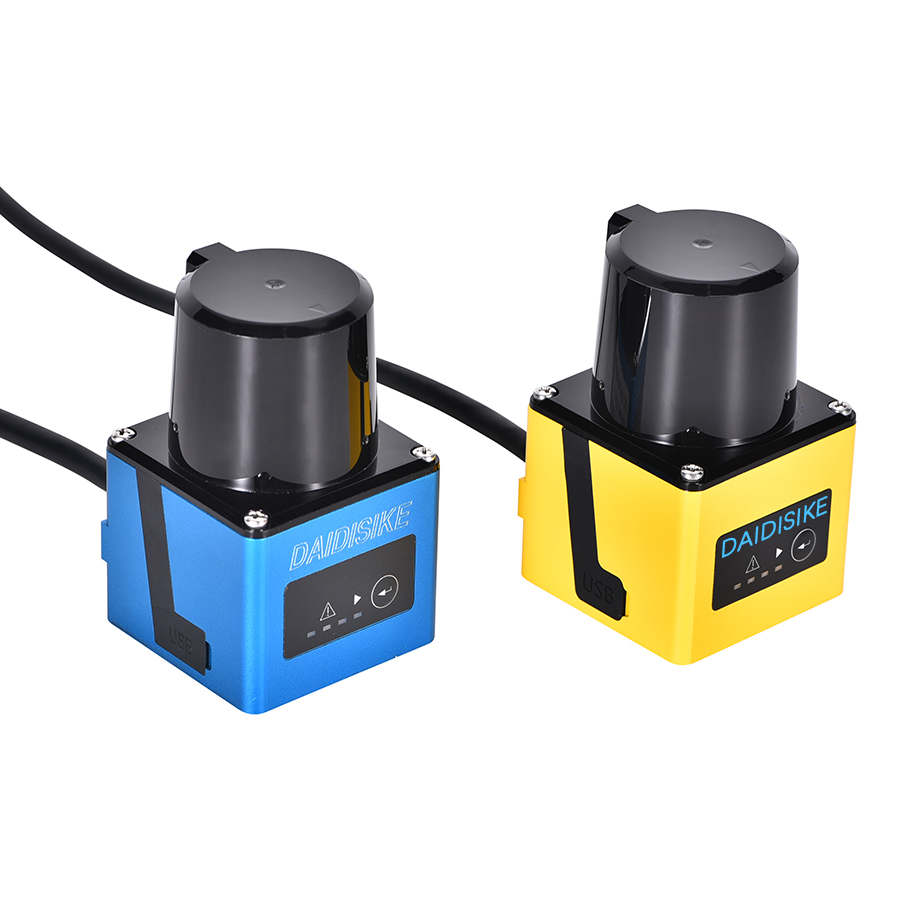
Our own hardware maps to these roles directly. The DLD-series obstacle-avoidance laser radar is the area-scanning device for floor-zone monitoring around a robot or an AGV — the kind of distance-aware presence detection SSM leans on. Where the application also has a fixed access opening — a load station, a maintenance gate — the DQSA area safety light curtain guards that defined plane. The two are not interchangeable, and most real collaborative applications use both. If you are weighing plane versus area for a cell, we compare them in light curtain vs scanner for robot cells.
Where is SSM the right answer — and where is it hype?
SSM earns its complexity when you genuinely need shared space and throughput: an operator who loads parts into the same area a robot works, where a fixed fence would either block access or cripple cycle time. There it is the honest answer, and the scanner-graded slow-down is real engineering value.
Where it gets oversold is the “fenceless” word itself. Fenceless does not mean sensorless or carefree. An SSM application replaces a steel guard with a continuously computed safety distance that has a 1.6 m/s human baked into it and a robot stopping distance you must actually know. If the robot is large and fast, Sp can grow until the “collaborative” floor zone is bigger than the fence you were trying to avoid. I have seen SSM proposed for big payload arms where the honest separation distance made the cell larger, not smaller, than a fenced layout. That is the moment to admit a Safety-Rated Monitored Stop, or a plain fenced cell with an area scanner for walk-in detection, is the better application. The method should fall out of the risk assessment and the real stopping numbers — not out of a wish to say the word “collaborative” in a brochure.
References & standards cited
- ISO 10218-2:2025 — Robot applications and cells; published 5 Feb 2025; ISO/TS 15066 absorbed.
- ISO 10218-1:2025 — Safety requirements for industrial robots (the robot itself).
- A3 / automate.org — the four collaborative methods explained — including SSM monitored by a safety laser scanner.
- A3 / automate.org — updated ISO 10218 FAQ — on “collaborative application” vs “cobot.”
- ISO/TS 15066:2016 — the protective separation distance Sp equation and the vh = 1.6 m/s human approach default.
- IEC 61496-2 / -3 — light curtains and diffuse-reflection safety laser scanners; ISO 13855 — intrusion distance C and safeguard positioning.