
Not Every Punch Press Can Be Fitted with a Safety Light Curtain (ESPE)
Whether a light curtain can be added depends on the press’s actuation/braking design and its ability to stop. This page gives authoritative compatibility rules, retrofit options, and compliance notes to accelerate decisions and approvals.
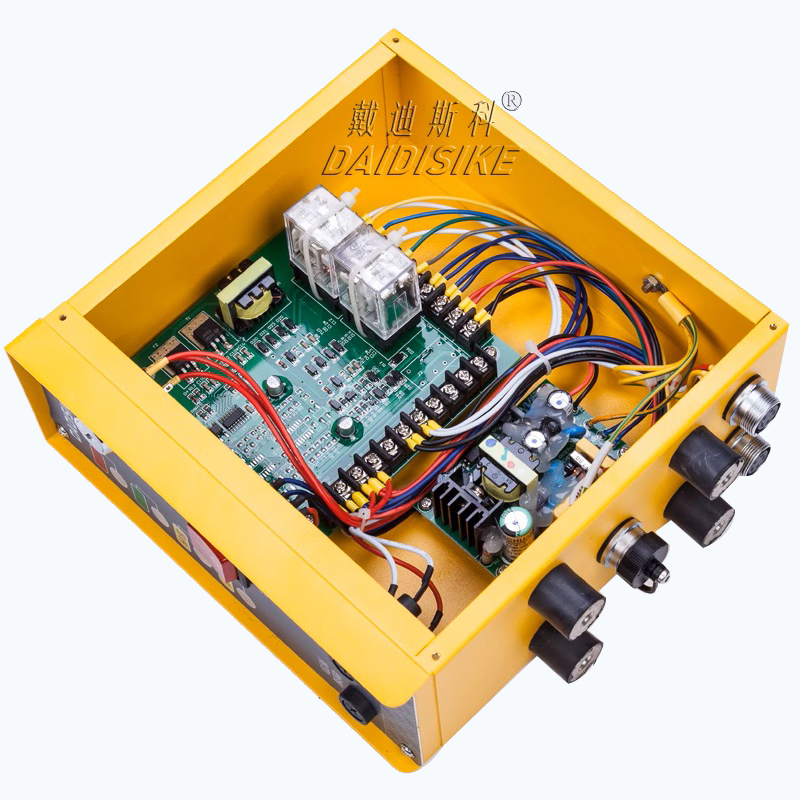
Read this first
Suitable as-is: Mechanical presses with a part-revolution clutch + brake, and pneumatic/servo presses—these can quickly and predictably stop when the stop signal arrives.
Not suitable as-is: Full-revolution mechanical presses (no effective mid-stroke stopping). To use a light curtain, the drive must be converted to stoppable (e.g., add clutch/brake or convert to pneumatic/servo). Otherwise use fixed guards + two-hand control and other measures.
Standards reference: IEC/EN 61496 (ESPE/safety light curtains), ISO 13849-1 (safety control PL), ISO 13855 (location of safeguards).
Why can’t all presses use a light curtain?
A light curtain is a presence-sensing safeguard: when hands or objects enter the hazard zone, the control system must stop motion before reaching the hazard point. If the machine cannot stop mid-stroke (e.g., a full-revolution crank once engaged must complete the cycle), then even if the curtain detects intrusion it cannot prevent the press from continuing. That violates the “predictable safe stop” requirement in the standards.
Compatibility matrix (simplified)
| Press type | Light curtain as-is? | Notes | Typical alternative/retrofit |
|---|---|---|---|
| Mechanical (with part-revolution clutch + brake) | Yes | Has mid-stroke stopping; can interlock with safety relay/PLC. | Measure stopping time; use Type 4 with dual-channel and EDM. |
| Mechanical (full-revolution, not stoppable) | No | Cannot stop before the hazard; curtain loses its safety function. | Convert to part-revolution clutch + brake, or to pneumatic/servo; otherwise use fixed guards + two-hand control. |
| Pneumatic/hydraulic/servo presses | Yes | Controllable stop; easy to realize SS1/STOP. | Compute S distance per ISO 13855; include de-energize on loss of pressure/power. |
| Mechanical (with clutch and monitored brake) | Yes | Meets “stoppable” condition; interlock curtain with clutch/brake safety circuit. | Set clutch consistency, brake time monitoring, and periodic measurement. |
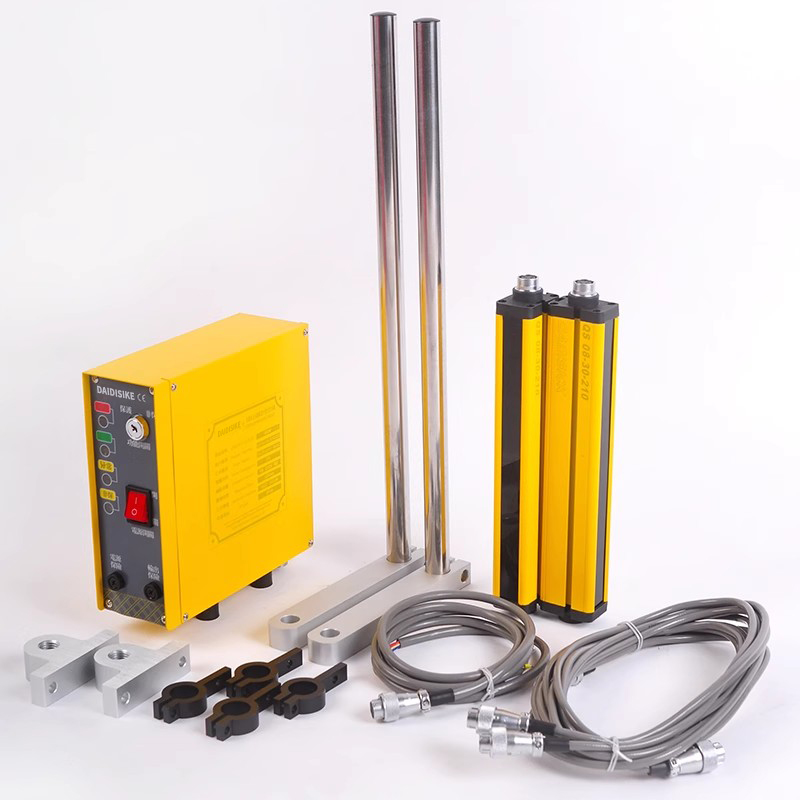
Recommended model
If your machine meets the “reliably stoppable mid-stroke” condition, we recommend DQS Press Safety Light Curtain for personnel protection interlocking on presses. It simplifies PL calculations and distance verification.
Typical retrofit schemes (topologies)
Scheme A: Mechanical press (part-revolution clutch) + safety light curtain
- Select a Type 4 light curtain (IEC 61496-1/2); choose 14–30 mm resolution per workpiece.
- Dual channels from the curtain → safety relay/PLC (with EDM feedback).
- Safety outputs → control the clutch/brake circuit and isolate energy (main contactor/brake coil).
- Implement brake time monitoring and fault-stop logic; record T for distance calculation.
Scheme B: Convert full-revolution mechanical to pneumatic/servo
- Replace with a controllable stop drive (pneumatic with safety valves, or servo with safe stop).
- Add the safety valve or drive STO/SS1 channels so the curtain rapidly dumps pressure/disable torque.
- Complete risk assessment and PL calculation to meet required PLr (ISO 13849-1).
- Re-measure stopping time and re-verify mounting distance per ISO 13855.
Mounting distance & selection notes
- Light curtain type: For press applications, prefer Type 4; ensure anti-vibration/anti-oil mist/IP rating matches the site.
- Safety distance S: Follow ISO 13855 with S = K × T + C, where K is approach speed (typically 1600–2000 mm/s), T is the total stopping time (sensor + control + brake), and C is the resolution compensation. Always use measured T.
- Control circuit: Dual-channel inputs, EDM feedback, interlocked reset, and anti-bypass design; never treat the curtain like a simple switch.
- Associated guarding: Use fixed guards or mirrors/reflectors for the opposite/upper sides to prevent reach-around.
Project checklist
- Confirm the press is reliably stoppable mid-stroke (clutch/brake or pneumatic/servo).
- Measure and record stopping time T (repeat periodically).
- Select suitable Type/resolution/height and IP rating.
- Calculate S distance per ISO 13855 and verify reachability on site.
- Complete PL calculation and validation (ISO 13849-1); retain technical documentation.
- Establish inspection & proof-test routines (curtain self-test, brake time monitoring, EDM loop).
FAQ
Can a mechanical press use a safety light curtain?
If it is a mechanical press with a part-revolution clutch + brake and monitorable braking, it can be interlocked with a light curtain. Full-revolution presses that cannot stop mid-stroke cannot use a curtain directly; convert to a stoppable drive or use fixed guards + two-hand control.
Do I have to use pneumatic actuation?
Not necessarily; you must have a controllable stop. Pneumatic/servo systems have this property; mechanical presses with a clutch and reliable braking can also work with light curtains.
How do I set the mounting distance?
Use ISO 13855: S = K × T + C. K is approach speed, T is total stopping time (must be measured), C is the compensation term for resolution. Also check for bypass paths and reflections.