
M18 / M30 Series Metal Sensing Proximity Switches — Three-Wire Type
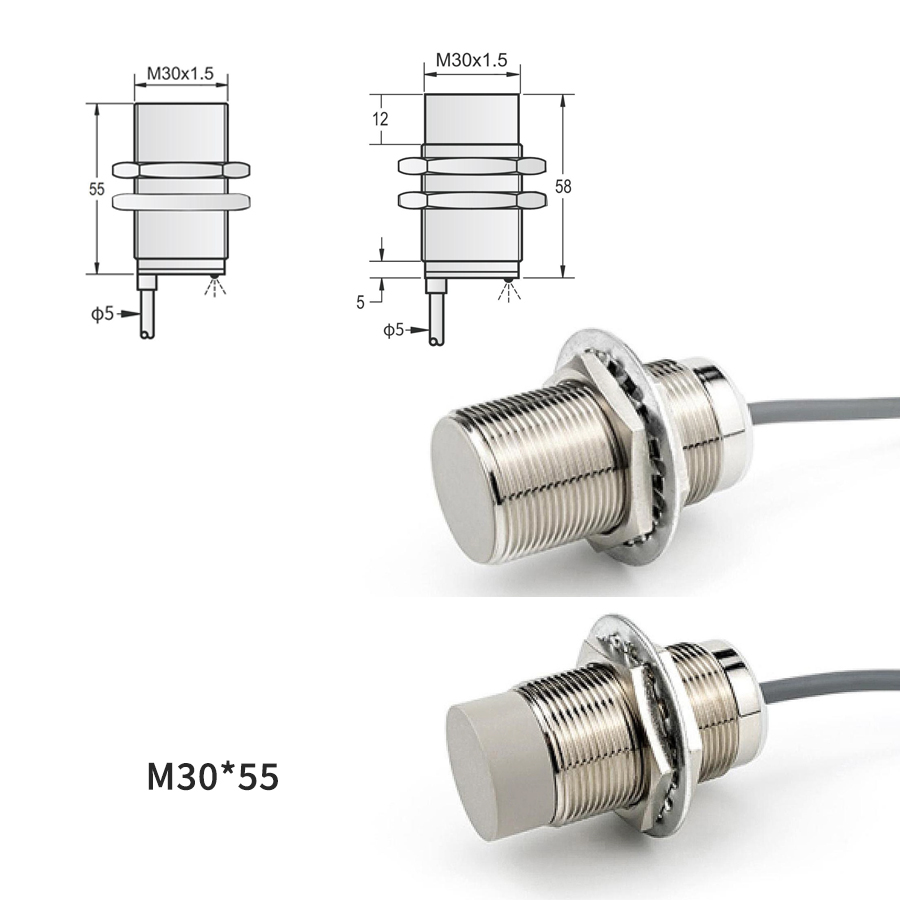
The M18 / M30 series metal inductive proximity switch is a high-performance cylindrical electromagnetic proximity sensor designed for industrial automation. The series uses DC three-wire power supply, supports NPN / PNP outputs, and detects metal objects without physical contact. Variants include M18 × 35 (shielded), M18 × 55 (unshielded), M30 × 50 (shielded) and M30 × 60 (unshielded), with detection distances from 5 mm to 40 mm. The housing is stainless steel or copper nickel-plated for corrosion resistance, and a built-in LED makes status monitoring straightforward.
Product Introduction
The DAIDISIKE M18 & M30 series metal inductive proximity switch is a high-performance cylindrical electromagnetic proximity sensor designed for industrial automation applications. The series uses DC three-wire power supply, supports NPN and PNP output modes, and detects metal objects without physical contact. It complies with RoHS standards, has an IP67 protection rating, and is suitable for harsh industrial environments.
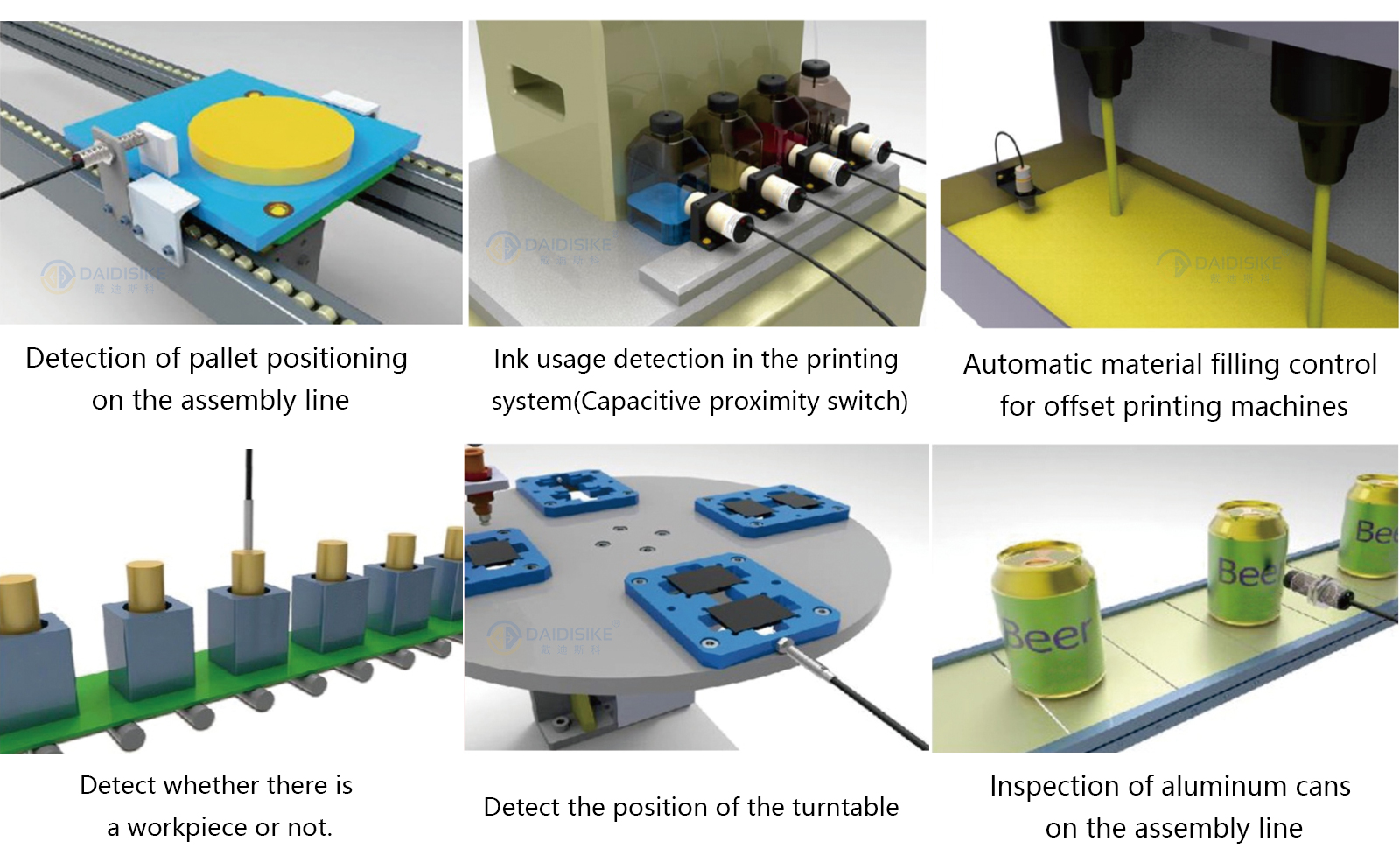
The series includes M18 and M30 variants — M18 × 35 (shielded), M18 × 55 (unshielded), M30 × 50 (shielded) and M30 × 60 (unshielded) — with detection distances ranging from 5 mm to 40 mm. The sensor housing is made of stainless steel or copper nickel-plated material for high corrosion resistance, and is equipped with an LED indicator for easy status monitoring. The product is widely used in mechanical manufacturing, automotive industry, food processing and similar fields for object position detection, counting and limit control.
Specifications — M18 vs M30
| Parameter | M18 Series | M30 Series |
|---|---|---|
| Brand | DAIDISIKE | DAIDISIKE |
| Product name | M18 Metal Inductive Proximity Switch | M30 Metal Inductive Proximity Switch |
| Installation method | Shielded (Flush) / Unshielded (Non-flush) | Shielded (Flush) / Unshielded (Non-flush) |
| Detection distance (std iron target) | Shielded: 5 / 8 / 12 mm · Unshielded: 8 / 12 / 16 / 20 mm | Shielded: 10 / 15 mm · Unshielded: 15 / 20 / 25 / 40 mm |
| Output mode | NPN / PNP — NO / NC / NO+NC | NPN / PNP — NO / NC / NO+NC |
| Operating voltage | 10 – 30 V DC (some models support 5 – 40 V DC) | 10 – 30 V DC (some models support 20 – 250 V AC / 10 – 300 V DC) |
| Maximum load current | 150 mA / 200 mA / 300 mA | 200 mA / 300 mA |
| No-load current | < 10 mA | < 15 mA |
| Voltage drop | < 1.5 V / < 2 V | < 2 V / < 3 V |
| Leakage current | < 0.01 mA | < 0.1 mA |
| Switching frequency | 50 Hz / 100 Hz / 500 Hz / 1000 Hz / 2000 Hz | 50 Hz / 90 Hz / 100 Hz / 200 Hz / 500 Hz |
| Response time | < 0.5 ms / < 1 ms | < 1 ms / < 2 ms |
| Switch hysteresis | < 15 % (Sr) | < 15 % (Sr) |
| Repeatability | < 3.0 % (Sr) / < 5 % | < 3.0 % (Sr) / < 5 % |
| Indicator light | Yellow LED — on when detecting | Yellow LED — on when detecting |
| Protection rating | IP67 / IP68 | IP67 / IP68 |
| Operating temperature | −25 °C to +70 °C / −40 °C to +85 °C | −25 °C to +70 °C / −40 °C to +85 °C |
| Storage temperature | −40 °C to +85 °C | −40 °C to +85 °C |
| Temperature drift | < 10 % (Sr) | < 10 % (Sr) |
| Short-circuit protection | Yes | Yes |
| Reverse-polarity protection | Yes | Yes |
| Overload protection point | 180 mA / 220 mA | 220 mA / 350 mA |
| Shell material | Stainless steel / copper nickel-plating / brass nickel-plating | Stainless steel / copper nickel-plating / brass nickel-plating |
| Sensing-face material | PBT / Polyester | PBT / Polyester |
| Standard wire length | 2 m (PVC cable) | 2 m (PVC cable) |
| Connection method | Cable / M12 connector | Cable / M12 connector |
| Dimensions | M18 × 35 – 50 mm (shielded) · M18 × 55 – 65 mm (unshielded) | M30 × 50 – 60 mm (shielded) · M30 × 60 – 80 mm (unshielded) |
| Weight | ≈ 50 – 100 g | ≈ 100 – 150 g |
| Compliance | RoHS · CE · UL | RoHS · CE · UL |
| Vibration resistance | 10 – 55 Hz, 1 mm amplitude | 10 – 55 Hz, 1 mm amplitude |
| Shock resistance | 500 m/s², 10 times | 500 m/s², 10 times |
| Electromagnetic compatibility | IEC 61000 series | IEC 61000 series |
Technical Parameters
Detection distance depends on installation method, target material, and environmental factors. Values listed are typical for standard iron targets with correction factors for other metals — stainless steel 0.9, aluminum 0.4, brass 0.5, copper 0.4. Power supply is DC 10 – 30 V three-wire (brown = V+, blue = 0 V, black = output); some models support AC / DC dual power. Output types are NPN (open-collector, common positive, output negative) or PNP (open-collector, common negative, output positive), with NO / NC / NO+NC combinations.
The sensor offers high switching frequency — up to 2000 Hz on M18 and 500 Hz on M30 — suitable for high-speed applications. Response time is < 0.5 – 2 ms, ensuring real-time detection. Protection features include short-circuit protection (auto-reset), reverse-polarity protection, overload protection (trigger point 180 – 350 mA), and surge suppression. Environmental adaptability is strong: temperature drift < 10 %, repeatability < 3 – 5 %. Selected models support analog output options (4 – 20 mA or 0 – 10 V) for continuous distance measurement. Electromagnetic compatibility complies with IEC 61000 standards.
Working Principle
The inductive proximity sensor is based on the law of electromagnetic induction (Faraday). Internally it contains a high-frequency oscillator made up of an inductive coil (LC oscillation circuit), oscillation circuit and output amplifier. The coil generates an alternating electromagnetic field (typically hundreds of kHz to MHz). When a conductive metal object enters this field, it induces eddy currents on the object surface that produce a counter-field, absorbing energy from the original field — causing the oscillator amplitude to attenuate, frequency to shift or stop oscillating. The detection circuit (e.g. a Schmitt trigger) captures this change and converts it into a digital high / low switching signal.
Detection distance is influenced by the conductivity and permeability of the target — iron (high permeability) has the longest sensing distance; non-ferrous metals such as aluminum and copper reach roughly 40 – 50 % of iron's distance. The sensor does not detect non-metallic objects, has strong anti-interference (electromagnetic shielding), no contact wear, and resists oil and dirt. Shielded sensors concentrate the field at the front and are suitable for embedded installation; unshielded types have a broader field and longer sensing distance but require more side clearance.
Frequently Asked Questions
What is the difference between shielded (flush) and unshielded (non-flush) M18 / M30 sensors?
Shielded (flush) sensors mount level with surrounding metal and give a shorter range — 5–12 mm on M18 and 10–15 mm on M30. Unshielded (non-flush) types need side clearance but reach 8–20 mm on M18 and 15–40 mm on M30. Choose flush for embedded installation and non-flush when you need a longer sensing distance.
Should I order NPN or PNP, and NO or NC output?
These are DC three-wire sensors offered in NPN (sinking) or PNP (sourcing), with NO, NC or NO+NC contacts. PNP is the default for most modern PLCs, especially in Europe, while NPN is common in some Asian controls. Wiring is brown = V+, blue = 0 V, black = output. Match the output type to your controller input.
How does target material affect the sensing distance?
Rated detection distance is specified for a standard mild-steel (iron) target. Other metals reduce it by a correction factor: stainless steel ≈ 0.9, brass ≈ 0.5, aluminum ≈ 0.4 and copper ≈ 0.4. So an unshielded M30 rated at 40 mm on iron senses aluminum at roughly 16 mm. Allow margin and verify with your actual target.
Can the DAIDISIKE M18 / M30 replace an Omron, Balluff, SICK or Autonics sensor?
Usually yes. They share the standard M18×1 / M30×1.5 thread, DC three-wire NPN/PNP wiring, IP67 rating and cable or M12 connector, so they fit the same bracket and lead. Match the shielded/non-flush type, sensing distance, body length and output (NO/NC) to the unit being replaced for a drop-in swap.
What ingress protection and temperature range do these switches have?
The M18 / M30 series is rated IP67 / IP68 with a stainless-steel or nickel-plated brass housing and a −25 °C to +70 °C operating range (storage −40 °C to +85 °C). With short-circuit, reverse-polarity and overload protection plus 500 m/s² shock resistance, they suit machine tools, automotive lines, robotics and process industries.
Specs reviewed by Engineer Cai, Senior Application Engineer. RoHS, CE & UL compliant — see certificates.
Safety Light Curtain — Customer Cases
Real installations from DAIDISIKE clients. Click any case to view in full. Filter by scenario to quickly find a similar setup.