
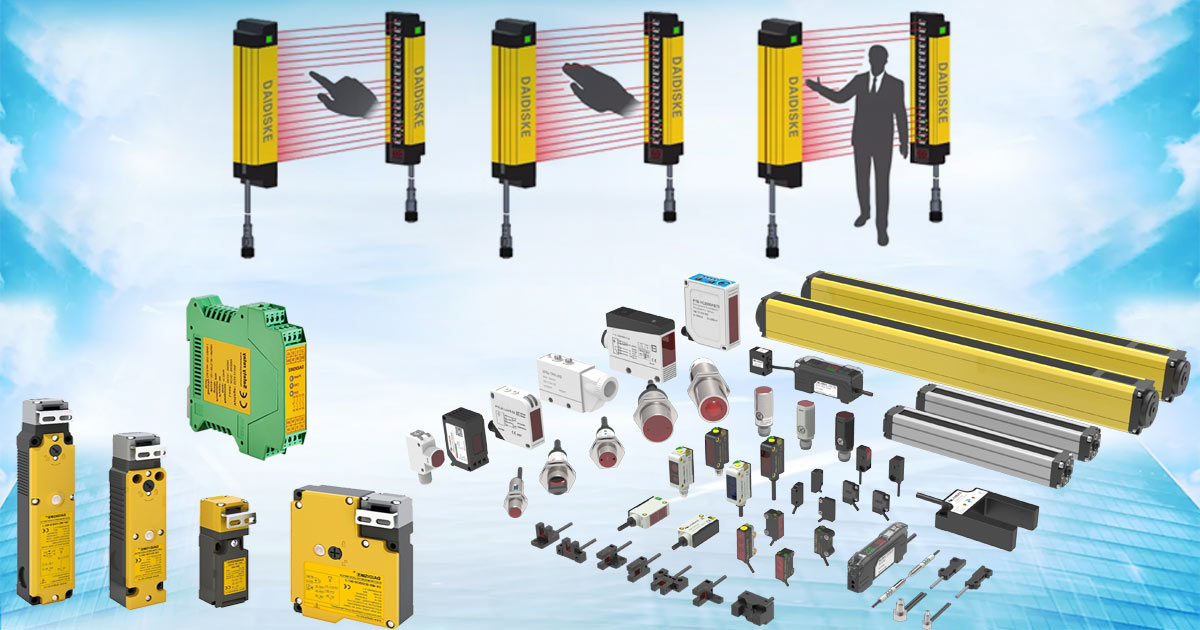
Inductive proximity sensors are the most ordered, most replaced sensor in any factory — and the two names that come up most when someone needs a replacement are Pepperl+Fuchs and IFM. Either the original part went obsolete, or the price came in high enough that purchasing asked for an alternative. This guide is the cross-reference, built the way our light-curtain brand guides are: from each maker's public headline specs, never from a copied datasheet, and never with an invented one-to-one part map.
The blunt truth first. An inductive sensor “replacement” is not a magic part number — it is a match on four specifications. Get those four right and a DAIDISIKE sensor drops into the same hole and the same PLC input as the P+F or IFM unit it replaces. Get one wrong — non-flush where you needed flush, NPN where the card wants PNP — and no badge makes it work. Everything below is about getting the four numbers right.
What are the four numbers that decide an inductive sensor match?
Barrel size, mounting style (flush/non-flush), nominal sensing distance, and output type (NPN/PNP, 2-/3-wire, NO/NC) with supply voltage. Every cylindrical inductive sensor — P+F NBB, P+F NBN, IFM IG, IFM IE, or a DAIDISIKE equivalent — reduces to these. Read them off the side of the installed unit or its datasheet:
- Barrel size — M8, M12, M18 or M30. This is the mounting thread and it caps the sensing range. Match it so you don't re-machine the fixture.
- Flush vs non-flush — shielded (embeddable in metal, shorter range) or unshielded (longer range, needs a free zone). P+F NBB = flush, NBN = non-flush. Get this wrong and the sensor either won't reach or will trip on the surrounding metal.
- Sensing distance — the nominal range in mm against a standard steel target. Design to the assured (guaranteed) distance, not the nominal headline figure.
- Output type — PNP (sourcing) or NPN (sinking); 2-wire or 3-wire; NO or NC; and the supply (commonly 10–30 V DC). This must match your PLC input card.
How do I cross-reference a Pepperl+Fuchs NBB or NBN to a DAIDISIKE sensor?
Map the P+F family to a mount style, then match size, range and output: NBB → DAIDISIKE flush, NBN → DAIDISIKE non-flush. Pepperl+Fuchs runs one of the largest cylindrical inductive programs in the industry — thousands of variants across M8/M12/M18/M30, NPN and PNP, NO/NC, cable or M8/M12 connector, rated IP67/IP68/IP69K and typically −25…+70 °C (high-temperature variants run much hotter). The families you meet most often:
- NBB — flush / embeddable. e.g. NBB4-12GM30-E2-V1 (M12, 4 mm flush, PNP NO, M12 connector, 10–30 V DC) and NBB5-18GM50-E2-V1 (M18, 5 mm, PNP NO, M12 connector).
- NBN — non-flush / increased operating distance. e.g. NBN12-18GM50-E2-V1 (M18, 12 mm non-flush, PNP, M12 connector), NBN8-18GM60-A2-V1 (M18, 8 mm non-flush, PNP NO/NC) and NBN4-12GM50-E2-V1 (M12, 4 mm).
- NCB / NJ — stainless or NAMUR. e.g. NCB10-30GM40-N0-V1 (M30, 10 mm flush, NAMUR NC, stainless) and NJ10-30GM-N-V1 (M30, 10 mm flush, NAMUR NC). These are intrinsically-safe / NAMUR or stainless builds — confirm whether you genuinely need NAMUR for a Zone before cross-referencing, because a standard 3-wire DC part is not a NAMUR substitute.
To cross-reference: take the size, mount style, range and output from the NBB/NBN code and request the DAIDISIKE part with the same four. A flush M18 5 mm PNP NO 3-wire NBB5-18GM50 maps to a DAIDISIKE flush M18 PNP NO 3-wire part; a non-flush M18 12 mm PNP NBN12-18GM50 maps to a DAIDISIKE non-flush M18 PNP part. The wiring interface is identical — we are not claiming P+F's catalogue figures as ours, we are building the same four-spec sensor.
What replaces an IFM IG, IF or IE inductive sensor?
Same method — IFM's families also reduce to size + mount + range + output, with IO-Link as the one feature to confirm before you swap. IFM's inductive program spans sizes from 3 mm and M5 up through M8/M12/M18/M30, sensing ranges from roughly 0.2 mm to about 40 mm, DC PNP / NPN (and AC/DC and 2-wire variants), NO/NC, cable or connector. The common families:
- IG — M12/M18/M30 cylindrical. e.g. IG0374 / IGC002 (M18×1, 12 mm sensing range), IG5953, IG0012; DC PNP/NPN, 10–36 V DC.
- IF — M12 inductive. e.g. IF5349, IF5712, IF6124 (with IO-Link); flush IFS-series units (IFS204/IFS209/IFS286) run roughly 4–7 mm sensing.
- IE — M8 inductive. e.g. IE5338 / IE5349 (M8, 3 mm, NPN/PNP NO, 10–30 V DC, flush).
- IM / IGB / IGC — M18/M30, including full-metal & IO-Link. Full-metal-face lines cover roughly 2–26 mm sensing depending on size and shielding.
One honest caveat for IFM swaps: several IF/IM units carry IO-Link. If your control actually reads the IO-Link process data — not just the switching signal — a plain switching DAIDISIKE sensor replaces the discrete output but not the IO-Link channel. For a standard NO/NC switching application (the large majority), the DAIDISIKE part is a direct functional equivalent on size, range and output. Tell us if IO-Link is load-bearing in your design.
Cross-reference: P+F / IFM family to DAIDISIKE equivalent
This table maps competitor family + size + output to the DAIDISIKE spec to request — it is a starting map from public headline specs, not a drop-in part number. Always confirm the four numbers against the original unit and re-verify any competitor figure on the official pepperl-fuchs.com or ifm.com datasheet, because distributor listings go stale.
| Competitor example | Size / mount | Headline range & output | DAIDISIKE spec to request |
|---|---|---|---|
| IFM IE5338 / IE5349 | M8, flush | ~3 mm, NPN/PNP NO, 10–30 V DC | M8 flush, NPN or PNP NO, 3-wire |
| P+F NBB4-12GM30 / NBN4-12GM50 | M12, flush / non-flush | 4 mm flush / 4–8 mm non-flush, PNP NO | M12 flush or non-flush, PNP NO, 3-wire |
| IFM IF5349 / IFS-series | M12, flush | ~4–7 mm, PNP/NPN, 3-wire | M12 flush, PNP or NPN, NO/NC, 3-wire |
| P+F NBB5-18GM50 (flush) | M18, flush | 5 mm, PNP NO, M12 connector | M18 flush, PNP NO, 3-wire, M12 connector |
| P+F NBN12-18GM50 / IFM IG0374 | M18, non-flush | ~12 mm, PNP, 3-wire, 10–36 V DC | M18 non-flush, PNP, 3-wire |
| P+F NCB10-30GM40 (flush) | M30, flush | 10 mm; NAMUR (confirm if required) | M30 flush, NPN/PNP 3-wire (std DC, non-NAMUR) |
| IFM IM/IGB/IGC M30 | M30, flush / non-flush | ~10–22 mm, PNP/NPN, NO/NC | M30 flush or non-flush, PNP/NPN, NO/NC, 3-wire |
The pattern is consistent: both brands converge on M8/M12/M18/M30, flush and non-flush, PNP-default-with-NPN-available, NO or NC, at 10–30 V DC. That is exactly the envelope the DAIDISIKE inductive proximity range was built for. Divergence is at the edges — NAMUR / intrinsically-safe, IO-Link process data, full-metal weld-immune faces, extreme-temperature builds — and that is where you confirm the special feature before you cross-reference, instead of assuming a 3-wire DC part covers it.
How do I find a replacement for a discontinued or obsolete proximity sensor?
Decode the four numbers from the obsolete part code or the physical unit, then request the matching DAIDISIKE part — you do not need the original to still be in any catalogue. When a P+F or IFM part goes end-of-life, the sensor on the machine still tells you everything: barrel size is on the thread, the code suffix encodes range and output, and the wiring is on the connector or in the old drawing. A discontinued NBB or IG number is just a label for a flush/non-flush M-size sensor at a known range and output — all of which DAIDISIKE still builds. Send us the dead part number plus a photo of the connector, and we'll return the live equivalent. This is often faster than chasing a last-time-buy of the original.
Why DAIDISIKE — price, MOQ and lead time
DAIDISIKE is a Chinese OEM/ODM inductive-sensor manufacturer: MOQ 1 set, 3–15 day lead time, OEM/ODM branding, exporting to 20+ countries since 2013. Premium-brand inductive sensors are excellent and priced accordingly; IFM sits in the affordable-premium tier and Pepperl+Fuchs spans a wide range. Where DAIDISIKE wins is the combination buyers actually need on a replacement: a functionally equivalent M8/M12/M18/M30 sensor, in the flush or non-flush build and the NPN/PNP / 2-wire / 3-wire output you specify, at IP67/IP68 — with no painful minimum order, fast turn, and the option to brand it as your own for resale or OEM machine builds. We do not publish competitor prices as if they were ours; we quote our part against your four numbers.
The honest engineering advice on a brand switch: validate one sample against your real duty cycle and your actual target metal before you commit to a bulk or wholesale order. A sensor that reads steel at 12 mm on the bench can behave differently against an aluminium tab on a fast line. We ship single samples precisely so you can prove it first.
Send the four numbers — size, flush/non-flush, sensing range, output (NPN/PNP, 2-/3-wire, NO/NC) — plus the connector and supply voltage, or just the discontinued part number and a photo. Our engineering team returns the matching DAIDISIKE part, with samples at MOQ 1 and a 3–15 day lead time.
Contact DAIDISIKE engineering · Phone / WhatsApp +86 15218909599
Is naming these brands legal, and how do you keep the comparison honest?
Naming Pepperl+Fuchs and IFM to describe a compatible alternative is nominative reference and is legitimate; the comparison stays honest by using only each vendor's public headline specs. We reference these brands and their part families by name so you can find the DAIDISIKE equivalent — normal, lawful comparison. What we deliberately do not do: we don't reproduce their datasheets or manuals, we don't use their trademarks or logos as our own, we don't publish a fabricated one-to-one part-number map, and we don't claim any P+F or IFM certificate or exact datasheet number as a DAIDISIKE figure. The competitor specs above are public headline values used as “compatible-with” reference points, and they should be re-verified on the official manufacturer datasheet before they go into a live order, since distributor listings can be stale.
Sources & specifications cited
- Pepperl+Fuchs — inductive sensors (NBB / NBN / NCB / NJ) — M8/M12/M18/M30, flush & non-flush, NPN/PNP, IP67/IP68/IP69K.
- IFM — inductive sensors (IG / IF / IM / IGB / IGC / IE) — M5–M30, ~0.2–40 mm sensing, DC PNP/NPN, IO-Link variants.
- Contrinex — Series 600/700 Factor 1 weld-immune inductive sensors — equal steel / aluminium detection distance reference.