
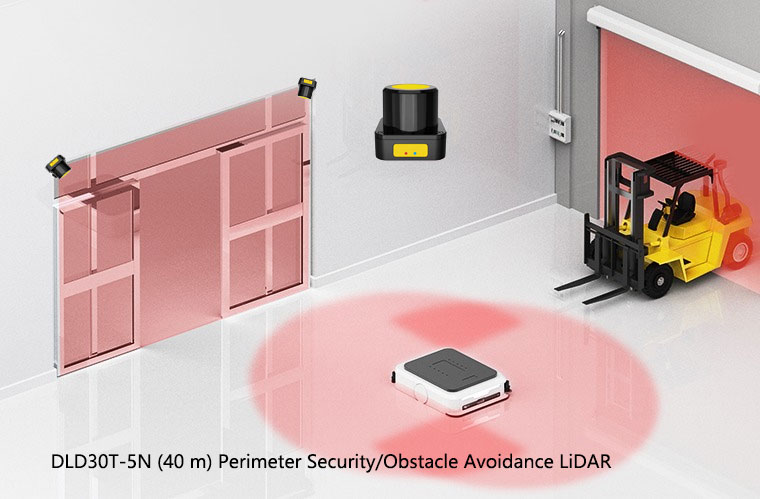
A site manager at a logistics yard near Tianjin sent us a video last winter. It showed a brand-new safety scanner, very expensive, mounted on a steel post overlooking a vehicle gate. Every few minutes the protective output dropped and the boom barrier slammed shut. The video was filmed in light snow with watery afternoon sun coming over the warehouse roof. The device had been spec'd as “weather resistant.” What he had actually bought was an indoor scanner with an IP65 housing stretched over it, and the optical engineering inside had no idea what to do with snowflakes drifting through the protective field while sunlight glared off a wet truck cab.
That is the article in one paragraph. Outdoor perimeter LiDAR is a distinct category of device, and the difference is not the housing. It is the signal processing, the optics, the wavelength decision and the temperature design. This page is the engineering reference we keep meaning to write — what changes when a LiDAR moves outside, and what the answer looks like for fence lines, vehicle lanes, port operations, substations and parking entrances.
Why outdoor is fundamentally different from indoor
An indoor AGV obstacle-avoidance scanner lives in a controlled environment. Ambient light is artificial and stable. There is no rain, no fog, no snow, no airborne dust at the levels that hurt LiDAR returns. The temperature varies maybe ten degrees across a day. The targets are pallets, racks and humans at reasonable distances. IEC 61496-3, the international standard for active opto-electronic protective devices responsive to diffuse reflection, is explicit on this: its scope is indoor use, with ambient light tested at up to 40,000 lx and rain only at 10 mm per hour, fog only to a meteorological optical range of 50 m or better.
Step outside and every one of those numbers is wrong. Direct sunlight at the sensor face can exceed 100,000 lx. A real rainstorm runs 25 to 50 mm per hour. Heavy fog drops MOR to ten metres or less. Airborne dust at a quarry or a cement plant is a continuous aerosol. The temperature swings forty degrees over a year and the device sits in direct sun for hours at a time. None of that is covered by the indoor envelope, which is why the relevant compliance standard for fixed outdoor perimeter use is IEC TS 62998-1:2019 — the technical specification that extends safety-sensor requirements to outdoor environmental conditions.
The practical consequence: when someone tells you their scanner is “outdoor capable,” ask which standard it has been tested to, at what ambient light level, at what rain rate, and at what temperature range. If those numbers are not on the datasheet, you have an indoor scanner in a weather housing.
IP ratings: IP65, IP67, IP69K and what they actually buy you
The ingress-protection rating is defined by IEC 60529. Two digits: the first is solid-particle protection on a 0 to 6 scale, the second is water protection on a 0 to 9 scale. The shorthand everyone uses on outdoor LiDAR datasheets:
- IP65 — dust-tight; protected against water jets from any direction. The practical minimum for any outdoor mount. Fine for a scanner under a canopy or eave, fine for a yard fence line in temperate climates.
- IP67 — dust-tight; protected against immersion to one metre for 30 minutes. The right answer where puddle splash, ground-level mounting, or short flood events are real, e.g. low-mounted scanners on a port apron or a vehicle wash bay approach.
- IP69K — dust-tight; protected against high-pressure, high-temperature wash-down. Strictly speaking this rating comes from ISO 20653 (formerly DIN 40050-9) rather than IEC 60529, and the standard test is roughly 80 C water at 80 to 100 bar from defined nozzle angles. Overkill on a fence line. Necessary in a food yard, dairy yard, or any facility where hot pressure-washing is a routine cleaning cycle.
One trap worth flagging: IP67 is not strictly stronger than IP65 on the water digit. IP65 is jets, IP67 is immersion — a device certified to IP67 only has not been tested against continuous high-pressure jets, just static immersion. Where both jets and immersion matter, look for a device certified to IP67 and IP65, or to IP69K which covers both ends.
Weather: fog, rain, snow, dust and the multi-echo trick
The single most important piece of signal processing in a modern outdoor LiDAR is multi-echo discrimination. A pulsed time-of-flight LiDAR fires a short laser pulse and times the return. In clear air the return is unambiguous. In fog or rain, the same pulse hits a droplet at two metres, another droplet at four metres, the rear wall of a fog bank at twelve metres, and finally a real solid target at thirty metres. A primitive single-echo scanner takes whichever return crosses the detection threshold first — usually the closest droplet — and reports a person standing two metres in front of the scanner. Boom barrier slams shut, vehicle queue backs up, operations get frustrated, scanner gets bypassed.
A multi-echo scanner records the first, last and sometimes two intermediate echoes for every pulse. The firmware then runs a decision: weak diffuse returns at short range that vary pulse-to-pulse are precipitation; a strong, consistent return that holds steady across consecutive scans is a real object. The protective field only fires on the latter. That is the difference between a scanner that nuisance-trips every twenty minutes in light rain and one that holds the perimeter through a moderate storm.
The published research on multi-echo denoising in adverse weather has matured significantly in the last few years — modern outdoor-grade firmware combines multi-echo with intensity filtering and short-window temporal averaging to reject not just rain but also airborne dust and the spurious returns you get from blowing snow.
Sun glare and wavelength — the 905 nm versus 1550 nm question
Solar irradiance on a clear day at sea level peaks in the visible and rolls off into the near infrared, but there is still plenty of solar power at 905 nm — the wavelength almost all safety-certified LiDAR uses. That sunlight is noise on the detector. When the scanner is pointed roughly toward the sun, or at a wet, sunlit surface, the noise floor rises and weak returns become harder to discriminate.
1550 nm has real physical advantages for outdoor work. Solar irradiance is lower at 1550 nm, so the noise floor is lower. The cornea and lens of the human eye absorb 1550 nm before it reaches the retina, so the Class 1 eye-safe limit under IEC 60825-1 is much higher — about 40 times the pulse energy permissible at 905 nm. That means longer range and stronger returns from low-reflectivity targets like dark clothing on a dark surface.
The reason 1550 nm has not taken over industrial safety LiDAR is economic. 1550 nm requires indium-gallium-arsenide (InGaAs) detectors, which cost an order of magnitude more than the silicon avalanche photodiodes used at 905 nm. The safety-certified product lines have stayed at 905 nm because the performance is good enough with multi-echo processing and tuned optical filtering, and the cost works. Expect 905 nm to remain the default safety perimeter wavelength through this generation; 1550 nm sits in automotive long-range and survey mapping.
For sun-glare immunity specifically, what matters more than wavelength on a 905 nm device is the receiver's optical bandpass filter (a narrow filter centred on 905 nm rejects most solar background) and the dynamic range of the detector front-end. Datasheet figures of 80,000 lx or 100,000 lx ambient light tolerance — well above the IEC 61496-3 indoor figure of 40,000 lx — are what tell you the device is engineered for outdoor sun, not just rated for outdoor housings.
Temperature: what -25 to +50 C really means
A typical outdoor-rated industrial LiDAR operates between -25 C and +50 C, with storage range often extended to -40 C and +70 C. That window covers temperate climates well, and most of the industrial world sits inside it. It is not universal.
Two situations push you to a wider rating. The first is genuine extreme climate: Inner Mongolian winters drop below -30 C, Gulf summers run above +50 C ambient, and a black scanner housing in direct desert sun can hit +70 C case temperature with the air at +45 C. The second is cold-start behaviour. A scanner that operates fine once warm may not boot reliably at -20 C if the internal heater is undersized or the scanner spins up before the optics window has cleared of condensation. Read the datasheet for both the steady-state operating range and the cold-start specification.
Where the climate exceeds the device rating, the standard answer is a heated and ventilated enclosure with a defrosting window. That works, but it adds a part to maintain, and a heating element that fails silently turns into a winter dead-zone on the perimeter. The cleaner answer for hard climates is a wider-rated scanner from the start.
False-trip taxonomy: what actually trips an outdoor perimeter
On every long outdoor installation we see, the same list of false-trip sources comes up. In rough order of frequency:
- Precipitation — rain, snow, sleet, hail. Handled by multi-echo processing and intensity filtering.
- Birds and insects — a sparrow crossing the field, a moth at dusk. Handled by minimum-object-size filtering and dwell-time filtering in the configuration software.
- Vegetation — a deciduous branch moving in wind, a tumbleweed, leaves falling across a beam. Handled by physical aim — do not point a perimeter field through foliage — and by careful protective-field geometry.
- Sun glare — direct sun in the scanner field at sunrise or sunset. Handled by mount orientation and by the receiver bandpass filter.
- Reflective surfaces — a wet truck cab, a corrugated metal building wall, a puddle reflecting sky. Handled by background-teach-in during commissioning and by intensity-based filtering.
- Fence-post movement — the post the scanner is mounted on swaying in wind. Handled by a rigid mount on a substantial structure, not a chain-link post.
On a well-engineered fence line of 100 metres or so, a properly configured outdoor scanner will see a few false alarms per month rather than per day. Zero is not the target and is not realistic. Single digits per month is.
Long-range performance and laser class
Outdoor perimeter applications need range. An indoor AGV scanner with five metres of protective field is enough for a forklift inside a building; a fence line needs 20, 30 or 40 metres of usable detection because that is the distance from a sensible mounting point to the boundary it is protecting. The trade-off is reflectivity. A datasheet that promises 40 m range usually means 40 m on a target of 90 percent diffuse reflectivity — a white card. A person in dark clothing (around 10 percent reflectivity) is detected at a shorter distance, and a wet asphalt surface at the same range can be almost invisible. Always check the range specification at the relevant target reflectivity, not the headline figure.
Long range and eye safety pull in opposite directions. More range needs more pulse energy or longer integration; eye safety under IEC 60825-1 caps the accessible emission for a Class 1 product. The outdoor-rated 905 nm scanners that reach 30 to 40 m on a person sit right at the edge of what Class 1 permits with 905 nm silicon, and that is part of why this segment of the market is still relatively small. Any serious outdoor perimeter LiDAR you specify must be Class 1 eye-safe — no exceptions, no “keep people back” warnings on the housing.
Applications: where these scanners actually go
The application list is shorter than people expect, and the common thread is that the protected boundary is outdoors and the consequences of an intrusion are serious enough to justify a safety device rather than just a security CCTV system.
- Yard perimeter and fence lines — logistics yards, storage compounds, warehouses with external storage. A scanner above the fence detects climb-over and breach attempts; multiple scanners on long runs handle hundreds of metres of boundary.
- Vehicle lane and gate control — barrier-controlled entrances where a person can walk through the open boom alongside a vehicle. A perimeter LiDAR field at the lane detects pedestrians and stops the barrier closing on them.
- Port and dock operations — quay-side crane working areas, automated container handling lanes, ship-to-shore approach paths. Wet, salty, high-traffic outdoor environments — the IP rating and corrosion resistance matter as much as the optics.
- Substation and high-voltage yard perimeters — intrusion detection on energised yards. The consequence of a person inside the boundary is potentially fatal, which is why this is safety perimeter rather than security perimeter.
- Outdoor automated parking and AS/RS approaches — automated parking towers, outdoor automated storage retrieval entry zones. A vehicle enters, the perimeter clears, the system commits.
Indoor vs outdoor scanner requirements — at a glance
| Parameter | Indoor scanner (AGV / cell) | Outdoor perimeter scanner |
|---|---|---|
| Governing standard | IEC 61496-3 (indoor) | IEC 61496-3 + IEC TS 62998-1 (outdoor extension) |
| IP rating (typical) | IP54 to IP65 | IP65 minimum; IP67 / IP69K where water exposure is real |
| Ambient light | Up to 40,000 lx (indoor test) | 80,000 to 100,000+ lx sun-glare tolerance |
| Rain rate | 10 mm/h (indoor test) | 25 to 50 mm/h with multi-echo discrimination |
| Fog (MOR) | 50 m or better | Down to ~10 m with multi-echo + intensity filter |
| Temperature | 0 to +50 C typical | -25 to +50 C (or -40 to +65 C for hard climates) |
| Range (protective) | 3 to 8 m typical | 15 to 40 m at 10 percent reflectivity |
| False-trip sources | Steam, reflective floor, sparks | Birds, rain, snow, sun, foliage, fence movement |
Where the DAIDISIKE DLD30T-5N fits
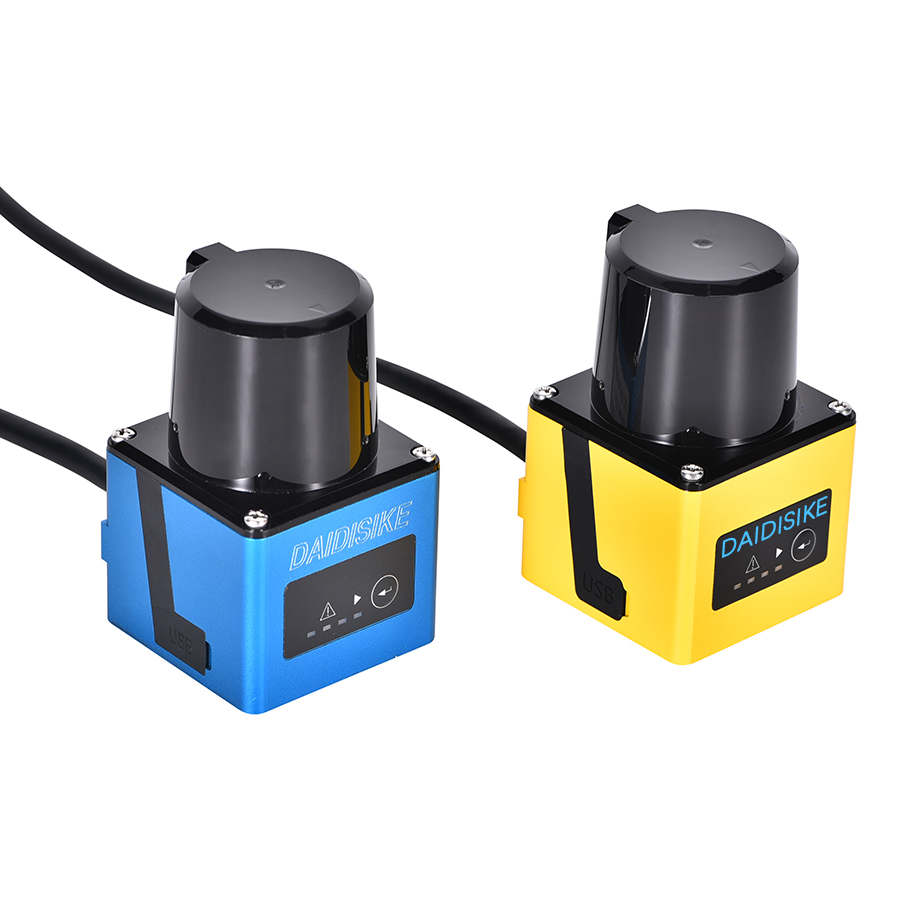
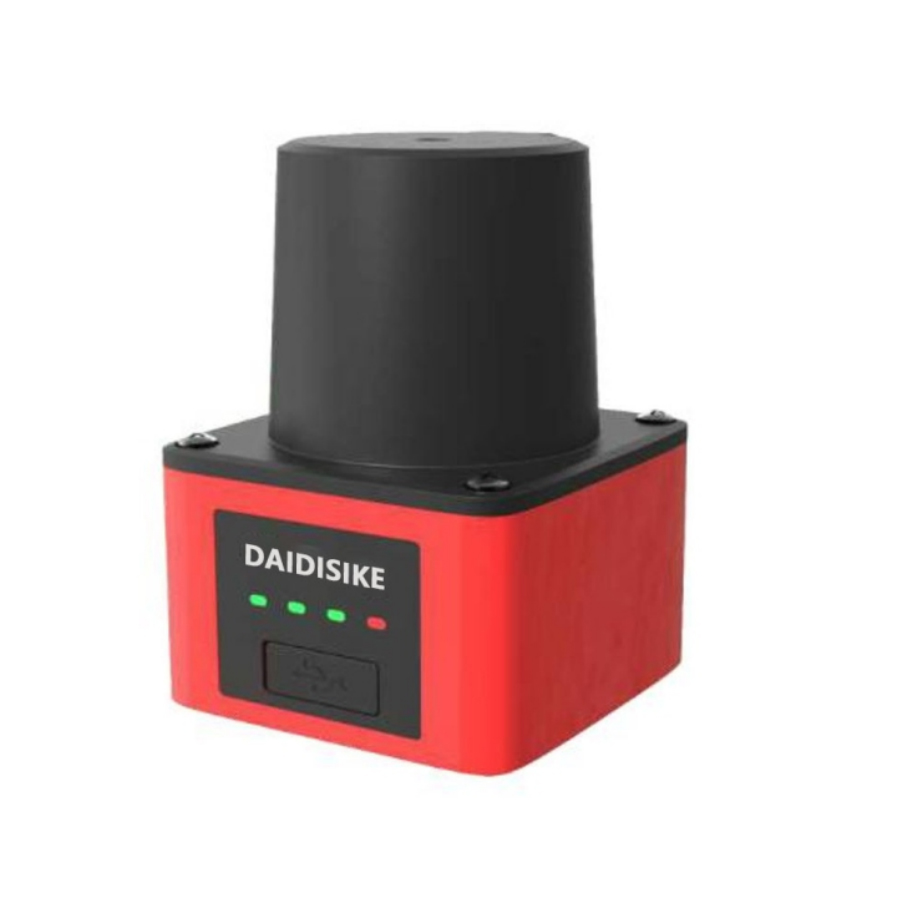
We make a family of LiDAR scanners covering indoor and outdoor use, and at the outdoor perimeter end of the range the DLD30T-5N is the model that gets specified into the applications above. It is a 40 m perimeter security and obstacle-avoidance LiDAR with the outdoor housing, multi-echo signal processing, 905 nm Class 1 eye-safe emission and the temperature range that the engineering case above describes. We position it honestly: it is the right tool for yard, fence-line, vehicle lane and substation perimeter work, not for tight indoor AGV obstacle avoidance where our DLD05A3 (5 m AGV-grade scanner) or DLD20A5 (20 m AMR-grade scanner) are the better fit.
The honest engineering rule we follow: match the device to the environment first, the range second. A 40 m scanner configured into a five-metre indoor cell is overkill that probably nuisance-trips on reflections it would never see outdoors; a 20 m indoor-grade scanner moved outside fails on the very first wet afternoon. The product families exist because the engineering problems are genuinely different.
The bottom line
The shorthand for specifying outdoor perimeter LiDAR is four questions, asked in order. What is the worst water event the scanner will see — pick the IP rating from that. What is the worst weather the perimeter has to hold through — pick a device with multi-echo processing and a documented adverse-weather specification. What is the worst lighting situation — pick an ambient-light tolerance well above the indoor 40,000 lx figure. What is the climate — pick a temperature range that covers the cold-start case as well as the steady-state. Everything else (range, response time, field configuration) is the same engineering you would do indoors. The four outdoor questions are what separate a working perimeter from one that gets bypassed inside its first season.
Related reading
Industrial Safety LiDAR — Complete Reference
The pillar guide to the LiDAR cluster — fields, ranges, response time and selection.
DAIDISIKE DLD30T-5N 40 m Perimeter LiDAR
Long-range outdoor-rated perimeter scanner for fence lines, yards and vehicle lanes.
What Is a LiDAR Scanner?
Time-of-flight basics, how LiDAR builds a scan, and where it fits in industrial safety.