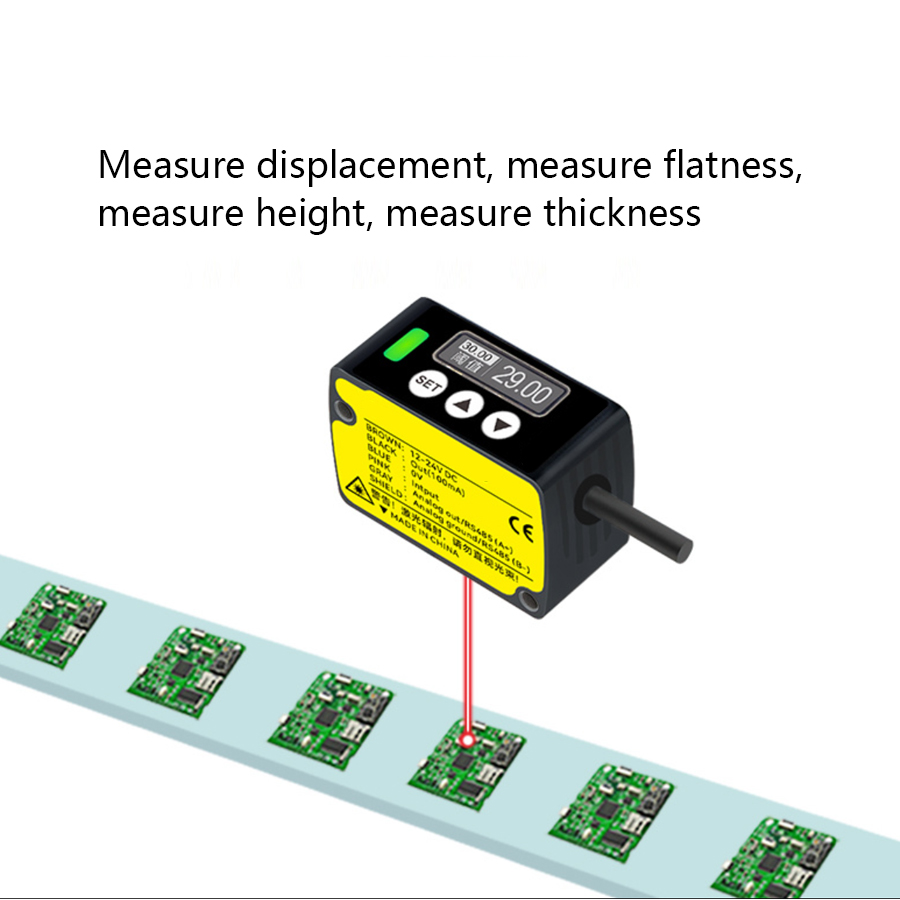
DK-G Series485 Laser Displacement

DAIDISIKE laser switch sensors give you what an LED photoelectric can't: sub-millimeter spot size at any distance, range up to 50 m, immunity to ambient sunlight, and consistent detection across paint colors, metallic finishes, and clear plastics. The lineup covers every standard cylindrical mounting size from M3 / M4 / M5 ultra-small heads for SMT placement and robot end-effectors, through M8 / M12 / M18 workhorse bodies for conveyor and indexer duty, up to DK-G / LK-F displacement sensors for inline gauging and DAI-JNS10 / DAI-G20 TOF ranging modules for robotic distance feedback. All units carry IEC 60825-1 Class 1 or 2 eye-safe ratings and ship with PNP/NPN switching outputs, 4–20 mA analog, or RS-485 Modbus-RTU digital — ready for any modern PLC.
Laser falls behind in two scenarios: (a) where the target moves through extremely dusty or oil-mist environments that coat the lens (use IP67/IP69K LED photoelectric with auto-cleaning windows instead), and (b) where the cost of an LED photoelectric is acceptable and the precision penalty doesn't matter (high-volume packaging where any container break-beam is good enough).
| Body Size | Target Size (Min) | Typical Range | Best-Fit Applications |
|---|---|---|---|
| M3 / M4 / M5 | ≤ 5 mm | 100 – 300 mm | Pick-and-place heads, robot end-effectors, electronics assembly, micro-feeders |
| M6 / M8 | 8 – 10 mm | 300 – 1000 mm | Small-conveyor edge detection, indexer position confirmation, fill-level sensing |
| M12 | 12 mm | 1 – 5 m | General conveyor detection, packaging-line counting, automated warehouse sorting |
| M18 | 18 mm | 5 – 20 m | Long-range factory bays, wide conveyors, AGV docking confirmation |
| M30 | 30 mm | 20 – 50 m | Through-beam across a hall, perimeter doorway detection, outdoor canopies |
| Displacement (DK-G / LK-F) | Inline standoff 30 – 500 mm | 0.1 – 30 mm measurement window | Thickness, height, profile gauging on stamping and assembly lines |
| TOF Ranging (DAI-JNS10 / G20) | Compact | 0.05 – 20 m | AGV obstacle avoidance, robotic distance feedback, bin-level monitoring |
Laser through-beam with sub-millimeter spot reads each container's leading edge cleanly at line speeds up to 600/min. The narrow beam ignores splashed liquid, condensation, and label-overlap that confuses LED photoelectrics.
M3/M4 laser diffuse-reflection mounted on the SMT placement head verifies that the previous component was deposited before the next pick. Small spot resolves SOT-23-sized chips that LED switches can't distinguish from bare PCB.
Long-range M18 through-beam across the coil cradle triggers automatic reloading when the strip end passes. Laser tolerates the oily, reflective steel surface that defeats short-range proximity switches.
Black, white, and metallic paints reflect very differently for LED photoelectrics. A red laser locks onto the painted surface across all colors, providing consistent triggering for spray-booth indexers and paint-line clamping.
DK-G or LK-F displacement sensors mounted above the sorter conveyor read each parcel's height to ±0.1 mm. Feed the data to the warehouse-management system for cubic-volume billing and bin-allocation.
TOF ranging modules (DAI-JNS10, DAI-G20) provide millisecond distance feedback for AGV docking, cart-distance maintenance in train mode, and pallet-fork height calibration in automated forklifts.
DK-G Series485 Laser Displacement
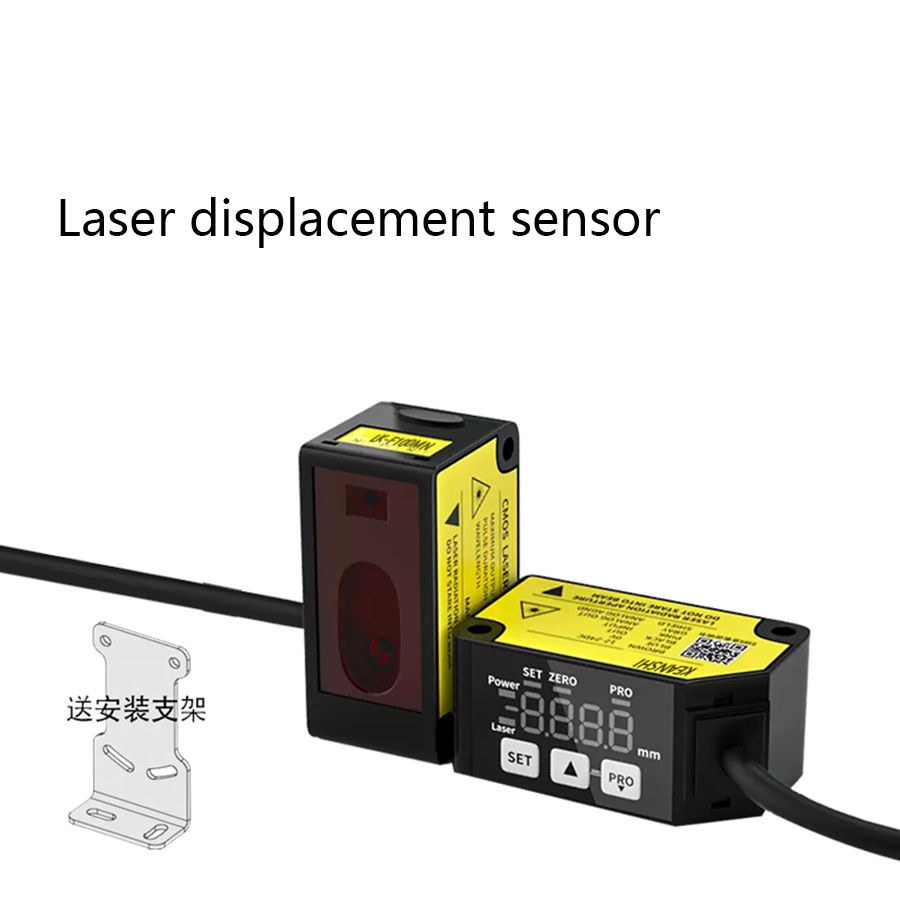
LK-F Series Laser Displacement
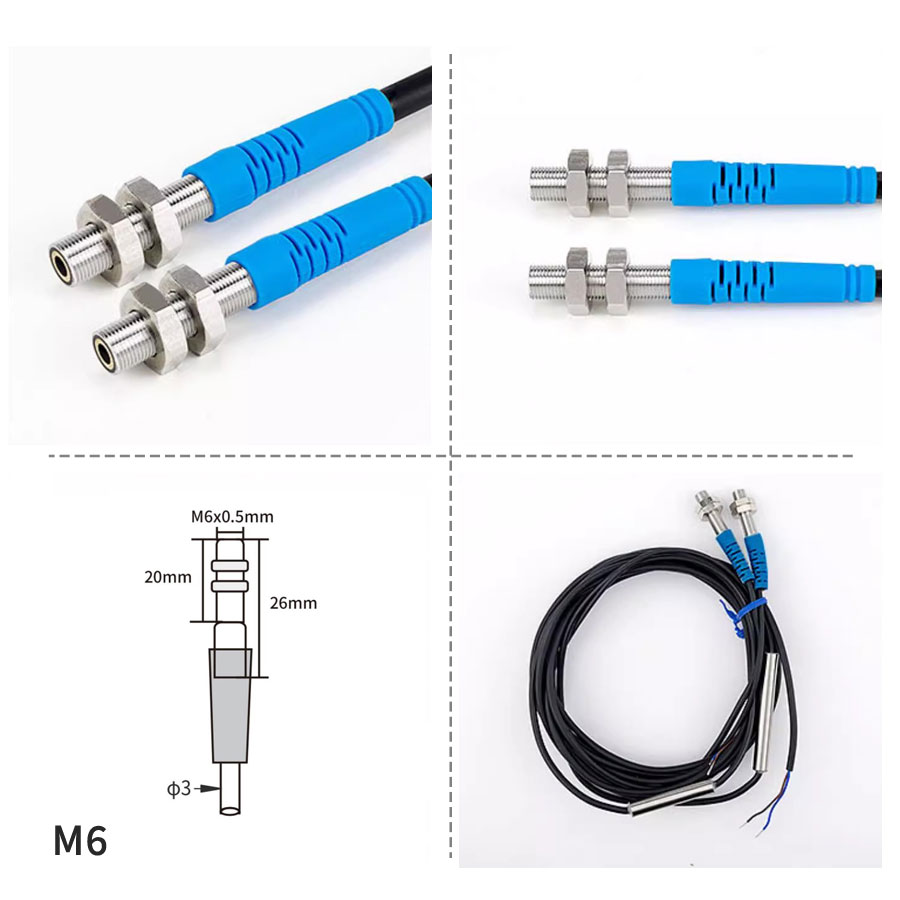
M3M4M5M6 Laser Photoelectric Sensor (one pair)
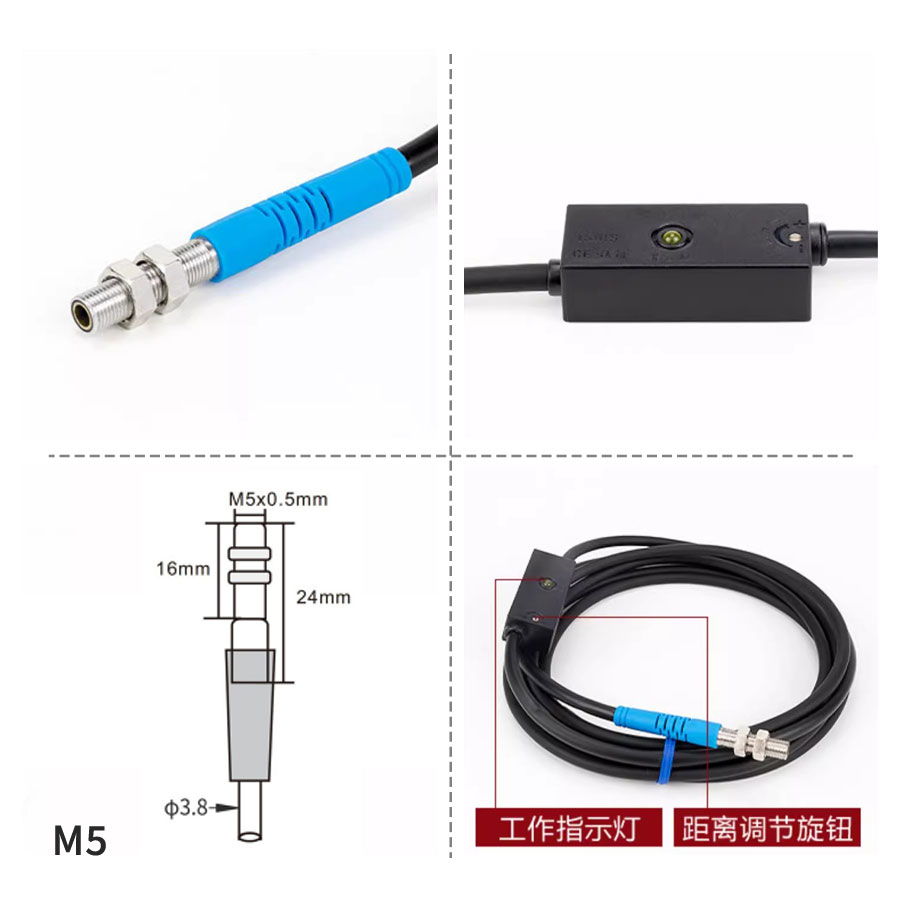
M3M4M5 Laser Diffuse Reflection (one)
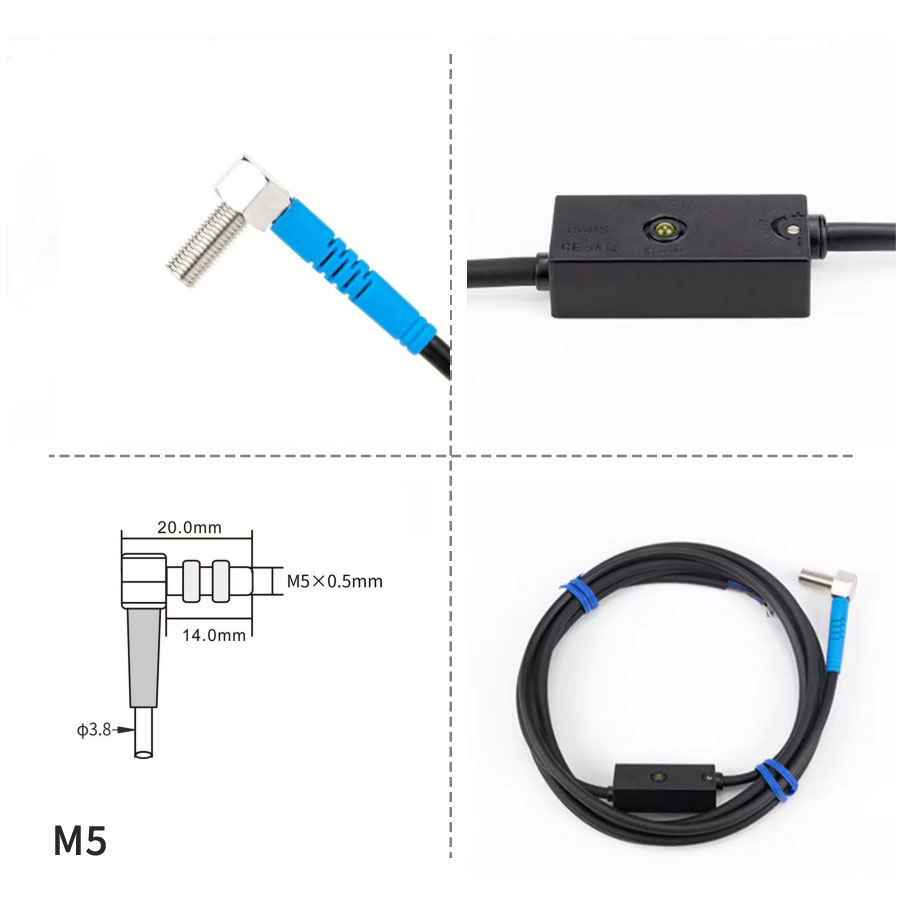
M5M6M8 Laser Diffuse Reflection (one)
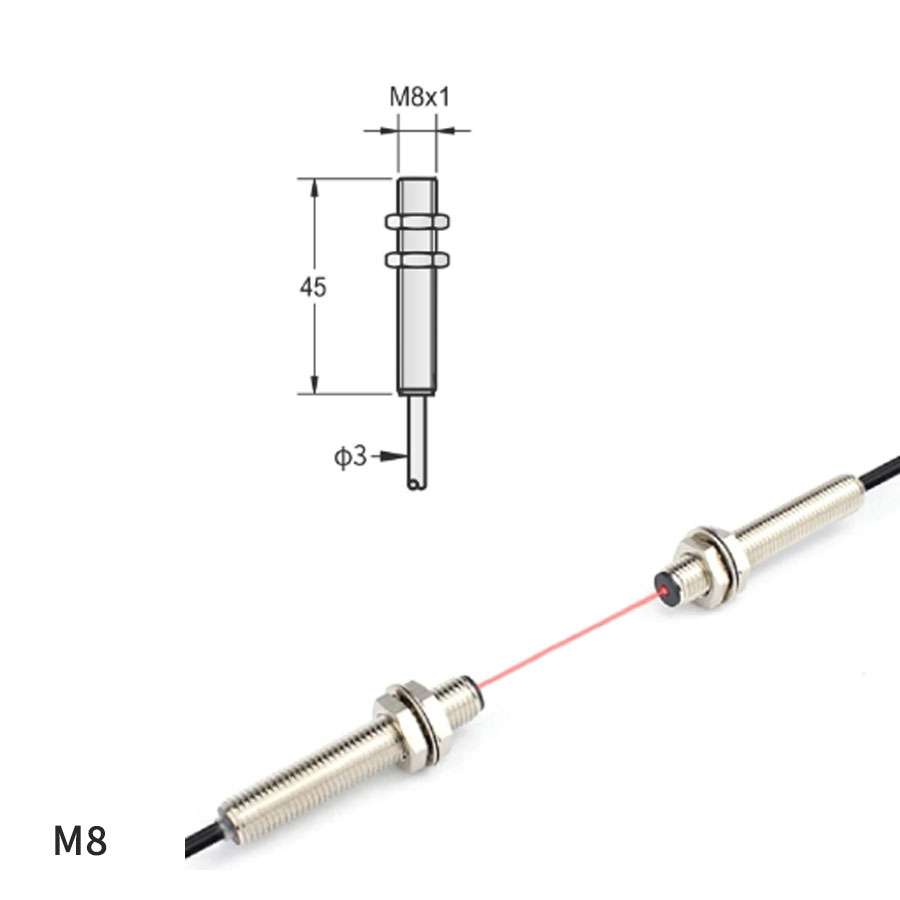
M8M12M18 Laser Photoelectric Sensor (one Pair)
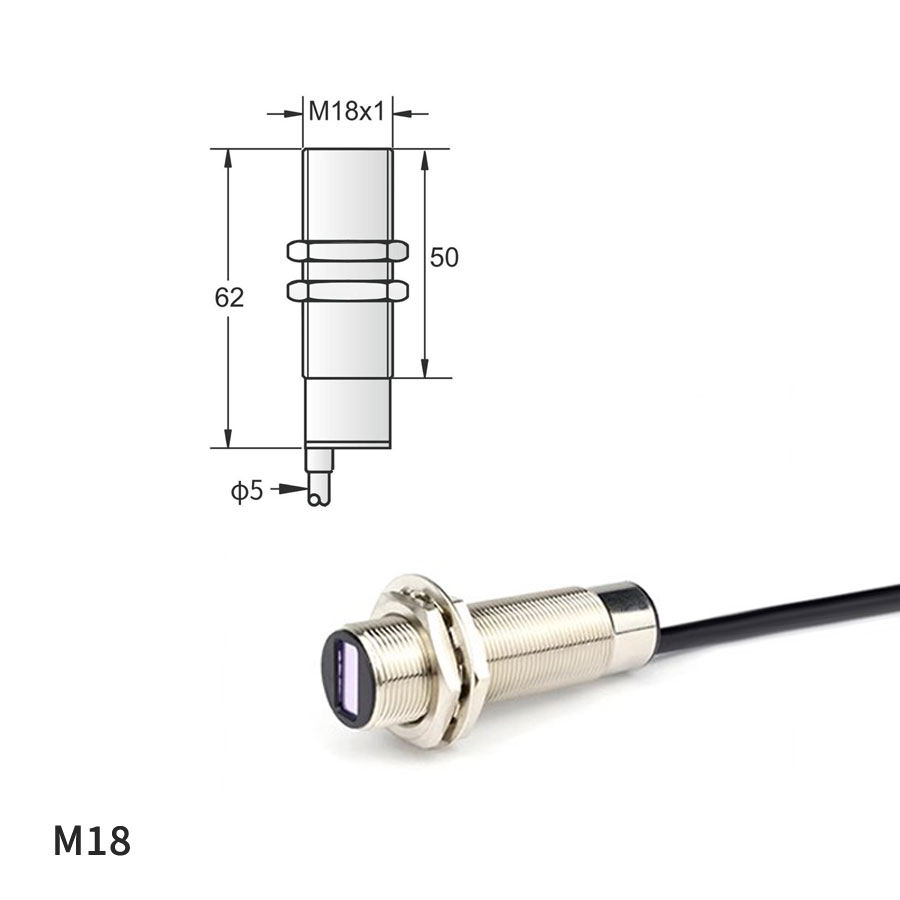
M12M18 Laser Diffuse Reflection (one)
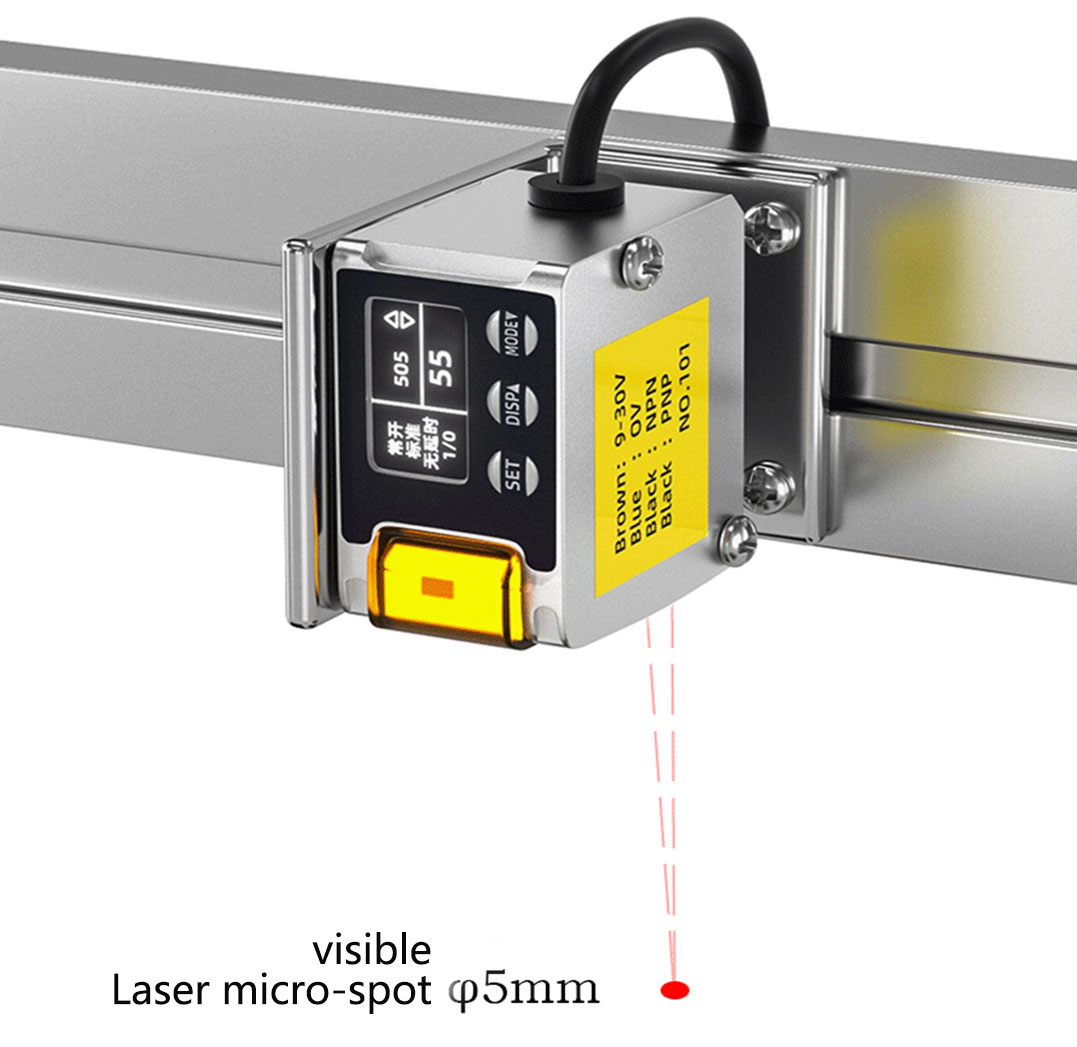
TOF Laser Ranging Sensors DAI-JNS10 and DAI-G20
A laser switch uses a collimated laser diode (red 650 nm or near-infrared 850 nm) instead of an LED. The result is a sub-millimeter spot at any distance — typically 0.5 to 1 mm diameter even at 10 m — versus the 30-50 mm cone of a typical LED photoelectric. That tight spot is what lets you detect small targets, edges of thin sheets, holes in indexing plates, and tiny gaps that an LED switch would miss entirely. Laser switches also see further (up to 50 m through-beam) and resist ambient sunlight better because the receiver can be tuned to the narrow laser wavelength.
Through-beam (emitter + receiver in two housings) is the most reliable mode — pick this for long range (up to 50 m), small-target detection, and dusty environments where signal loss matters. Diffuse-reflection (single housing reads the bounce off the target) is the simplest to install — pick it when you can't mount both sides, the target is bigger than the beam, and the surface is reasonably matte. Retro-reflective is uncommon for laser switches because the corner-cube reflector adds complexity without much benefit at the typical laser ranges.
The M-number is the body's mounting thread diameter in millimeters. M3-M5 are 'ultra-small' bodies for tight equipment (pick-and-place heads, robot end-effectors, electronics assembly fixtures). M8-M12 are the everyday workhorse range for conveyor and indexer detection. M18-M30 carry more powerful emitters for longer range, ruggedized housings, and easier alignment. As a rule of thumb: pick the smallest body that gives you the range and standoff you need plus a safety margin.
DAIDISIKE laser switches ship with either PNP or NPN three-wire DC output (factory configurable, +V / OUT / 0V). Both are PLC-friendly: PNP sources current to a sinking PLC input, NPN sinks current from a sourcing input. For displacement (DK-G, LK-F) and TOF ranging (DAI-JNS10, DAI-G20) products, the analog output is 4-20 mA or 0-10 V and the digital output is RS-485 with Modbus-RTU — same protocol as the rest of the DAIDISIKE product family.
All DAIDISIKE laser switches are IEC 60825-1 Class 1 or Class 2 — eye-safe under normal industrial use. Class 1 needs no warning labels and is intrinsically safe (the natural blink reflex protects the eye). Class 2 visible-red models include a yellow warning label and require operators to avoid prolonged direct viewing into the aperture. Neither class requires laser interlock systems, lockout/tagout, or protective eyewear in normal use.
Two clear advantages: range (laser reaches meters; inductive proximity tops out at about 60 mm) and material flexibility (laser detects anything that reflects or blocks light — paper, plastic, glass, metal, wood — while inductive switches only see metal). Laser also wins when you need to detect a small feature on a larger part, like a hole in an indexing plate or the edge of a thin sheet, because the sub-millimeter spot resolves features that a 5 mm-radius inductive coil can't distinguish.
Switching laser sensors respond in 0.5 to 2 ms — fast enough for 30,000+ parts/hour on a typical pitch-controlled conveyor. Displacement and TOF ranging models report measurements at 100 to 1000 Hz, sufficient for inline gauging at any practical line speed. The real speed limit is usually the PLC scan time and the actuator response, not the sensor.