
IP69K-Class Washdown Safety Light Curtains for Food, Dairy and Beverage Processing — An Engineering and Hygienic-Design Guide
Safety light curtains on food, dairy and beverage lines need ingress protection that survives high-pressure hot-water washdown, plus surfaces and seals that survive caustic CIP and peracetic-acid sanitisation. IP69K is the formal class for direct steam-jet zones; IP68 with the right gasket chemistry and downward-sloped mounting handles the broader splash-zone envelope at a lower cost. Hygienic mounting — slope, fastener choice, drainage — matters as much as the IP number itself, because a sealed housing with biofilm growing on its top surface still fails the BRCGS swab test. The DAIDISIKE DQR IP68 waterproof safety light curtain is the food-environment specification in the DAIDISIKE product family — anodised aluminium body, FKM gasket, sealed M12 connectors.
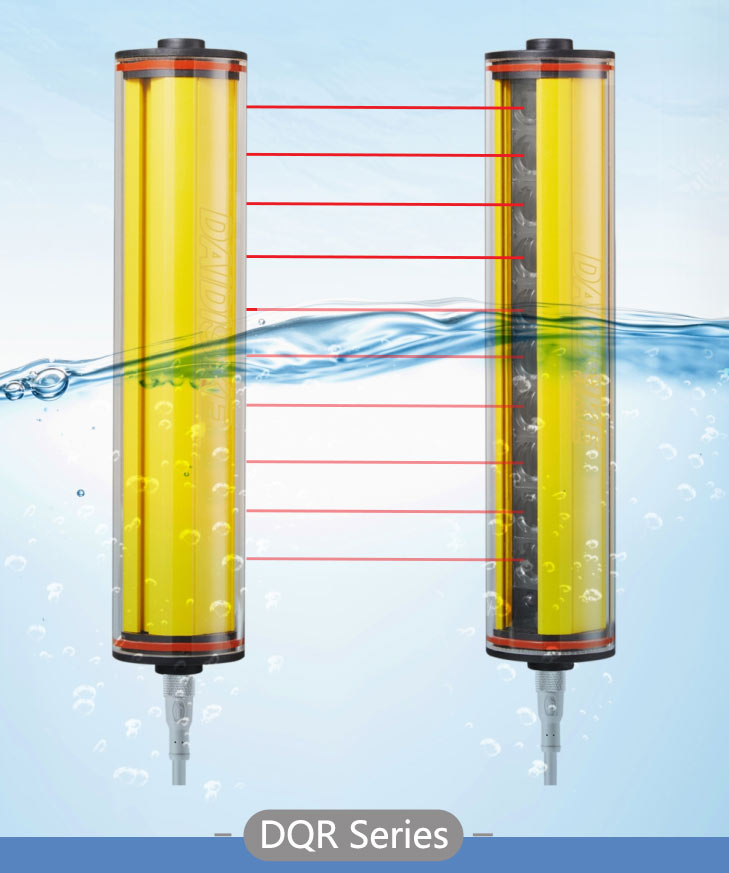
The food and beverage sector punishes safety sensors. A machine-shop safety light curtain that runs for ten years on a stamping cell will fail in eighteen months on a meat-cutting line, and the failure mode is almost never the optics. It is ingress: a degraded gasket lets caustic foam get past the housing seam, the front-window adhesive fails after a hundred peracetic-acid cycles, water enters the M12 connector during high-pressure rinse and shorts the OSSD output. Once you start getting nuisance trips on a Monday morning after the weekend shutdown wash, you have an ingress problem, not a sensor problem.
This guide is the engineering specification for getting a safety light curtain through a food-plant duty cycle. We cover what the IP ratings actually test, the cleaning chemistry that decides which housings survive, the hygienic-mounting rules that the BRCGS auditor will check, and where in the DAIDISIKE product family the DQR IP68 waterproof safety light curtain is the right specification. We are honest where the DQR is the right fit and where an IP69K-specific device with a washdown shield should be specified instead.
1. The IP65 / IP67 / IP68 / IP69K hierarchy — what each test actually does
The IP code under IEC 60529 has two digits. The first is protection against solids (0 to 6, with 6 being dust-tight). The second is protection against water (0 to 9). The confusing part is that the water digits are not a strict hierarchy — they describe different tests, not increasing severity. A device tested to IP67 (immersion) is not automatically protected against IP69K (high-pressure spray). The food industry needs both.
| Code | What it tests | Typical food-industry use |
|---|---|---|
| IP65 | Protected against low-pressure water jets from any direction (6.3 mm nozzle, 30 kPa, 3 minutes). | Dry zones, packaging downstream of the wash area, control panels with internal sensors. |
| IP67 | Temporary immersion: 1 m depth for 30 minutes at ambient temperature. | Splash zones with occasional wipe-down cleaning; sensors mounted above the splash arc. |
| IP68 | Continuous immersion at conditions agreed between manufacturer and user (typically deeper or longer than IP67). | Splash zones with regular foam cleaning and rinse; meat and dairy lines outside the immediate steam-jet area. |
| IP69K | ISO 20653: 80 °C water at 80 to 100 bar from a fan-spray nozzle at 0°, 30°, 60° and 90°, rotated 5° per second, 30 seconds per angle. | Direct high-pressure hot-water washdown: bottle-washer interiors, immediate filling-head zones, intensive cleaning routines in meat and poultry processing. |
Two practical points get missed:
- IP69K does not include the IP68 immersion test. A device rated only to IP69K may not be safe to submerge. Most food-environment safety sensors are dual-rated (IP67 + IP69K, or IP68 + IP69K) and the user should look for both numbers on the datasheet, not just IP69K alone.
- The IP test is performed once on a sample at end-of-line. It is not an in-service durability claim. A device that passes IP69K when new may degrade after 200 cleaning cycles if the gasket is the wrong chemistry. The gasket chemistry and the connector seal type matter as much as the IP number.
2. The cleaning-chemistry reality — what destroys housings in twelve months
A food plant's CIP recipe is what actually decides whether a safety light curtain lasts ten years or eighteen months. The typical day in a dairy filling line is:
- Pre-rinse: 40 to 50 °C water for 5 to 10 minutes to remove gross product residue.
- Caustic CIP: sodium hydroxide (NaOH) at 1 to 5 % by mass at 65 to 85 °C for 20 to 40 minutes — the hardest chemistry the housing sees, attacks fats and proteins.
- Intermediate rinse: water at 50 to 60 °C for 5 to 10 minutes.
- Acid CIP: nitric or phosphoric acid at 0.5 to 2 % at 50 to 70 °C for 15 to 25 minutes — attacks mineral scale, particularly important in dairy where milk-stone deposits build up fast.
- Final rinse: water at ambient for 5 to 10 minutes.
- Sanitisation: peracetic acid (PAA) at 100 to 300 ppm at ambient to 40 °C for 5 to 10 minutes — kills the residual microbial load.
A meat-processing line typically replaces the dairy acid step with chlorinated alkaline foam (1 to 3 % active chlorine plus NaOH) and adds an open high-pressure rinse after each shift to remove fat from machine surfaces. A beverage line uses a similar caustic-acid sequence but often at lower temperatures and with the addition of ozone for sanitisation.
The materials decisions that follow from this:
| Component | Food-grade default | What fails first |
|---|---|---|
| Housing body | Anodised aluminium (Type II or III) or 304/316L stainless steel | Mild steel rusts within weeks of caustic exposure; chromated aluminium fades and pits. |
| Front window | Polycarbonate (PC) or PMMA with food-safe coating | Untreated acrylic crazes in PAA; PC handles caustic and PAA well but yellows under UV. |
| Housing gasket | FKM (Viton) or EPDM | Silicone swells in PAA and chlorinated alkaline foam; NBR is destroyed by hot caustic. |
| End-cap seal | FKM or EPDM, mechanically retained (not adhesive-only) | Adhesive-bonded end caps debond after 100 to 200 hot-CIP cycles; mechanical retention with O-ring lasts the life of the device. |
| Connector | M12 with FKM seal, gold-plated pins, hex-collar overmould | Plastic-collar M12 connectors crack at the strain-relief; PVC overmoulds soften in hot water. |
| Cable | PUR or food-grade TPE jacket; FDA-approved if in splash zone | PVC jackets harden and crack in PAA; standard rubber softens in hot caustic. |
The DAIDISIKE DQR housing is anodised aluminium with FKM seals throughout, mechanical M12 connector retention and a polycarbonate front window — the food-line specification rather than the dry-environment specification.
3. Hygienic mounting — the rules the BRCGS auditor checks
A sealed housing alone does not pass a hygienic-design audit. The mounting layout decides whether water drains away or pools, whether biofilm grows on top surfaces, and whether the cleaning crew can reach every face with a foam lance. EHEDG Doc 8 and the 3-A Sanitary Standards lay out the principles; the practical mounting rules for a safety light curtain on a food line are:
- Slope the housing at 3° to 5° from horizontal so water drains rather than pools on any face. Mount the housing with the cable exit at the lower end.
- Connectors and cable glands point downward. Upward-facing connectors trap water around the seal and accelerate ingress failure. If the layout forces a sideways connector, fit a drip loop.
- Brackets in stainless or food-grade anodised aluminium, not painted mild steel. Galvanised steel is not acceptable in the splash zone — the zinc carbonate scale that forms in caustic is itself a contamination source.
- Standoffs at least 12 mm between housing and any wall so a foam lance and cleaning brush can reach every face. The classic mounting mistake is to bolt the curtain flush against a panel.
- Domed or rounded fastener heads with sealed thread. Hex socket and crosshead fasteners with exposed slots are biofilm traps. Stainless dome-head socket caps with food-grade thread sealant are the standard solution.
- No horizontal ledges, no overlap joints. Where two surfaces meet, they should either be continuous-welded (for stainless) or sealed with a food-grade silicone bead pulled smooth, no caulk lines.
- Identification labels under the housing, not on the top face. A top-face label is a water trap and a biofilm host.
4. Application notes by sub-sector
Meat processing
Meat processing lines combine high-fat product residue with aggressive chlorinated alkaline foam cleaning and frequent high-pressure rinses. Safety light curtains are typically installed at slicer guards, packaging cell gates, mixer outfeeds and trim-line robot cells. The dominant failure mode is fat ingress between the front window and the housing — a plain butt-joint window will accept fat creep over six to twelve months; a window with a continuous food-grade silicone bead between window and housing extends this to the life of the device. DQR housing with the FKM-retained polycarbonate window survives the typical meat-line cleaning regime provided it is mounted with the 3° drainage slope and the connectors point down.
Dairy filling lines
Dairy is the harshest CIP chemistry — hot caustic at 80+ °C for 30 minutes, twice a day on a milk filling line. The sensor must be mounted outside the direct CIP path; ideally behind a removable splash shield that is cleaned separately. The DQR's anodised aluminium body is compatible with the recurring caustic exposure; the limiting factor is the connector seal, which sees thermal cycling between 80 °C wash and 4 °C product environment. Specifying a sealed M12 with FKM gasket and a sacrificial cable gland on the panel side gives the longest service life.
Beverage bottling
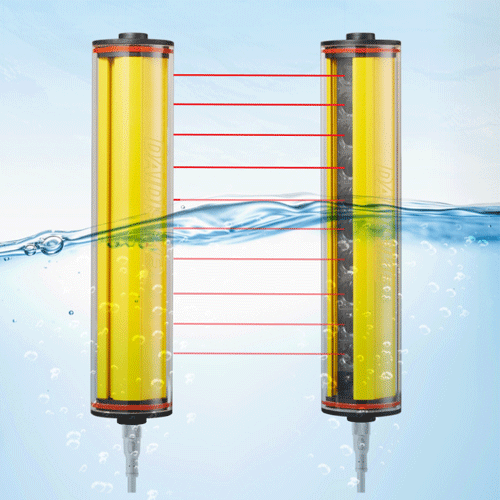
Beverage lines run faster than dairy and the sanitation chemistry is gentler, but the speed of the line makes the response-time budget tight. A bottle handler at 600 bottles per minute can have a safety distance of only 150 to 200 mm available, which forces a fast Type 4 light curtain with a short response time. The DQR's 14 to 20 ms response time across typical heights fits within this budget. Mounting is usually above the conveyor with downward-pointing brackets and an inline splash deflector — the bottle washer's spray arc reaches surprisingly high and surprisingly far.
Frozen-food and ready-meal packaging
Frozen-food lines combine cold operating temperatures (down to -25 °C in some IQF zones) with periodic hot washdown (up to 80 °C). The thermal cycling stresses every seal in the device and is harder on connector seals than on housing gaskets. The DQR's specified operating temperature range covers -10 to 55 °C; for IQF freezer zones an external insulated enclosure with sealed sight-glass is the standard accommodation. Ready-meal lines are less temperature-aggressive but have very high splash exposure from sauce filling and washdown.
5. The regulatory frame — EHEDG, FDA, 3-A, BRCGS
EHEDG (European Hygienic Engineering and Design Group)
EHEDG publishes a set of hygienic-design documents that are the industry reference for food-machinery design. EHEDG Doc 8 covers general hygienic-design principles; EHEDG Doc 13 covers equipment for open processing; EHEDG Doc 14 covers materials. EHEDG operates a certification scheme for components, primarily for product-contact items. For safety sensors in the splash zone, EHEDG certification is rare but the design principles are universally applied.
FDA 21 CFR (US food contact)
21 CFR 175 covers adhesives and coatings; 21 CFR 177 covers polymers permitted in food-contact applications. A safety light curtain in the splash zone does not normally contact food and is not strictly required to comply, but the polymers used should be those acceptable under 21 CFR 177 (polycarbonate, FKM, EPDM, PUR cable jacket) as evidence of food-safe materials throughout.
3-A Sanitary Standards (dairy)
3-A publishes detailed sanitary-design standards for dairy equipment. The 3-A Symbol Council certifies equipment that meets these standards. Safety sensors do not normally seek 3-A certification because they are not product-contact, but a 3-A-aware mounting (drainage slope, weld smoothness, no dead spaces) is what the dairy plant's QA team will look for during audit walk-rounds.
BRCGS (Global Standard for Food Safety)
BRCGS issue 9 is the current global standard for food safety audits. It does not specify safety-sensor design directly but its requirements for environmental hygiene (clause 4) and equipment maintenance (clause 4.7) drive the practical rules for sensor mounting in the splash zone. A safety light curtain that pools water, traps food residue under a flat mounting bracket, or has biofilm visible at the connector interface will be flagged in the audit even if the device itself is IP69K-rated.
6. Common installation mistakes
Mounting the device flush against a panel
The most common error. The 12 mm standoff is the difference between a sensor the cleaning crew can reach and a sensor that grows biofilm on the back face. The fix is a pair of stainless standoff posts at each mounting hole.
Upward-pointing connectors
A vertical-mount light curtain with the M12 connector at the top is convenient for the wiring loom but a water trap. The connector seal sits in a pool of CIP fluid after every wash. Flip the device or relocate the cable exit.
Wrong gasket chemistry
A device specified for a machine shop ships with NBR (nitrile) gaskets and fails within months on a dairy line. Always confirm gasket chemistry on the spec sheet before ordering for a food-line installation. FKM and EPDM are the safe defaults.
Painted brackets in the splash zone
Mild steel brackets with food-safe paint look acceptable on day one. After three months of caustic and PAA, the paint blisters and the underlying steel rusts; rust particles become a contamination source. Stainless brackets cost more but are the only long-term answer in the splash zone.
Confusing IP67 and IP69K
A purchasing form that asks for "IP rating: high" is too vague. The specification should say "IP67 + IP69K" or "IP68 with washdown shield" depending on the zone. A device rated IP67 alone may be inadequate for the immediate filling head; a device rated IP69K alone may not be safe to immerse during a tank cleaning event.
7. The DAIDISIKE DQR family — neutral product reference
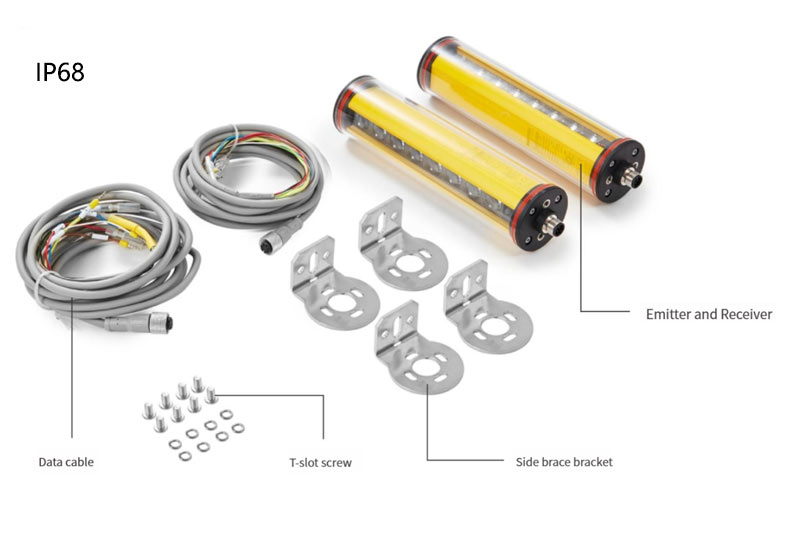
Since this is the DAIDISIKE site, a short note on where the DQR sits in the product family. The DQR series is the waterproof variant in the DAIDISIKE safety light curtain line: anodised aluminium housing, FKM gaskets throughout, polycarbonate front window, sealed M12 connectors with mechanical retention, designed and tested to IP68 (IEC 60529). Beam spacings of 10, 14, 20, 30 and 40 mm cover finger through hand-and-arm detection; protected heights from 160 mm up. Response times 10 to 25 ms across the range. Type 4 ESPE under IEC 61496-2 architecture.
The DQR is the right specification for the broader food- industry splash zone — dairy crate-washer outfeeds, meat packaging cells, beverage bottle-handling robots, frozen- food carton sealers — where IP68 protection plus FKM seal chemistry plus correct hygienic mounting gives a service life that comfortably exceeds the line maintenance window. For the immediate high-pressure steam-jet zone (inside a bottle washer, at the filling head) an IP69K-class device with a removable washdown shield should be specified instead — the DQR is not certified to ISO 20653 and we would not put it in the direct jet path without additional protection.
To talk through a specific food-line application, share the CIP chemistry and the planned mounting position with our engineering team at our contact page or look at the DQR waterproof safety light curtain, ingress-protection background article and the broader DAIDISIKE safety light curtain family to see where the DQR sits relative to the standard DQE, DQC, DQO, DQT and DQT4 series.
8. Frequently asked questions
What is the difference between IP67, IP68 and IP69K for a safety light curtain?
All three are ingress-protection ratings under IEC 60529 but they test different things. IP67 tests temporary immersion: the housing is submerged 1 metre deep for 30 minutes at room temperature and water must not enter in harmful quantities. IP68 tests continuous immersion at conditions agreed between manufacturer and customer — typically deeper, longer or at higher temperature. IP69K is an additional test from ISO 20653 (originally automotive but adopted across hygienic industry) that simulates high-pressure, high-temperature washdown: 80 °C water at 80 to 100 bar from a fan-spray nozzle, at four angles, while the device rotates. A device rated to IP69K typically also passes IP67 and IP68, but a device rated to IP68 is not automatically IP69K — the steam-cleaning regime is harder than the immersion test, especially on connector seals and cable glands.
Is IP69K mandatory for food-processing safety sensors?
Not as a regulation, but it is the de facto requirement for any sensor in the splash zone of a meat, dairy or beverage line where the cleaning regime uses high-pressure hot water or foam. Lines that use low-pressure rinse or wipe-down cleaning, and sensors that are physically isolated from the splash zone (mounted behind a guard, above the wash arc, or in the dry zone of the cell), can be specified at IP67 or IP68 with appropriate cable-gland and connector selection. Sensors in the immediate splash zone — beside the conveyor in a meat-slicing cell, at the filling head of a dairy line, around the bottle-washer outfeed — should be IP69K-class if the budget allows, or installed with a sacrificial washdown shield if the available device is IP68.
What cleaning chemistries does a food-grade safety light curtain need to survive?
Most food plants run a combination of caustic and acidic CIP (clean-in-place) sequences plus foam cleaning between batches. The typical chemistries are: sodium hydroxide (NaOH) at 1 to 5% by mass for caustic CIP, at 60 to 85 °C; nitric or phosphoric acid at 0.5 to 2% for acid CIP at 50 to 70 °C; peracetic acid (PAA) at 100 to 300 ppm at ambient to 40 °C for sanitisation; chlorinated alkaline foam at 1 to 3% applied for 15 to 30 minutes before rinse. Anodised aluminium housings hold up to the cleaners themselves but the seals matter more than the metal — FKM or EPDM gaskets are the food-industry baseline; silicone is widely used but can swell in PAA. Polycarbonate front windows survive most cleaning regimes; acrylic does not. Always check the safety-sensor manufacturer's published chemical-compatibility list against the plant's actual CIP recipe, not the generic claim of waterproof.
Where should a safety light curtain be mounted on a food-processing line to stay clean?
EHEDG hygienic-design principles apply to safety sensors just as they apply to product-contact surfaces. The standard rules are: mount the housing at a downward slope of at least 3 degrees so water drains rather than pools; orient connectors and cable glands downward for the same reason; use stainless or food-grade anodised brackets, not plain mild steel; avoid horizontal ledges, dead spaces and lap joints where biofilm can grow; use a single-piece front bezel rather than a screwed-on lens cover; specify domed or rounded fasteners with sealed heads, not crosshead screws with exposed slots. The sensor body itself should sit at least 12 mm clear of any wall or panel to allow cleaning access on every side. These are the rules that keep a plant's swab tests passing the BRCGS audit, separately from the IP rating.
Can the DAIDISIKE DQR safety light curtain be used in food processing?
Yes for splash-zone and food-line guarding applications where IP68 protection is the design target. The DQR series is rated IP68 with sealed M12 connectors and a one-piece anodised aluminium housing with FKM gasket. It has been used in commissioned installations on meat-cutting and packaging lines, dairy crate-washer outfeeds, beverage bottle-handling robots, frozen-food carton sealers and ready-meal tray loaders. It is not certified to ISO 20653 IP69K and is therefore not the first choice for the direct, repeated high-pressure steam washdown zone (filling heads, immediate bottle-washer interior), where an IP69K-class device with a washdown shield should be specified. For the broader food-environment application where the sensor will see splash, foam contact and periodic wipedown but is not in the direct steam-jet path, the DQR sits well and is the cost-effective choice.
What is EHEDG and does it certify safety sensors?
EHEDG is the European Hygienic Engineering and Design Group. It publishes hygienic-design guidelines and operates a certification scheme for components that meet those guidelines. EHEDG certification applies most strictly to product-contact components (valves, fittings, pumps, sensors that touch the food stream) but the design principles in EHEDG Doc 8 (Hygienic Design Principles) and Doc 13 (Hygienic Design of Equipment for Open Processing) are widely applied to splash-zone components including safety sensors. There is no general regulation that requires EHEDG certification of a safety light curtain; what auditors look for is evidence that the design follows hygienic principles — drainage, no dead spaces, food-safe materials, accessible cleaning — which any competent food-machinery designer should be able to demonstrate from drawings.
What FDA and EU regulations apply to plastic or elastomer parts on a food-line safety sensor?
For US-market food contact, FDA 21 CFR 175 (indirect food additives — adhesives and components of coatings) and 21 CFR 177 (indirect food additives — polymers) define the polymers and additives that may contact food. For splash-zone sensors that do not directly contact food, the requirement is usually framed as 'food-safe materials throughout' rather than strict food-contact compliance. For the EU, Regulation (EU) No 10/2011 on plastic materials and articles intended to come into contact with food sets the equivalent restrictions. The polymers in a DQR-class housing — anodised aluminium body, polycarbonate front window, FKM gasket — sit within the typical food-machinery-component scope. For direct food-contact sensors a documented declaration of compliance from the manufacturer is required.
Can a standard IP65 safety light curtain survive washdown in a food plant?
Usually not for long. IP65 only certifies protection against low-pressure water jets from a nozzle, which is well below the conditions of a real food-plant clean: caustic CIP at 65 to 85 °C, peracetic-acid sanitisation, and in many zones a direct high-pressure or steam-jet washdown that corresponds to IP69K. An IP65 device may keep water out on day one, but the bigger problem is materials: a mild-steel housing rusts within weeks of caustic exposure, chromated aluminium pits and fades, and the wrong gasket chemistry lets caustic foam past the seal within a few hundred cleaning cycles. For any zone that sees CIP or washdown you should specify a sealed, food-environment device — IP67 or IP68 for the immersion case, with IP69K additionally where there is direct steam-jet cleaning — and confirm the housing and gasket materials, not just the IP number.
What housing and gasket materials should a washdown safety light curtain use?
The housing should be anodised aluminium (Type II or III) or 304/316L stainless steel — mild steel rusts within weeks of caustic exposure and chromated aluminium fades and pits. The front window should be polycarbonate or PMMA with a food-safe coating: untreated acrylic crazes in peracetic acid, while polycarbonate handles both caustic and PAA well. The single most important — and most overlooked — choice is the gasket. Silicone swells in PAA and chlorinated alkaline foam, and NBR is destroyed by hot caustic; FKM (Viton-class) is the seal chemistry that survives the full pre-rinse, caustic CIP, acid CIP and PAA sequence. Cable jackets should be PUR or food-grade TPE, FDA-approved if in the splash zone, because PVC hardens and cracks in PAA. The DQR housing is built to this specification: anodised aluminium body, FKM seals, polycarbonate front window.
How long will a food-grade safety light curtain last under daily CIP and washdown?
There is no fixed service-life figure, and you should be cautious of any IP rating treated as a durability promise. The IP test is performed once, on a sample, at end of line — it is a type test, not an in-service claim. A device that passes IP69K when new can still degrade after roughly 200 cleaning cycles if the gasket chemistry is wrong, because a degraded gasket lets caustic foam get past the sealing surface and water enters the M12 connector during washdown. In practice, the lifetime of a washdown sensor is governed far more by gasket chemistry, connector seal quality and mounting orientation than by the headline IP number. Specify FKM seals and sealed M12 connectors, mount the device so cleaning chemicals drain rather than pool, and inspect the gaskets on a schedule rather than waiting for an ingress failure.
Does a meat plant need a different safety light curtain than a dairy or beverage line?
The core specification — sealed housing, FKM gasket, corrosion-resistant body, IP67/IP68 with IP69K where steam-jet cleaning is used — is the same across the sub-sectors, but the cleaning chemistry each line throws at the device differs and is worth confirming against your actual CIP recipe. Meat and poultry lines typically use chlorinated alkaline foam (1 to 3 % active chlorine plus caustic), which is aggressive on seals and on any chlorine-sensitive coating. Dairy runs a similar caustic-then-acid sequence but leans harder on the acid CIP step, because milk-stone (mineral) deposits build up fast and need nitric or phosphoric acid to remove. Beverage lines often run a comparable caustic-acid sequence at somewhat lower temperatures. The right approach is to take the same food-environment device family and verify its material and gasket compatibility against the specific chemistry and temperatures of your line before installation.
Related reading
IP65 / IP67 / IP69K — ingress protection deep dive
The wider context for IP ratings across welding, oil-mist and washdown environments.
DQR IP68 vs MK IP65 — when each fits
The decision between standard splash protection and full waterproof in the DAIDISIKE range.
Outdoor safety light grating
The outdoor cousin of the food-environment specification — same IP discipline, different threat model.
References
- IEC 60529 — Degrees of protection provided by enclosures (IP Code) — Definitions of IP65, IP67 and IP68 test methods.
- ISO 20653 — Road vehicles. Degrees of protection (IP code). Protection of electrical equipment against foreign objects, water and access — Source of the IP69K high-pressure, high-temperature spray test.
- EHEDG — Hygienic Design Guidelines — EHEDG Doc 8 (Hygienic Design Principles) and Doc 13 (Open Processing Equipment) define the hygienic-design rules applied to food-line components.
- FDA 21 CFR Part 175 — Indirect food additives: adhesives and components of coatings — US food-contact regulations for adhesives and coatings.
- FDA 21 CFR Part 177 — Indirect food additives: polymers — US food-contact regulations for polymers including PC, FKM and EPDM.
- Regulation (EU) No 10/2011 — Plastic materials and articles intended to come into contact with food — EU equivalent of FDA 21 CFR 177.
- 3-A Sanitary Standards — Detailed sanitary-design standards primarily for dairy equipment, widely referenced in food-line design.
- BRCGS Global Standard for Food Safety — Issue 9 environmental hygiene and equipment maintenance clauses drive the practical mounting requirements in audit-driven food plants.
- IEC 61496-2:2020 — Active opto-electronic protective devices (light curtains) — The Type 4 ESPE standard the DQR architecture is designed against.
This article is general engineering and hygienic-design guidance for the food and beverage sector, not a substitute for the cited standards themselves, a competent risk assessment for your specific machine, or a hygienic-design assessment by a qualified third party. Always confirm IP-rating, gasket chemistry and material compatibility with the manufacturer's published specification against your plant's actual CIP recipe before relying on a sensor in a wash zone.