How to Choose an Industrial LiDAR Scanner — Range, Protective Fields and the Safety-vs-Navigation Difference
Two LiDAR units can look identical on a shelf and be worlds apart in what they are allowed to do. Get that distinction wrong and you either overspend or build an unsafe machine. Here is how to choose properly.
An industrial LiDAR scanner monitors a 2D zone across the floor — but range and safety rating must match the job.
In short: The first decision is not range — it is whether you need a safety laser scanner (certified to IEC 61496-3, with dual OSSD outputs, allowed to protect people) or a navigation LiDAR (for mapping and obstacle awareness, not a safety device). Then choose range to match the stopping distance and space — roughly a 5 m class for compact AGVs, 20 m for faster mobile robots, 40 m or more for perimeter security. Configure protective and warning fields, and confirm the IP rating fits the environment.
LiDAR has become one of the most marketed terms in factory automation, and that is exactly why buyers get burned. The word covers everything from a cheap mapping sensor to a certified protective device, and the datasheets do not always make the difference obvious. So before any discussion of range or fields, start with the question that actually matters.
The decision that comes first: safety or navigation
There are two fundamentally different classes of industrial LiDAR, and confusing them is the costliest mistake in this category.
A safety laser scanner is a certified protective device. It is built and type-tested to IEC 61496-3, it provides self-monitored, redundant OSSD safety outputs, and it is designed, documented and rated to stop a machine before a person is injured. It can be part of a safety function with a defined Performance Level or SIL.
A navigation LiDAR is a sensing device. It maps, it localises (SLAM), it gives a vehicle general obstacle awareness. It is genuinely useful and often very accurate — but it is not a safety-rated device, and it must never be the layer you rely on to keep people safe. The hard rule: a navigation LiDAR may help a vehicle drive; only a certified safety laser scanner may be trusted to protect. An AGV can carry both — navigation LiDAR for the route, a safety scanner for the protective field — and on a well-designed vehicle it does. What it cannot do is let the navigation sensor stand in for the safety one.
Before anything else: if the LiDAR’s job includes protecting people, it must be a safety laser scanner certified to IEC 61496-3 with a safety rating that meets your risk assessment. No navigation LiDAR, however precise, satisfies that.
Protective fields and warning fields
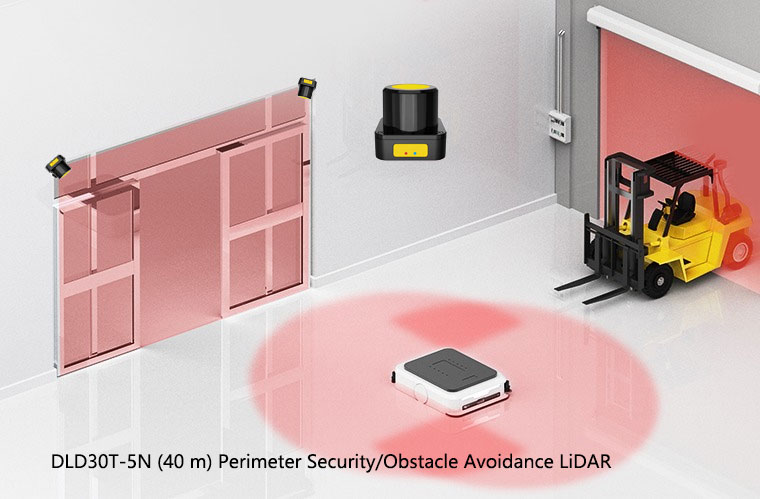
A safety laser scanner sweeps a horizontal plane and monitors a 2D zone across the floor. That zone is configured as nested fields:
The protective field is the inner, safety-critical zone. Anything detected inside it switches the safety outputs and stops or halts the machine.
The warning field is a larger outer zone. An intrusion there triggers a non-safety reaction first — slow down, sound a horn, flash a light — before a hard stop is needed.
Catching an approach in the warning field and easing off, instead of waiting for a protective-field hard stop, is what keeps an AGV or a cell productive rather than constantly slamming to a halt. A capable scanner supports multiple field sets that switch with the situation — for example a longer protective field when an AGV drives fast and a shorter one when it slows or turns.
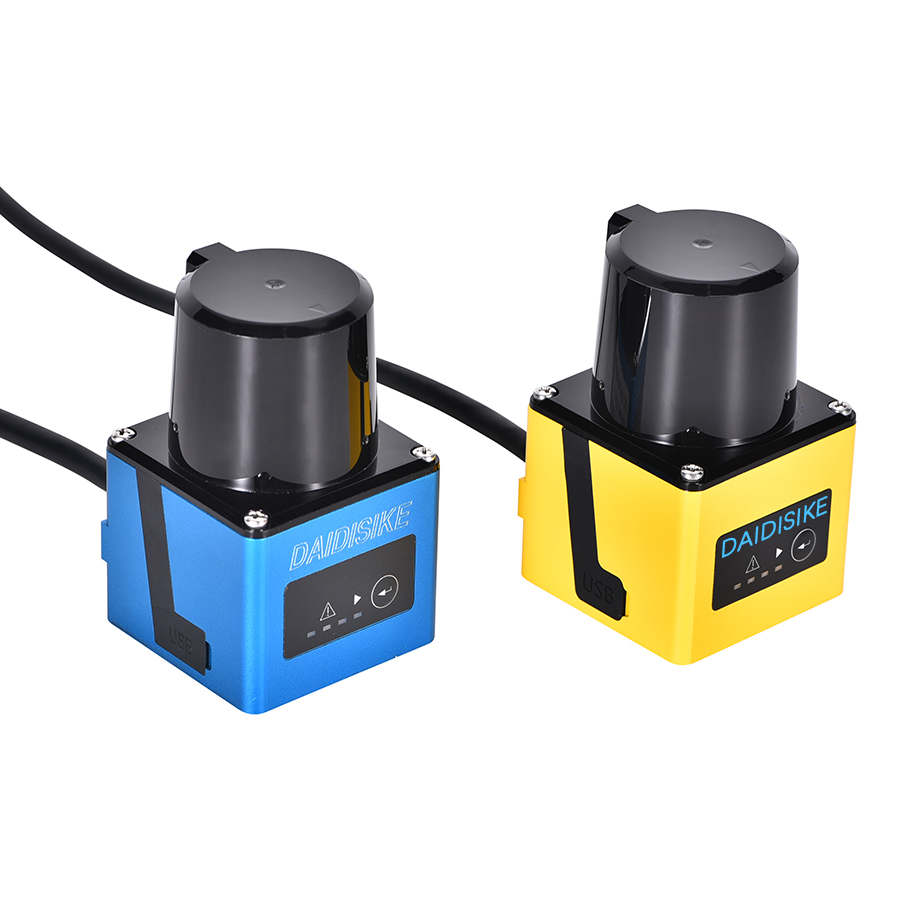
DAIDISIKE DLD05A3 (5 m) and DLD20A5 (20 m) obstacle-avoidance scanners — sized to the AGV’s speed and stopping distance.
Choosing the range
Range should follow the application, not ambition. The protective range has to cover the machine’s stopping distance with margin — beyond that, excess range mostly adds cost and picks up background clutter you then mask out.
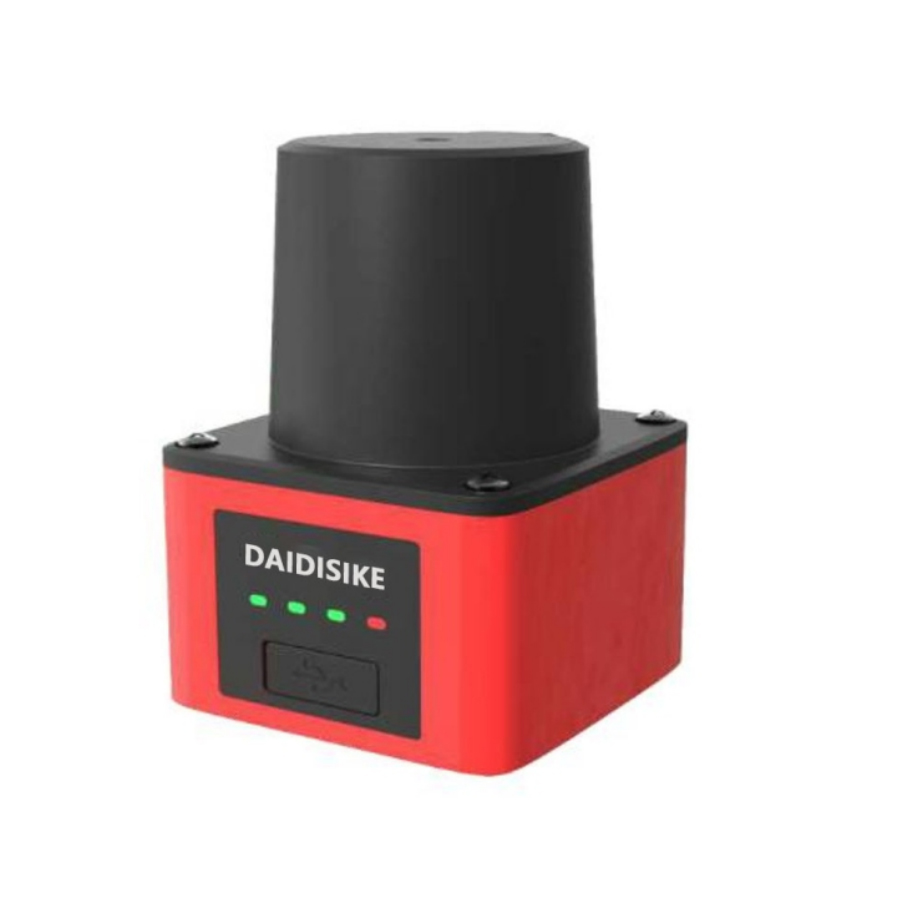
The DAIDISIKE SDLD-05A 14 m TOF scanner — sized for AGV hazard-area monitoring.
The other specs that matter
Scan angle — the angular field of view, often around 270°. It must cover every direction a hazard can come from for that mounting position.
Response time — how quickly an intrusion becomes a stop command. It feeds directly into the safety distance, the same way light-curtain response time does.
Detection capability — the smallest object, and the lowest-reflectivity object, the scanner is guaranteed to detect. A leg in dark trousers is a harder target than a bright test piece.
IP rating and environment — an indoor obstacle-avoidance scanner and an outdoor perimeter scanner are different product classes. Match the rating to where the unit will actually live, including rain, fog and dust tolerance.
Interfaces and field switching — OSSD safety outputs for the protective function, plus the I/O or network needed to switch field sets with vehicle speed or cell state.
Scanner or light curtain?
A last point, because the two devices are often weighed against each other. They guard different shapes. A safety light curtain guards a plane — a defined opening someone passes through. A laser scanner guards an area — a floor zone, open access, moving vehicles. A machine with a clear access opening usually wants a light curtain; an open-footprint cell or a mobile robot wants a scanner; many installations use both. Decide by the shape of the space and every route a person can take to the hazard — not by which technology is newer.
Choose the class first, the range to the stopping distance second, the fields and environment rating third. Do it in that order and an industrial LiDAR scanner is a straightforward, reliable purchase — do it backwards, starting from a range number, and you risk either wasted budget or, far worse, a machine that is not actually safe.
What is the difference between a safety LiDAR and a navigation LiDAR?
They look similar and are easy to confuse, but they do different jobs. A safety laser scanner is a certified protective device — built and tested to IEC 61496-3, it provides self-monitored dual OSSD safety outputs and is designed to stop a machine before a person is hurt. A navigation LiDAR is a sensing device for mapping, localisation (SLAM) and general obstacle awareness; it is accurate and useful, but it is not a safety-rated device and must never be relied on as the protective layer that keeps people safe. The cardinal rule: navigation LiDAR can help a vehicle drive, but only a certified safety laser scanner may be trusted to protect people. Mixing the two up is the single most dangerous and most common mistake in LiDAR selection.
What are protective fields and warning fields on a safety laser scanner?
A safety laser scanner monitors a two-dimensional zone across the floor, and that zone is configured as nested fields. The protective field is the inner, safety-critical zone: anything detected inside it triggers the safety outputs and stops or halts the machine. The warning field is a larger outer zone: an intrusion there triggers a non-safety reaction — a slowdown, a horn, a light — before a hard stop is needed. Catching an approach in the warning field and slowing down, rather than waiting for a protective-field stop, is what keeps a vehicle or cell productive instead of constantly hard-stopping. Good scanners support multiple field sets that switch with the situation, for example a different protective field for each speed of an AGV.
How much LiDAR range do I actually need?
More range is not automatically better — it should match the application. For obstacle avoidance on a compact AGV in tight aisles, a 5 m class scanner is often the right protective range; a faster AGV or a larger AMR that needs more stopping distance suits a 20 m class device. Fixed-perimeter security and large area guarding — fence lines, vehicle lanes, outdoor boundaries — is where a long-range scanner of 40 m or more earns its place. The protective range has to be long enough that the field, plus the machine's stopping distance, keeps people clear; beyond that, excess range mainly adds cost and can pick up clutter you then have to mask out. Size the range to the stopping distance and the space, not to the biggest number on the datasheet.
Can one LiDAR scanner replace safety light curtains on a machine?
Sometimes, but they are not interchangeable — they guard different geometries. A safety light curtain guards a defined plane: a fixed opening an operator passes through. A safety laser scanner guards an area: a horizontal floor zone, ideal for open footprints, walk-in access and moving vehicles. A machine with a clear, defined access opening is usually best served by a light curtain; a cell with an open floor area, or a mobile robot, needs a scanner. Many installations use both. The right question is not 'curtain or scanner' but 'what shape is the space I need to protect, and what are all the ways a person can reach the hazard'.
Do safety laser scanners work outdoors and in dust or fog?
It depends on the model and the rating. Indoor obstacle-avoidance scanners are designed for clean factory air. Outdoor and harsh-environment use — perimeter security, yards, ports — needs a scanner specified for it: a suitable IP rating against water and dust, and signal processing that tolerates rain, fog and airborne particulate without nuisance trips. Long-range outdoor perimeter LiDAR is a distinct product category from a compact indoor AGV scanner. Match the environment rating to where the device will actually live; an indoor-rated scanner mounted outdoors will either fail early or trip constantly.
What standards apply to industrial safety laser scanners?
The core product standard for a safety laser scanner is IEC 61496, specifically IEC 61496-3 for active opto-electronic protective devices responsive to diffuse reflection (AOPDDR) — the family a scanner belongs to. The required safety performance of the overall function is set by ISO 13849-1 (Performance Level) or IEC 62061 (SIL), driven by a risk assessment. For mobile applications, ISO 3691-4 governs driverless industrial trucks and ANSI/RIA R15.08 covers industrial mobile robots in North America. When you specify a scanner for a safety function, confirm it is certified to IEC 61496-3 and that its safety rating meets the PL or SIL your risk assessment requires.
About DAIDISIKE: Foshan-based long-established industrial safety sensor manufacturer. The DLD-series laser scanners — DLD05A3 (5 m), DLD20A5 (20 m), DLD30T-5N (40 m perimeter) and the SDLD-05A 14 m TOF scanner — cover AGV/AMR obstacle avoidance and perimeter protection, alongside the DAIDISIKE safety light curtain range. Specifying a scanner for an AGV fleet or a perimeter? Talk to our engineering team or browse the DAIDISIKE LiDAR scanner range.