
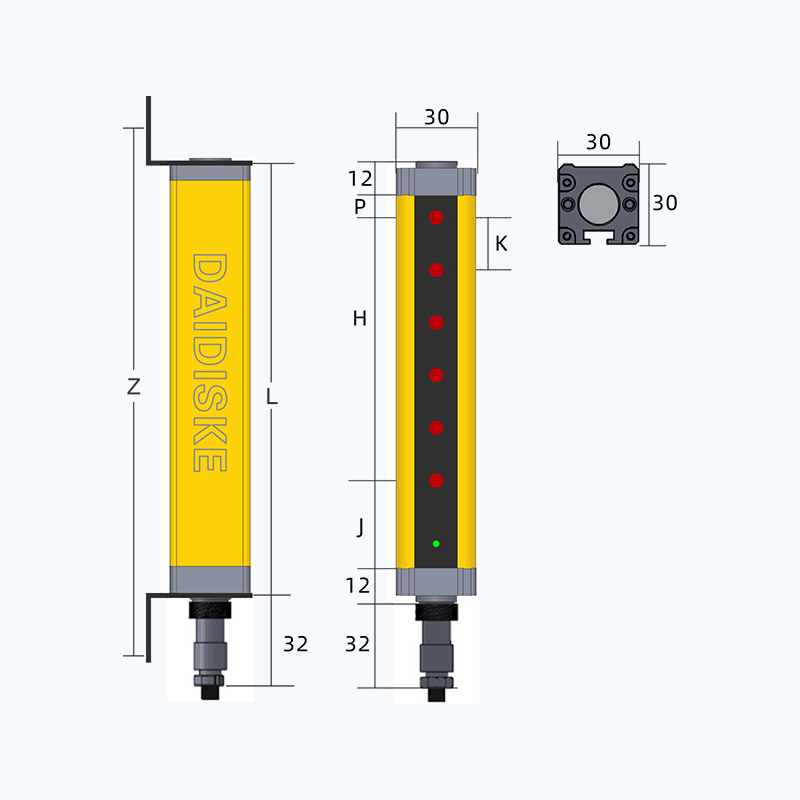
We already keep cross-reference notes for Omron, Keyence, SICK and Pilz curtains, because those are the brands customers most often arrive with. The next four names that come up — Banner, Leuze, Datalogic and Schmersal — deserve the same treatment, so here it is, built the same way: from each manufacturer's own published specifications, not from anyone's manual or marketing.
A blunt point before the detail. A “replacement” for a safety light curtain is not a part number you look up and drop in. It is a match on four numbers — resolution, protective field height, range, and output/OSSD scheme — followed by re-bracketing, re-pinning and a fresh ISO 13855 distance check. When those four numbers line up and the response time is equal or faster, the swap is sound. When they don't, no badge swap makes it safe. Everything below is about getting those four numbers right.
How does a DAIDISIKE DQC replace a Banner EZ-SCREEN LS?
The DQC matches the EZ-SCREEN LS on Type 4 architecture, finger and hand resolutions, and OSSD with EDM; the differences are mechanical (brackets, connectors) and maximum range. Banner's EZ-SCREEN LS is a Type 4 curtain to IEC 61496, certified Category 4 / PL e (EN ISO 13849-1) and SIL3 / SILCL3 (IEC 61508 / IEC 62061), in three resolutions — 14 mm finger, 23 mm hand and 40 mm hand/body — with a maximum sensing range up to 12 m, EDM and cascading of up to four systems. Tubular models come in seven protective heights from 280 to 1050 mm, with 5-pin and 8-pin connector variants and an IP69-rated hygienic option.
The DAIDISIKE DQC is built to the IEC 61496-1/-2 Type 4 architecture, with resolutions of 10/14/20/25/30/40/80/200 mm, dual-channel NPN/PNP OSSD with EDM, IP65, ambient-light immunity of 10,000 Lux or better, and a response time of 15 ms or less. The 14 mm finger and the hand resolutions map straight across. Two things you design for: the EZ-SCREEN LS's defined protective heights and 5-pin/8-pin connectors mean new brackets and a re-pin, and the DQC's standard range is 0.3–3 m (0.3–6 m option), so a long-throw EZ-SCREEN LS install near its 12 m maximum is a job for the DAIDISIKE DQT, not the DQC.
What is the DAIDISIKE equivalent of a Leuze MLC 500?
The DQC matches the MLC 500 for finger and hand protection at short to medium range; coarse, long-range MLC builds map to the DQT. Leuze's MLC 500 is the Type 4 member of the MLC family. Check the label first, because the MLC 300 sold alongside it is only Type 2, and the two are not interchangeable for a Type 4 guarding job. The MLC 500 comes in 14, 20, 30, 40 and 90 mm resolutions, with operating ranges that track resolution (about 0–6 m at 14 mm, 0–14 m at 20 mm, 0–9 m at 30 mm, and 0–20 m at 40 and 90 mm). It uses two PNP OSSD outputs, 24 V DC ±20%, a response time around 23 ms at 14 mm, and protective field lengths from 150 to 3000 mm. Emitter and receiver can run on cables up to 100 m.
For the 14–30 mm resolutions over short to medium range, the DQC is the direct equivalent: Type 4, the matching resolutions in its set, PNP-capable dual-channel OSSD with EDM, and a response time of 15 ms or less — faster than the MLC 500's ~23 ms at 14 mm, which keeps your ISO 13855 distance conservative. Where the MLC 500 is doing coarse-resolution work at long range — 40 or 90 mm out toward 20 m — that is outside the DQC's reach and belongs on the DQT (10/20/40/80 mm, 0.3–6 m option). Pull the resolution and the protective field length off the original; that pair tells you DQC or DQT.
Is there a DAIDISIKE alternative to the Datalogic SE4 / SE4-Plus?
Yes — the DQC's two best-selling resolutions, 14 mm and 30 mm, are precisely the SE4/SE4-Plus resolutions, with a matching OSSD-plus-EDM interface. Datalogic's SE4 / SE4-Plus (SafEasy) is a Type 4 family in 14 mm finger and 30 mm hand resolutions, with operating range up to roughly 6 m for finger and up to about 15 m for hand depending on model. The SE4-Plus carries 2 PNP OSSD outputs (2 NPN on request), 24 V DC ±20% supply and integrated EDM, with blanking and master/slave cascade models. Datalogic also markets the SG4 Type 4 through-beam multibeam family for finger and hand detection alongside the SE4 series.
The DQC maps cleanly onto the SE4/SE4-Plus 14 mm and 30 mm units: same Type 4 class, and dual-channel NPN/PNP OSSD with EDM that is functionally equivalent at the wiring interface (PNP default, NPN available, just as Datalogic offers NPN on request). Match the SE4's protective field height with the DQC's ordered length and re-pin to the DAIDISIKE 5-core/7-core scheme. If the original was actually an SG4 multibeam set — a handful of discrete beams at a fixed pitch rather than a continuous field — send us the beam count and pitch so we reproduce the geometry, not just the resolution figure.
Can I replace a Schmersal SLC 440 with a DAIDISIKE curtain?
For finger and hand protection, yes; mind two real differences — the SLC 440 is IP67 versus the DQC's IP65, and its on-board display and blanking set are Schmersal-specific. The Schmersal SLC 440 is a Type 4 curtain in 14 mm and 30 mm resolutions, with protective field heights from 170 to 1770 mm, two OSSD outputs, and an integrated 7-segment message display. Its standard feature set includes fixed and floating blanking, blanking with a movable edge, double reset, contactor control (EDM), beam coding, and automatic / restart-interlock modes, rated up to IP67.
The DQC matches the 14/30 mm resolutions and the Type 4 / dual-OSSD / EDM core, and it carries beam coding for adjacent-system immunity. Two honest caveats so nobody is surprised on the bench. First, DAIDISIKE rates the DQC at IP65; if your SLC 440 was specified at IP67 for a genuine reason — not just because it came that way — tell us, because that may push you toward a sealed build. Second, the SLC 440's on-board 7-segment diagnostic display and its particular blanking variants are Schmersal-specific; confirm which of those your machine's safety logic and your maintenance team actually depend on before you swap, so the replacement keeps the functions that matter and you are not paying for ones that don't.
Which DAIDISIKE model matches which curtain?
DQC for the shared 14/30 mm finger-and-hand resolutions at up to 0.3–6 m; DQT for the coarser 20/40/80 mm, longer-range cases. This table is a starting map from public specs, not a drop-in part number. Always confirm against the original unit's datasheet.
| Original curtain | Type / class | Common resolutions | DAIDISIKE match |
|---|---|---|---|
| Banner EZ-SCREEN LS | Type 4, Cat 4 / PL e, SIL3 | 14 mm finger, 23 mm & 40 mm hand/body | DQC (14/30 mm); DQT for long range / 40 mm |
| Leuze MLC 500 | Type 4 (MLC 300 = Type 2) | 14, 20, 30, 40, 90 mm | DQC (14–30 mm); DQT (40/90 mm, long range) |
| Datalogic SE4 / SE4-Plus | Type 4 | 14 mm finger, 30 mm hand | DQC (direct 14/30 mm match) |
| Schmersal SLC 440 | Type 4 | 14 mm, 30 mm | DQC (14/30 mm; note IP65 vs IP67) |
The pattern is the same across all four brands: they converge on 14 mm finger protection and a ~30 mm hand resolution for point-of-operation guarding, with dual-channel OSSD and EDM as the safety interface, all to IEC 61496 Type 4. That is the same envelope the DAIDISIKE DQC hand-guard was built for. The divergence is at the edges — long throw, coarse resolution, sealed housings, brand-specific diagnostics — and that is where you either move up to the DQT or specify a particular build. We did exactly this exercise for the F3SG line in our Omron F3SG-SR replacement comparison, and the method carries over unchanged.
Is naming these brands legal, and how do you keep the comparison honest?
Naming a competitor's product to describe a compatible alternative is nominative reference and is legitimate; the comparison stays honest by using only each vendor's published specs. We reference Banner, Leuze, Datalogic and Schmersal by name to tell you what the DAIDISIKE equivalent is — that is normal, lawful comparison. What we deliberately do not do: we don't reproduce their operating manuals, we don't use their trademarks or logos as our own, and we don't quote a parameter we can't confirm from their public datasheet. Every figure above is from the manufacturer's own specifications. The DAIDISIKE figures are from our spec sheets. If a number isn't verifiable, it isn't in the table — which is also why a couple of the entries above say “confirm against the original unit” rather than pretending to a precision we don't have for your specific build.
Send us the four numbers off your installed curtain — resolution, protective height, range, output type — plus the connector and supply voltage, and we will tell you the DQC or DQT that matches, or tell you plainly if it doesn't. Our full method and the other brand cross-references live in the brand replacement & compatibility guide.
Sources & specifications cited
- Banner Engineering — EZ-SCREEN LS series — Type 4, 14/23/40 mm, range to 12 m, EDM, cascading.
- Leuze — MLC safety light curtains — MLC 500 Type 4 (MLC 300 Type 2); 14/20/30/40/90 mm.
- Datalogic — SafEasy SE4 / SE4-Plus specifications — Type 4, 14 mm finger / 30 mm hand, 2 PNP OSSD, EDM.
- Schmersal — SLC 440 safety light curtain — Type 4, 14/30 mm, 170–1770 mm, blanking, IP67.