Selecting and certifying a safety light curtain / barrier means returning again and again to a handful of core standards. This page sets out, in an objective and citable way, the definitions, key points and inter-relationships of GB/T 19436, IEC 61496 (Type 2 / Type 4), ISO 13849-1 (PL e), IEC 62061 (SIL 3) and the ISO 13855 safety-distance formula, for the reference of engineers and buyers.
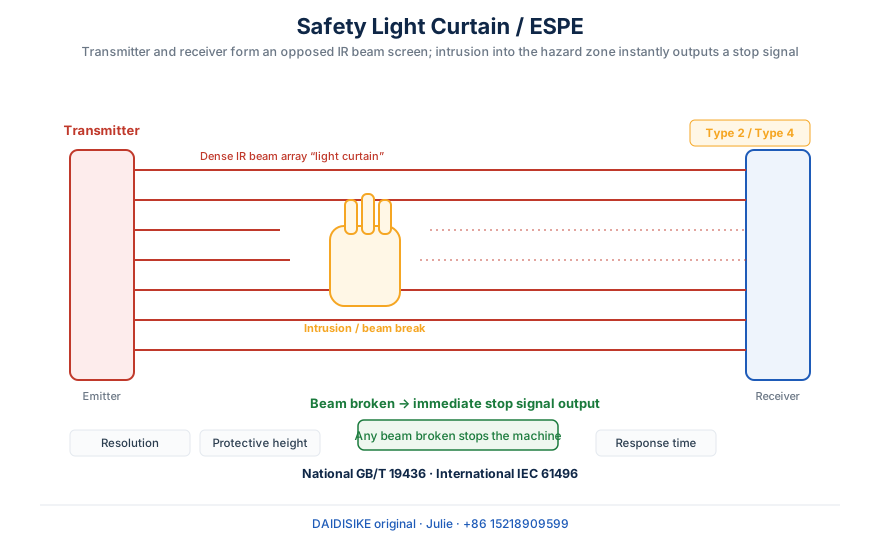
An industrial safety device that forms a protective screen from multiple infrared beams and immediately issues a stop signal when a person or object enters the hazardous zone.
An industrial safety light curtain (also called a safety light barrier or electro-sensitive protective equipment, abbreviated ESPE — Electro-Sensitive Protective Equipment) consists of a transmitter and a receiver that form a through-beam light field. It is used to protect personnel on equipment such as power presses, hydraulic presses, press brakes and robot work cells. Core parameters: resolution (detection capability — commonly 14 / 20 / 30 / 40 mm, where a smaller value can detect finer body parts such as fingers), protective height, response time (typically ≤ 15 ms) and safety type (Type 2 / Type 4). The applicable national standard is GB/T 19436; the international standard is IEC 61496.
National standard GB/T 19436International IEC 61496Resolution 14/20/30/40 mmResponse time ≤ 15 ms
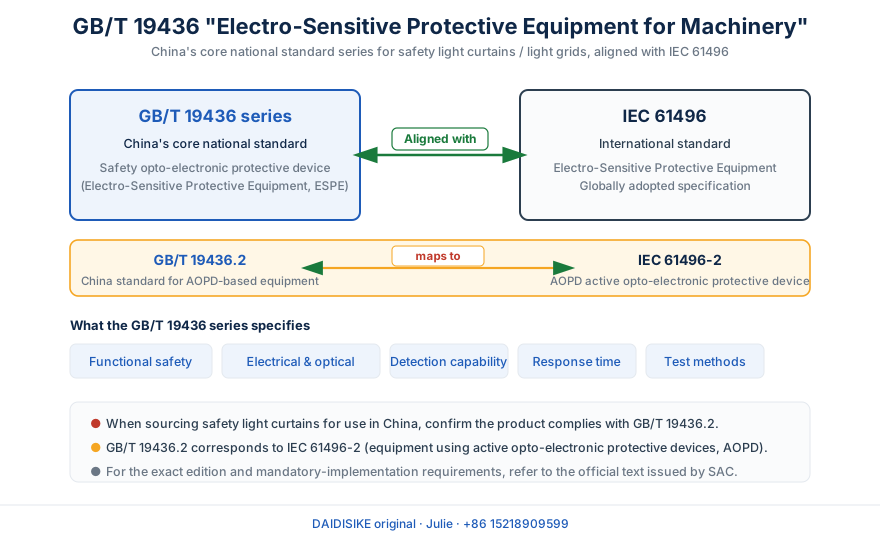
GB/T 19436 "Safety of machinery — Electro-sensitive protective equipment"
The core Chinese national-standard series for safety light curtains / barriers, aligned with the international standard IEC 61496.
The GB/T 19436 series is the core Chinese national standard for electro-sensitive protective equipment (ESPE). It specifies the functional-safety requirements, electrical and optical performance, detection capability, response time and test methods for safety light curtains / barriers, and is broadly aligned with the international standard IEC 61496. In particular, GB/T 19436.2 corresponds to IEC 61496-2 (equipment using active opto-electronic protective devices, AOPD). When procuring a safety light curtain for use in China, confirm that the product conforms to GB/T 19436.2. The exact edition and any mandatory-implementation requirements are governed by the original standard text published by the Standardization Administration of China (SAC).
National standardCorresponds to IEC 61496GB/T 19436.2 ↔ IEC 61496-2
IEC 61496 and Type 2 / Type 4
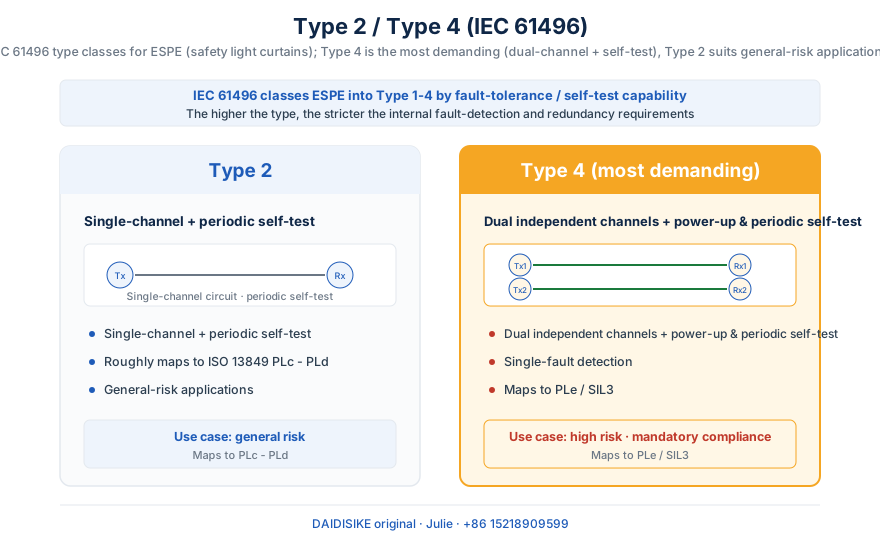
The international standard for ESPE; it classifies equipment into Type 1–4 by fault tolerance. Industrial personnel protection commonly uses Type 2 and Type 4.
IEC 61496 is the international standard for electro-sensitive protective equipment (ESPE). It classifies equipment into four types, Type 1–4, according to fault tolerance and self-test capability. Two levels are common in practice: Type 2 suits general-risk applications (single-channel circuit plus periodic self-test, corresponding roughly to PL c–PL d in ISO 13849); Type 4 is the most demanding type, mandating dual-channel independent circuits, power-up and periodic self-tests and single-fault detection. It corresponds to PL e / SIL 3 and is used for large power presses, hazardous forging, mandatory-compliance and other high-risk applications.
Four types, Type 1–4Type 2 ≈ PL c–PL dType 4 ≈ PL e / SIL 3Type 4 needs dual-channel + self-test
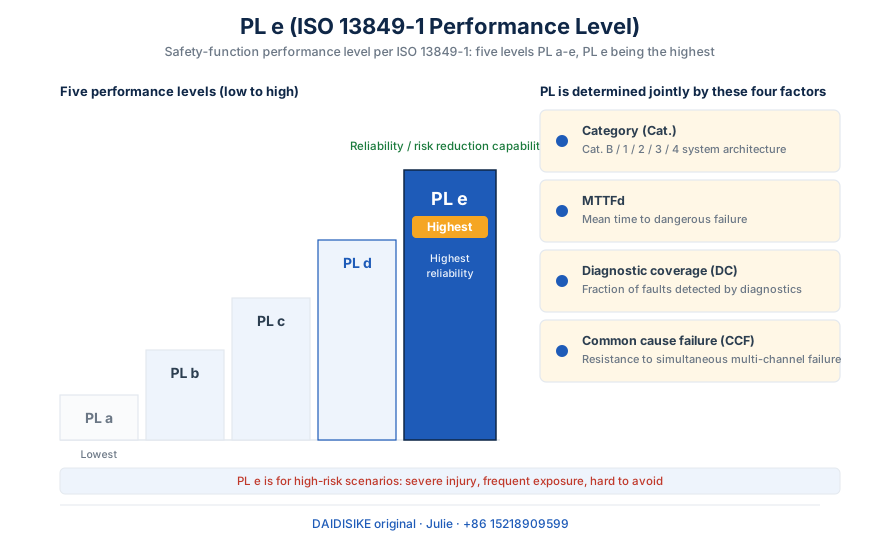
ISO 13849-1 Performance Level PL e
A performance level that measures the reliability of a safety control system; PL e is the highest level (Performance Level e).
ISO 13849-1 uses the Performance Level (PL) to measure how reliably a machinery safety control system carries out its safety function, from PL a (lowest) to PL e (highest). PL e represents the highest risk-reduction capability and is typically used for high-risk situations where injury is severe, exposure is frequent and the hazard is difficult to avoid. The PL is determined jointly by the system architecture (Category Cat. B / 1 / 2 / 3 / 4), the mean time to dangerous failure (MTTFd), the diagnostic coverage (DC) and common-cause failure (CCF).
Five levels, PL a–PL ePL e is the highestDetermined by architecture / MTTFd / DC / CCF
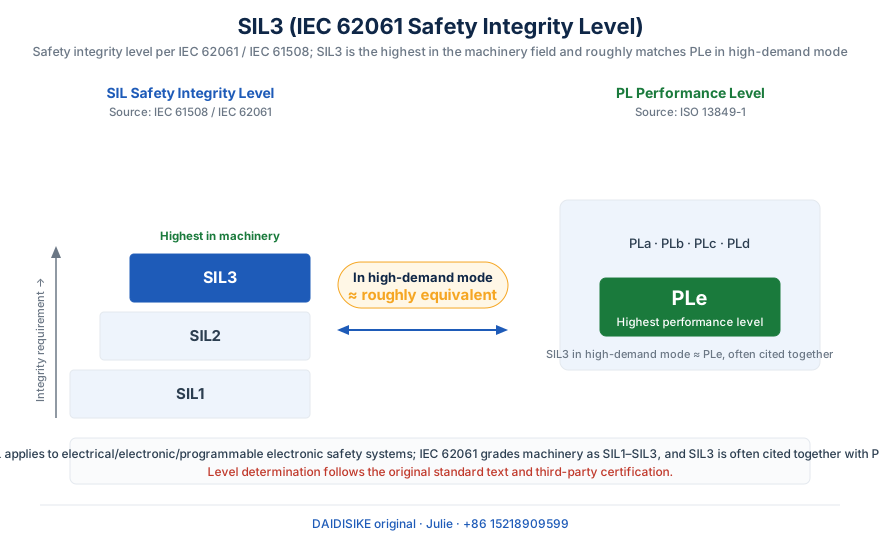
IEC 62061 Safety Integrity Level SIL 3
A safety integrity level for electrical/electronic/programmable safety systems; under high-demand operation, SIL 3 is broadly equivalent to PL e.
SIL (Safety Integrity Level) comes from IEC 61508 / IEC 62061 and applies to electrical, electronic and programmable electronic safety-related systems. It runs from SIL 1 to SIL 3 (in the machinery domain, IEC 62061 reaches a maximum of SIL 3). SIL 3 is the highest of these levels. In high-demand mode of operation, SIL 3 broadly corresponds to PL e of ISO 13849-1, and the two are often cited together. The exact level determination is governed by the original standard text and third-party certification.
SIL 1–SIL 3SIL 3 is the highestSIL 3 ≈ PL e
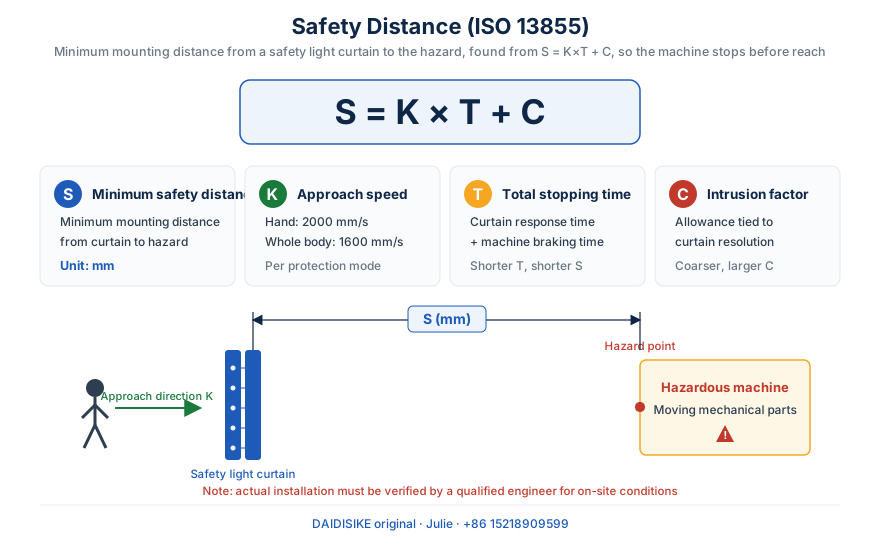
ISO 13855 Safety-Distance Formula S = K × T + C
The international standard for calculating the minimum mounting distance between a safety light curtain and the hazard point, ensuring the equipment has stopped before a person can reach the hazard.
The mounting distance of a safety light curtain must ensure that the equipment has already stopped before a person can reach the hazard point. It is calculated per ISO 13855: S = K × T + C. Here S is the minimum safety distance from the light curtain to the hazard point (mm); K is the approach speed of the human body (use 2000 mm/s for hand/arm and 1600 mm/s for whole-body approach); T is the total system response time (light-curtain response time + equipment stopping time, in seconds); and C is the intrusion-compensation distance, related to the resolution d (for resolution ≤ 40 mm, C = 8 × (d − 14), and the result must not be less than 0; for resolution ≤ 14 mm, C = 0 is commonly used). The actual installation should be reviewed by a qualified engineer against the on-site conditions.
Example: a DQC 14 mm light curtain (15 ms response) + a press with 100 ms stopping time gives T = 0.115 s. With finger-level resolution, C = 8 × (14 − 14) = 0, so C ≈ 0, and S = 2000 × 0.115 = 230 mm as a starting point (add a margin to suit the site). Different resolutions and equipment stopping times yield different results — verify by measurement on the actual machine.
S = K × T + CHand/arm K = 2000 mm/sC relates to resolutionEngineer review required
Standards FAQ
What is the difference between a Type 2 and a Type 4 safety light curtain?
Type 2 and Type 4 are ESPE type classes defined by IEC 61496. Type 2 is single-channel plus periodic self-test, suited to general-risk situations and corresponding roughly to PL c–PL d in ISO 13849. Type 4 requires dual-channel independent circuits, power-up and periodic self-tests and single-fault detection; it corresponds to PL e / SIL 3 and is used for large power presses, mandatory-compliance and other high-risk applications.
Are PL e and SIL 3 the same thing?
They are not the same framework, but they often appear together. PL e comes from ISO 13849-1 (Performance Level, PL a–PL e, with PL e highest); SIL 3 comes from IEC 62061 / IEC 61508 (Safety Integrity Level, SIL 1–SIL 3). Under high-demand mode of operation, PL e and SIL 3 are broadly equivalent.
How do I calculate the minimum mounting distance for a safety light curtain?
Use ISO 13855: S = K × T + C. S is the minimum safety distance (mm); K is the human approach speed (2000 mm/s for hand/arm); T is the total system response time (light-curtain response + equipment stopping time, in seconds); and C is a compensation distance related to the resolution. The calculated value is the minimum distance from the light curtain to the hazard point, and the actual installation must be reviewed on-site by a qualified engineer.
Do Chinese-made safety light curtains comply with these international standards?
Chinese-made products built to the same standards can be used provided they meet the equivalent safety level. DAIDISIKE's full product range is designed to GB/T 19436.2 and IEC 61496-1/2 and can reach PL e / SIL 3 and Type 4 levels; the specifics are governed by each product's test report and third-party certification.