
A safety engineer at one of the new US fabs put it bluntly last quarter: “The hard part is not the EUV scanner. ASML delivered that with the safety already wrapped around it. The hard part is the twenty pieces of ancillary equipment between the stocker and the EFEM that we have to make play together — and every one of them has to pass the same SEMI S2 walk-through the prime tools do.” That is the conversation this article is for.
By mid-2026 the new-fab construction wave is no longer hypothetical. TSMC Arizona’s Phase 1 is in full 4 nm and 5 nm volume production at reported yields rivalling Taiwan. Samsung’s Taylor, Texas site has moved past first-light on its ASML EUV tools and is ramping toward 50,000 wafer starts per month. Intel’s Ohio One has slipped to 2030–2031 first production but the construction itself ran heavy through 2025. TSMC Japan (JASM), Rapidus in Hokkaido, and SMIC’s mainland China expansions are layered on top. All of those projects are buying ancillary equipment from someone, and a meaningful portion of that equipment needs safety sensors that survive a SEMI review.
The SEMI standards an integrator actually has to read
Four of the SEMI EHS safety guidelines come up repeatedly when an integrator builds anything that lives in or beside a 300 mm fab. They are guidelines, not regulations — but every major fab buyer treats compliance as contractual.
- SEMI S2 — Environmental, Health and Safety Guideline for Semiconductor Manufacturing Equipment. The umbrella document, currently SEMI S2-0724 (the July 2024 revision rolled up roughly nine pending changes from a multi-year effort). Covers fire, electrical, mechanical, chemical, radiation, noise and ergonomic hazards across the install, operate and maintain phases. A third-party SEMI S2 report is what most fabs ask for before signing for the tool.
- SEMI S8 — Safety Guidelines for Ergonomics Engineering. Reach, force, posture, display height and lockout-tagout access. Safety sensor relevance: where you mount the light curtain, how the operator interacts with the muted zone, and whether the reset button is reachable from the hazard side (it must not be).
- SEMI S14 — Safety Guideline for Fire Risk Assessment and Mitigation. Drives material choices and ignition-source design across the equipment. The assessor will ask about housing material, cable jacket compound, and any switching component that could be a source. Plastic-housing curtains often get flagged here; metal housings rarely do.
- SEMI S22 — Safety Guideline for the Electrical Design of Semiconductor Manufacturing Equipment. Consolidated the older SEMI S9 verification tests. Sets electrical safety, isolation and verification requirements for the equipment as a whole. A safety light curtain’s own electrical type test (IEC 61496-1/2) does not substitute for the SEMI S22 review of the cabinet it lives in.
Note what that list does not say. None of these documents dictate a specific brand or model of safety light curtain or laser scanner. They set the surrounding requirements — cleanroom compatibility, fire risk, electrical isolation, ergonomic install — that the integrator’s chosen device has to fit inside. The product standard for the device itself is still IEC 61496-1/2 for light curtains and IEC 61496-3 for safety laser scanners, with the safety function evaluated against ISO 13849-1 (PL) or IEC 62061 (SIL).
Where OEM-locked safety dominates — and where it does not
Be honest with yourself about the actual scope. The list below is the realistic split we see across new-fab tool buys in 2025-2026.
| Equipment | Safety scope | Integrator-procured sensors realistic? |
|---|---|---|
| EUV / DUV lithography (ASML) | Fully OEM-integrated, SEMI S2 evaluated | No — do not touch |
| Etch (Lam, AMAT, TEL) | OEM-integrated | No — do not touch |
| Deposition / CMP / Implant | OEM-integrated | No — do not touch |
| EFEM (front end module) | Usually OEM with integral curtains | Sometimes — custom extensions |
| Sorters, stockers, custom load ports | Often integrator-built | Yes — primary scope |
| OHT floor drop zones | Floor side is integrator-defined | Yes — horizontal scanner role |
| Wafer test / probe / handlers | Mixed; many integrator-built | Yes |
| Assembly / packaging cells | Largely integrator-built | Yes — conventional cell guarding |
| Sub-fab utility skids | Integrator-built; SEMI S14 sensitive | Yes — sealed devices |
The pattern: the closer the equipment is to a single big-OEM tool identity, the less integrator-procured safety hardware fits on it. The further out you go — into transport, handling, test and sub-fab — the more conventional Type 4 light curtains and safety laser scanners become the right answer.
Cleanroom compatibility — what actually matters
The wafer-handling cleanroom is typically ISO 14644-1 Class 5 or better; photolithography areas can be Class 1 or Class 2, which are stringent enough that even worker breathing pattern becomes a design parameter. A safety sensor in those spaces has to clear three practical hurdles.
Particle shedding. The housing must not generate airborne particulate under normal handling and cleaning. Anodized aluminium extrusions are the standard answer; bare painted steel and powder-coat finishes are not, because the coating eventually chalks under repeated wipe-down with IPA. Avoid soft-fabric strain relief on cables. Verify gasketing material is a wipe-down rated elastomer, not foam.
Outgassing. Volatile materials in the housing, potting compound or cable jacket can release low concentrations of organics into the cleanroom return air, which is then recirculated across wafer surfaces. Outgassing data is usually requested for new-introduction equipment in the photolithography cluster. Most industrial safety light curtains do not publish formal outgassing test data, but they can usually provide a bill-of-materials declaration on request — ask for it before you commit.
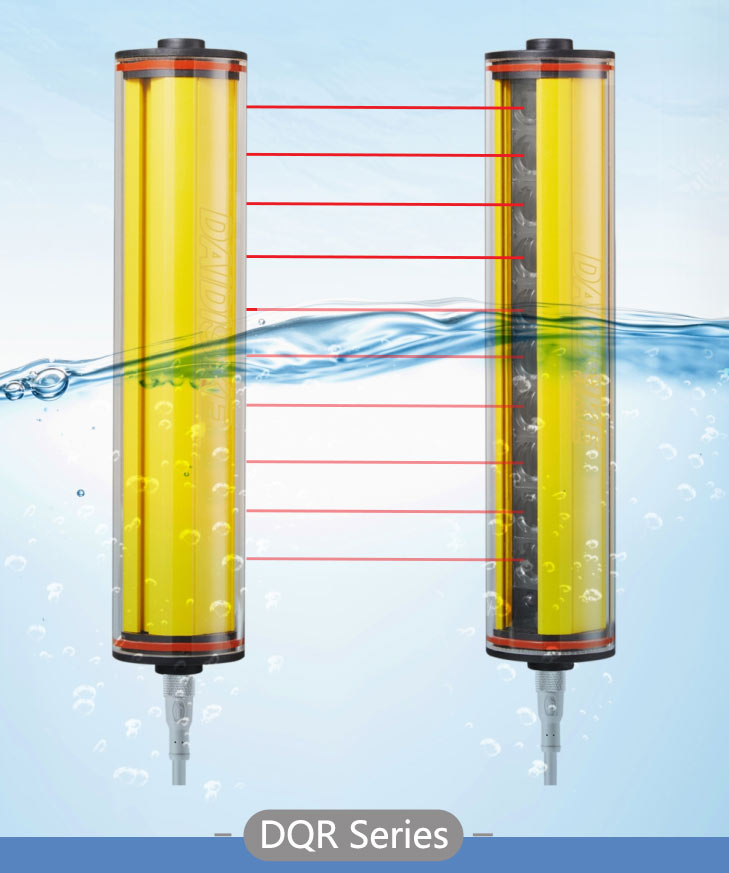
Wipe-down survivability. Cleanroom housekeeping uses IPA, occasional dilute H₂O₂ or aggressive sporicides in biotech-adjacent fabs. A sealed IP65/IP67 housing with no exposed labels and no soft seams will outlast a generic enclosure by years. This is why the sealed-body DQR-class IP68 light curtain is over-specified for most cleanroom-adjacent use — the over-specification is what lets it survive five years of daily IPA wipe.
ESD and EMI — the noisy reality of a fab floor
Two electrical environment problems get conflated and they are different problems.
ESD — protecting the wafer from the sensor. A 300 mm wafer carries hundreds of millions of transistors, and a discharge of ten volts is enough to damage some of them. The fab’s ESD control program will set a target surface resistance for working surfaces in the static-dissipative band, which industry guidance places between roughly 1×10⁵ and 1×10¹¹ ohm per square. A safety sensor’s anodized aluminium housing is naturally insulative and falls outside that band on its own. The fix is not an “ESD-safe” sticker on the datasheet; the fix is bonding the housing to the tool’s equipment ground through a known, short, low-impedance path — and verifying that bond with a meter at install. We have seen too many installs where the curtain mounting bracket is isolated by anodized contact surfaces and the “ground” runs only through the 24 V cable shield. That is not a ground.
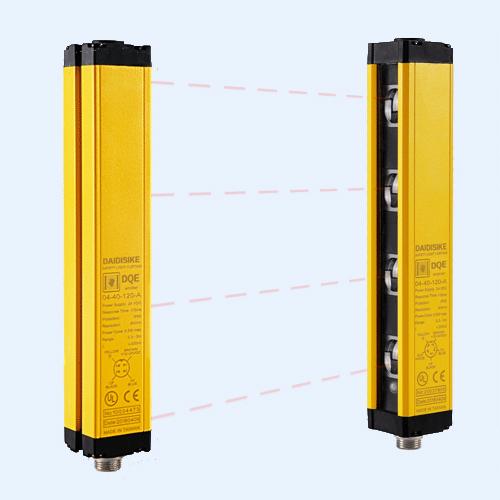
EMI — protecting the sensor from the tool. Plasma etch, ion implant, RF generators and high-power magnetrons radiate. A poorly shielded sensor cable that runs alongside an RF line in a sub-fab cable tray will nuisance-trip, and a curtain that nuisance-trips during a 24-hour wafer run gets bypassed by a frustrated technician. Specify devices with documented IEC 61000-4 immunity (4-2 ESD, 4-3 radiated RF, 4-4 fast transient, 4-6 conducted RF), use foil-and-braid shielded cable terminated 360 degrees at both ends, and route safety cabling on its own tray where you can. Type 4 / PL e devices from established manufacturers, including the DAIDISIKE DQA, DQT4 and DQE families, are designed for this environment, but the install practice has to match the device rating.
SEMI requirement vs. typical safety device feature
When the SEMI S2 walk-through happens, the assessor is not reading your light curtain datasheet line by line. They are checking that the device’s features line up against the surrounding fab requirements. The table below is the cross-reference we hand to integrators starting on their first fab build.
| SEMI requirement / fab driver | Typical safety device feature that satisfies it |
|---|---|
| SEMI S2 mechanical hazard mitigation | IEC 61496-1/2 Type 4 light curtain or 61496-3 safety laser scanner with PL e / SIL 3 capability |
| SEMI S2 ergonomic install (with S8) | Reset button mounted outside the hazard zone with visibility into it; mounting heights per ISO 13855 |
| SEMI S14 fire-risk on materials | Metal (anodized aluminium) housing; LSZH cable jacket; declared bill-of-materials available |
| SEMI S22 electrical isolation / verification | Class III SELV/PELV 24 VDC input; dual OSSD outputs with cross-monitoring; documented type test |
| ISO 14644 Class 5 particle control | Smooth machined housing, wipe-down compatible, no exposed labels or fabric strain relief |
| ESD environment (target dissipative range) | Housing bonded to equipment ground via short low-impedance path; verified at install |
| Fab EMI environment | IEC 61000-4-2/3/4/6 documented immunity; shielded cable; separated cable tray |
| OHT / AMHS drop-zone protection | Horizontal-plane safety laser scanner (IEC 61496-3) with configurable protective and warning fields |
Equipment by equipment — where the sensors actually go
1. EFEM front sides and load-port handlers
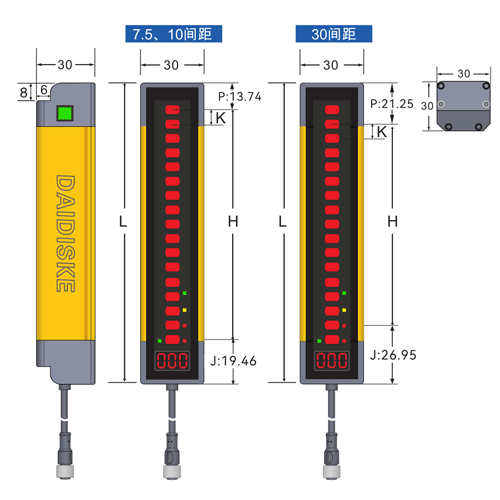
The EFEM is the FOUP-to-process bridge that sits in front of every 300 mm tool. Stock EFEMs from the major suppliers come with integrated front-side safety light curtains as part of the standard design — that is OEM scope, not yours. Where integrators get involved is custom EFEM extensions: a sorter that bolts onto a standard EFEM, a metrology cell that needs an extra load port, or a research-fab handler that does not have an off-the-shelf vendor. A slim Type 4 curtain with 14 mm finger or 25-30 mm hand resolution is the normal answer, mounted on the access face.
2. OHT and AMHS drop zones
The Overhead Hoist Transport system runs above head height; the vehicle itself carries OEM safety. The risk that lands on the integrator’s desk is the drop zone underneath each load port stocker where the FOUP descends. A horizontal-plane safety laser scanner with a configurable protective field around the load port detects an operator stepping into the drop column during an active handoff. We discuss the broader light curtain vs scanner decision separately; for OHT specifically, the scanner is almost always the right tool because the protected geometry is a floor area, not a door plane.
3. Stockers and sorters
Buffer stockers and FOUP sorters live at the boundary between cleanroom and gowning, often partly inside both. They have moving shelves and elevator axes — classic mechanical hazards. A conventional Type 4 light curtain at the operator access door, plus an interlocked guard at the service face, is the right design. The sealed DQR series earns its place here because wipe-down cycles are aggressive.
4. Wafer test and probe handlers
Test floors live in lower-class cleanroom space (often Class 6 or Class 7) and the safety design looks much more like a conventional electronics assembly cell — light curtains on access doors, interlock switches on enclosures, optional muting for tray conveyors. The fab-specific complication is mainly EMI from the tester itself, not cleanroom class.
5. Sub-fab utilities and chemical/gas cabinets
The sub-fab beneath the cleanroom houses pumps, abatement, chemical delivery, gas cabinets and slurry mixing. SEMI S14 dominates here — fire risk drives material and ignition choices — and the IP-rated, fully sealed safety device families belong in this space rather than in the cleanroom proper. Wash-down resistance, metal housings and LSZH cable jackets are the recurring requirements.
The mistakes that get caught
Particle shedding at the gowning audit. A painted-bracket curtain install from a generic machine builder gets installed by mechanics who have done it a hundred times in automotive plants. Then the cleanroom EHS team walks through with a particle counter and the install is rejected. Specify anodized or stainless brackets up front, not after rework.
EMI bypass. A curtain that nuisance-trips three times a shift during plasma processing gets jumpered by night shift. We have seen it. Specify documented IEC 61000-4 immunity, shield the cable properly, and route it separately from RF and high-current lines.
Reset button on the wrong side. A SEMI S8 ergonomic-and-LOTO finding that is trivially preventable: the manual reset for a light curtain function must be located so that the resetter has a clear view of the entire protected zone, and must not be reachable from inside the hazard. This is the same rule as ISO 13849 prescribes, but SEMI S8 makes it explicit and the assessor will look for it.
Treating ESD as a sticker. Already covered above, but it deserves repeating. The ground bond is the safety control; the label is paperwork.
Where DAIDISIKE fits — honestly
A direct answer, since this is our site. DAIDISIKE has built safety light curtains and laser scanners for industrial automation over many years, with deployments in electronics and automotive lines including leading EV manufacturers, global 3C electronics OEMs, home-appliance makers, Tier-1 contract assemblers and display-module producers. The fab market is one we treat as ancillary-equipment scope: we do not sell into the prime EUV / etch / deposition tools, because that is closed OEM territory, and any claim otherwise should be read sceptically regardless of who is making it.
Where our families fit cleanly are the integrator-procured applications described above — the DQA, DQC, DQT4 and DQE Type 4 light curtains for custom EFEMs, sorters, stockers and test handlers; the DQR sealed IP68 light curtain for sub-fab utility skids and aggressive wipe-down areas; and the DLD-series safety laser scanners for OHT drop zones and open-floor handling cells. If you are scoping ancillary equipment for one of the new-fab buildouts and want a second opinion on what is realistic to specify and what is wishful thinking, that is the conversation we are happy to have.
The bottom line
The 2025-2026 fab construction wave has not changed what a safety light curtain does. It has changed where it goes. Prime tools are OEM-locked and SEMI-evaluated as complete systems; the integrator scope sits in the cleanroom periphery and the sub-fab. Specify devices whose materials, electrical immunity and housing construction match the SEMI S2 / S8 / S14 / S22 expectations on the equipment around them, ground them properly so the ESD program is satisfied at the device, and document the install for the audit that will happen. The technology is mature; the discipline is what fab buyers are actually paying for.
Related reading
DAIDISIKE DQR Sealed Light Curtain
IP68 sealed Type 4 light curtain — wash-down and harsh-environment use including cleanroom-adjacent sub-fab areas.
Light Curtain vs Scanner
When to reach for a flat-plane light curtain and when a horizontal-plane safety laser scanner is the right answer.
DAIDISIKE Safety Light Curtain Range
The full DQA, DQC, DQT4, DQE, DQO, DQSA, DQR, MK and JER families at a glance.