The DAIDISIKE DKE-L3 series laser safety device protects against hand-crushing injuries in press brakes and shearing machines. Using multi-point laser beams, it creates safety zones with real-time monitoring and emergency stop functions. Compliant with CE and CAT IV safety standards, it's ideal for sheet metal processing, including high-precision bending and small workpiece operations.
The DAIDISIKE DKE-L3 series laser safety protection device is a specialized anti-hand-crushing protector designed for press brakes and shearing machines, aimed at preventing industrial accidents such as finger or arm injuries during metal processing. This series employs advanced laser safety curtain technology to form protection zones through multi-point laser beams, enabling real-time monitoring and emergency stop functions. The DKE-L3 series complies with international safety standards, such as CE certification and CAT IV safety level, suitable for various sheet metal processing scenarios, including high-precision bending and small workpiece operations.
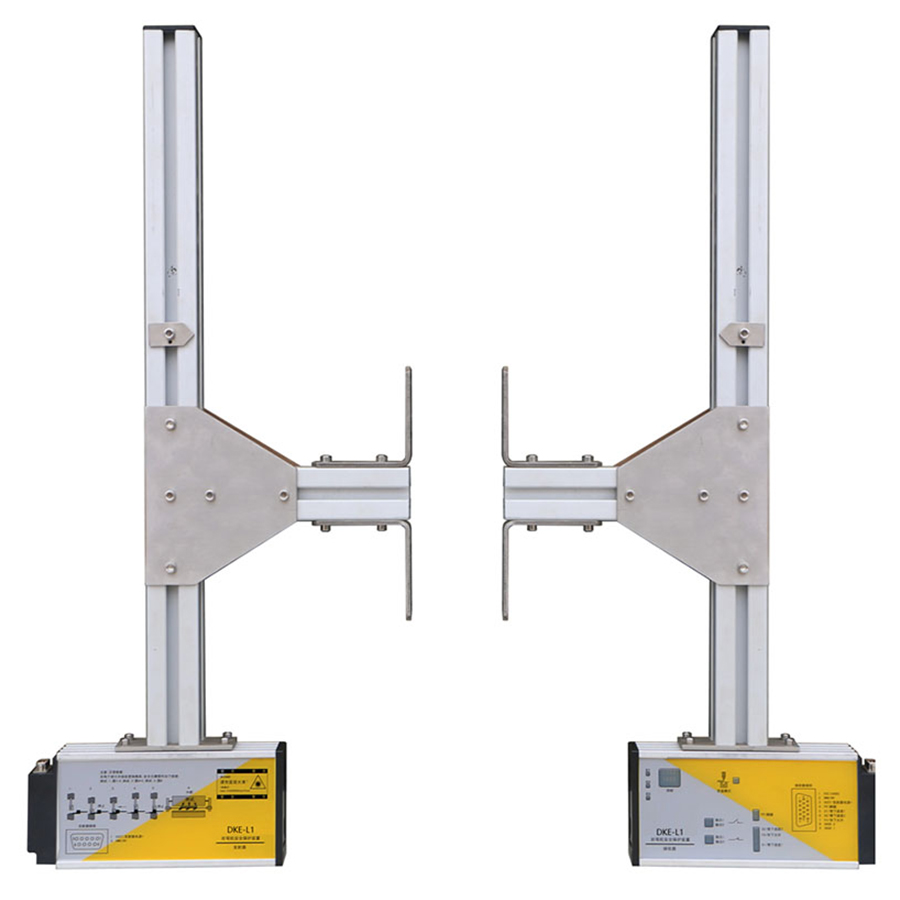
The main components of the product include: laser transmitters (E1, E2, E3), receiver, controller, transmission cables, and mounting brackets. The laser transmitters are installed on the upper die or slider, forming front, middle, and rear protection zones, with laser beams approximately 2-3mm below the die tip, ensuring that during high-speed descent of the slider, any object (such as fingers) must enter the protection zone before contacting the knife tip, thereby triggering machine stop. DKE-L3 supports multiple operation modes, such as Mode 1 (full zone monitoring), Mode 2 (middle zone only, for bending areas), and Mode 3 (front and middle zones, for rear stop finger moving above the mold).
The advantages of this device lie in its short response time (about 5ms), low speed conversion point (5mm + stop distance), which can significantly improve production efficiency while reducing industrial injuries. Mounting brackets can be customized based on machine structure, such as sliding brackets for side-drawing plates, extended beam brackets for mechanical interference, and reversible brackets. DKE-L3 also features additional functions like slow-down shielding and stop distance detection, providing reliable protection during fatigue operations or multi-person collaboration.
In practical applications, DKE-L3 effectively addresses common risks such as operator negligence, inconsistent workpiece placement rhythm, or fatigue work. According to OSHA's laser hazard guidelines, the device evaluates diffraction limitations and thermal damage mechanisms to ensure skin and eyes are protected from laser radiation. The product housing uses sturdy aluminum alloy material, with IP65 protection rating, suitable for operating temperatures from -25°C to 70°C, power consumption below 10W, and supports 12-24V DC power supply.
DKE-L3 Series Specification Table
Parameter Category
Parameter Name
Specification Value
Safety Level
Safety Category
CAT IV (Compliant with CE Standards)
Protection Distance
Max 15m
Power Specifications
Operating Voltage
DC12-24V
Current Consumption
0.3A ±10%
Power
<10W
Environmental Parameters
Operating Temperature
-25°C ~ 70°C
Storage Temperature
-50°C ~ 80°C
Protection Rating
IP65
Physical Dimensions
Laser Beam Height
4.5mm (Adjustable within 15mm)
Resolution
10mm
Housing Size
13-22mm (Height), Installation Gap 10mm
Laser Parameters
Laser Type
Infrared Laser (Invisible Infrared Laser)
Laser Points
3 Points (E1, E2, E3)
Response Time
5ms
Installation Options
Bracket Type
Standard Bracket, Customizable Sliding/Extended/Reversible Brackets
Installation Position
Upper Die Slider or Upper Beam
Function Modes
Operation Modes
Mode 1: Full Zone Monitoring; Mode 2: Middle Zone Monitoring; Mode 3: Front and Middle Zone Monitoring
Additional Functions
Slow-Down Shielding, Stop Distance Detection, Self-Test Function
DKE-L3 Series Technical Parameters
The technical parameters of DKE-L3 are based on the laser safety light curtain principle, emphasizing high-precision monitoring and fast response. Key parameters include:
Laser Wavelength and Power: Uses infrared laser with wavelength about 780nm, output power <1mW, ensuring Class 1 laser safety level (according to EN-IEC 60825-1 standard), with no visible light radiation risk.
Protection Zone Configuration: Front zone monitors finger intrusion, middle zone monitors bending process, rear zone handles rear stop movement. The protection zone synchronously follows the upper die movement, maintaining a 2-3mm gap.
Response Mechanism: When the laser beam is blocked, the controller immediately outputs a stop signal to the machine PLC or relay, with stop distance <10mm, supporting multiple echo analysis to handle rain, fog, or dust environments.
Self-Test Function: The device has fault self-testing, including dirty cover detection, temperature over-standard alarm, and output device self-test information via indicators and TCP packets.
Interfaces and Compatibility: Supports OSSD output, Ethernet interface (for IPC video tracking), and ONVIF protocol. Compatible with various PLC systems like Siemens or Omron, supporting PC-free configuration.
Durability: Anti-sunlight interference, anti-dirty capability, and rain/fog penetration (optional). Vibration resistance complies with IEC 60947-5-3 standard.
Efficiency Impact: After installation, efficiency loss per knife stroke <0.1s, suitable for frequent mold changes or side-drawing operations.
Safety Compliance: Complies with OSHA laser hazard standards (STD 01-05-001), including skin damage mechanism assessment and eye diffraction limitations.
These parameters ensure DKE-L3 provides reliable protection in the metal processing industry while minimizing interference with production processes.
DKE-L3 Series Working Principle
The working principle of DKE-L3 is based on laser beam interruption detection and thermal injury prevention mechanism. The laser transmitters (E1, E2, E3) are installed on the upper die slider, emitting multi-point parallel laser beams to form a rectangular protection light curtain, covering the area 2-3mm below the knife tip. The receiver is installed in the opposite position, monitoring the integrity of the laser beams in real time.
When the press brake or shearing machine's upper slider descends at high speed, the protection zone moves synchronously with the slider. If an operator's finger or other object enters the protection zone, the laser beam is blocked, and the receiver fails to receive the complete signal. At this point, the controller detects the interruption through the photoelectric receiving system and immediately triggers an emergency stop signal. The response time is 5ms, and the machine switches from high speed to low speed or fully stops, with the speed conversion point set to 5mm + machine stop distance.
In multiple echo analysis mode, the device can distinguish reflected echo pulses from atmospheric impurities (such as dust or fog) and real target echoes, ensuring accurate detection in harsh environments. The workflow is as follows:
Initialization: After power-on, the KT switch activates, self-testing laser transmission and reception status.
Monitoring Phase: Laser beams continuously scan the protection zone, with front zone preventing finger intrusion, middle zone monitoring bending, and rear zone handling rear stop movement.
Trigger Response: Upon beam interruption, the controller outputs OSSD signal to the machine control system, stopping slider movement.
Recovery: After removing the obstruction, manual reset or automatic recovery allows the machine to continue operation.
Additional Protection: If stop distance abnormality or cover dirt is detected, the device outputs alarms to prevent potential failures.
This principle complies with machinery safety interlocking device standards (EN ISO 14119), ensuring that under repetitively pulsed laser exposure, damage is avoided through additive thermal process effects. It also supports video location tracking (via IPC), enhancing accident analysis capabilities.
Frequently Asked Questions
How does the DKE-L3 laser guard prevent hand-crushing on a press brake?
The DKE-L3 projects three infrared laser beams (E1/E2/E3) from the upper die slider, forming a protection zone roughly 2–3 mm below the tool tip. The beam zone follows the slider down. If a finger or hand breaks a beam, the controller sends an OSSD stop signal in about 5 ms, switching the press brake to low speed or a full stop before contact.
Is the DKE-L3 a Type 4 / CAT IV safety device, and is it CE compliant?
Yes. The DKE-L3 is built to CAT IV safety category and is CE compliant, with self-test, dirty-cover detection and stop-distance monitoring for fail-safe operation. The invisible infrared laser is rated Class 1 per EN/IEC 60825-1, so it is eye-safe. It also follows EN ISO 14119 machine interlocking and IEC 60947-5-3 vibration requirements.
What is the response time and protection distance of the DKE-L3?
Response time is 5 ms, with a low-speed conversion point of 5 mm plus the machine stop distance. Maximum protection distance between transmitter and receiver is 15 m, with a resolution of 10 mm and adjustable laser beam height (4.5 mm, adjustable within 15 mm). This fast OSSD response keeps efficiency loss under 0.1 s per stroke.
Can the DKE-L3 wire into a Siemens or Omron PLC and replace an Omron / SICK laser AOPD?
Yes. The DKE-L3 provides OSSD safety outputs plus an Ethernet/ONVIF interface and is compatible with PLC systems such as Siemens and Omron, with PC-free configuration. As a press-brake laser AOPD it can substitute for comparable Omron, SICK or Pilz hand-protection units; match the protection distance, mounting position and OSSD wiring to the existing machine.
What mounting brackets and operation modes does the DKE-L3 support?
It installs on the upper die slider or upper beam using a standard bracket, with customizable sliding, extended-beam and reversible brackets for side-drawing plates or mechanical interference. Three modes are available: Mode 1 full-zone monitoring, Mode 2 middle-zone only for bending areas, and Mode 3 front and middle zones for rear-stop finger movement above the mold.