
Every few years a piece of regulation lands that the whole machine safety industry has to absorb at once. This is one of them. Regulation (EU) 2023/1230 — usually just called the new Machinery Regulation — was adopted on 14 June 2023 and entered into force a month later. It does not take full effect immediately; there is a transition window. That window closes on 20 January 2027. From that date, machinery placed on the EU market must comply with the Regulation, and the old Machinery Directive 2006/42/EC stops being the route to market.
We work with machine builders and safety integrators across automotive, electronics, battery and packaging, and the question we have been getting since the start of this year is some version of “how worried should we be?” The honest answer: not very — if you start in 2026. The Regulation is more an update than a revolution. But it is a real deadline with a real legal effect, and the builders who leave it until the last quarter of 2026 are the ones who will scramble.
Why a Regulation, not a Directive
The first change is structural and it is genuinely useful. The old Machinery Directive had to be transposed into the national law of each EU member state. That created 27 slightly different national versions of the same rules — small divergences in wording, in enforcement, in interpretation. A Regulation is different: it is directly applicable in every member state, with no national transposition step. The legal text is now identical from Portugal to Poland.
For anyone selling machinery across several EU countries, that is a simplification. One rulebook, one interpretation. The essential health and safety requirements — the substance of what makes a machine safe — are largely carried over from the Directive, so a machine that is well-designed today does not suddenly become unsafe. What the Regulation adds is new scope and tighter procedure.
What the Regulation newly addresses
The 2006 Directive was written for a world of mechanical and electrical machines. The Regulation is written for the machines actually being built now, and it explicitly brings several modern topics into scope:
- Artificial intelligence in safety functions. Where a machine uses AI or self-learning techniques to perform a safety function, the Regulation now addresses it directly — previously a grey area.
- Connectivity and the Internet of Things. Connected equipment is recognised, and with it the reality that a network connection is a potential way to interfere with a machine.
- Cybersecurity of safety functions. The Regulation expects that a safety function cannot be defeated by a malicious or accidental corruption of software or data. For machine builders this is a new line of thinking that sits alongside classic functional safety.
- Autonomous mobile machinery. AGVs, AMRs and other self-moving equipment are covered more explicitly than before.
- Digital documentation. Instructions for use and the declaration of conformity may be provided in digital form, rather than only on paper — a practical, welcome change.
What it means for safety light curtains and ESPE
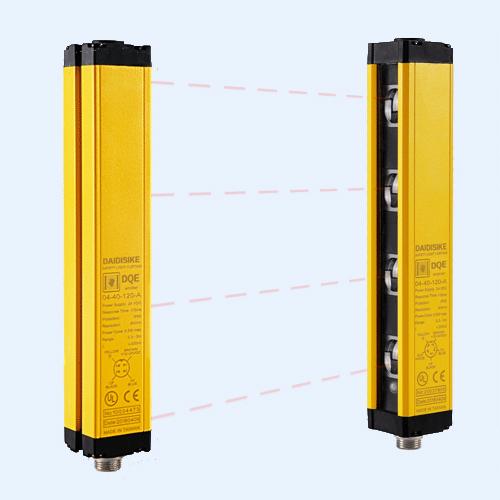
Here is the reassuring part for anyone who specifies protective devices. The Regulation does not change the protective device technology or the standards that govern it. A Type 4 electro-sensitive protective equipment (ESPE) light curtain built to IEC 61496-1 and IEC 61496-2 is still the correct device for finger, hand and access guarding. ISO 13855 still governs the safety distance calculation. ISO 13849-1 and IEC 62061 still decide the required Performance Level or SIL. None of that is being thrown out.
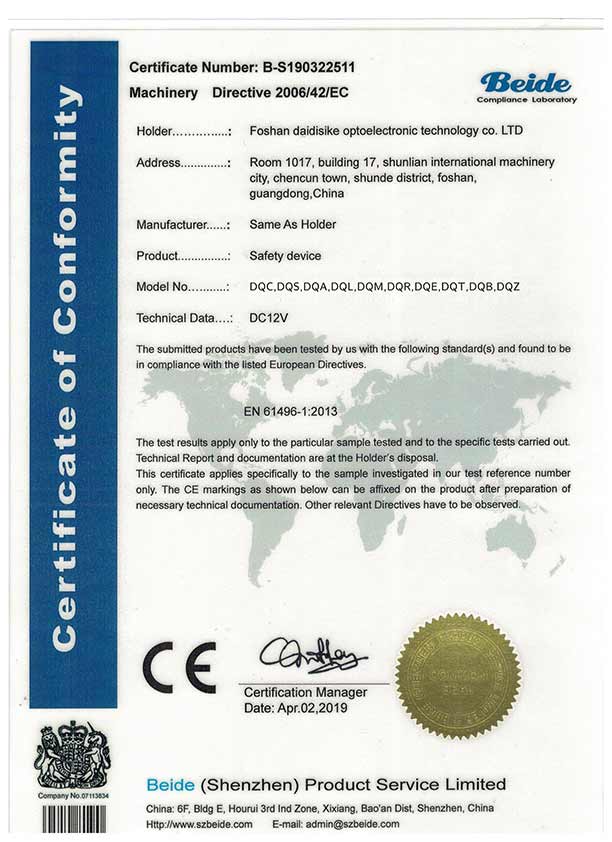
The harmonised standards — the documents that give a machine presumption of conformity — are being re-published so that they reference the Regulation instead of the Directive. The technical content of those standards is broadly stable; it is the legal pointer that updates. The practical instruction for 2026 is simply to re-check the official harmonised standards list for your machine type rather than assume the reference you cited three years ago is still the current one.
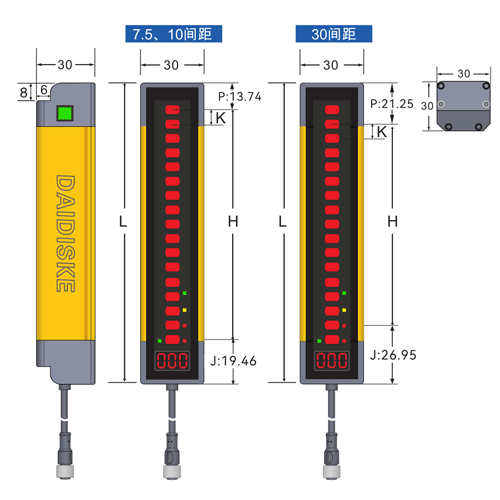
So the work around an ESPE installation is administrative. The conformity file, the instructions for use, the declaration of conformity, and the way you document the safety function all need a pass against the new text. The device on the machine — a DQT4, a DQC, a DQA — does not.
The retrofit trap: substantial modification
This is the part we most want machine owners and integrators to notice, because it catches people. The Regulation keeps and sharpens the idea of a substantial modification. If you change an existing machine in a way that introduces a new hazard, or increases an existing risk, and that change was not covered by the original risk assessment, the modification can be treated as substantial. A substantially modified machine is, in legal effect, a new machine — and whoever made the modification carries the obligation to assess conformity and apply CE marking.
That has a direct bearing on safety upgrades. Retrofitting a light curtain onto an old press, adding a laser scanner to a robot cell, fitting a new servo feeder — these are exactly the kinds of change that can cross the substantial-modification line. It is not a reason to avoid the upgrade; a safer machine is the goal. It is a reason to plan the upgrade properly: document the modification, redo the risk assessment for the changed function, keep the evidence. Handled deliberately, it is routine. Discovered during an audit, it is a problem.
A 2026 checklist
None of the following is dramatic. The danger is leaving all of it to the last quarter of 2026, when notified bodies and test labs will be busy. Through this year:
- Inventory every product line you will still place on the EU market after 20 January 2027, and confirm the conformity route for each.
- Re-check the official EU harmonised standards list for your machine types — the references are being updated to the Regulation.
- Review technical files, the declaration of conformity and instructions for use against the new content requirements, and decide where digital documentation helps you.
- Map any software, connectivity or AI in your safety functions against the new cybersecurity expectations.
- Brief everyone who performs machine modifications and retrofits on the substantial-modification rule, and put a documentation step into that workflow.
One machine, the higher standard
A closing thought for builders who sell outside Europe as well as in. The Regulation applies directly only to machinery placed on the EU market. But the EU machinery rules have long set the global reference point: buyers elsewhere write CE-equivalent safety into contracts, and other jurisdictions track the EU text when they revise their own. If any meaningful share of your output reaches Europe — or your customers re-export there — it is almost always cheaper to design one machine to the higher standard than to maintain two specifications and two paper trails.
The deadline is fixed and it is not far away. The work is mostly paperwork and process, not redesign. Builders who treat 2026 as the preparation year will find January 2027 a non-event — which is exactly how a regulatory transition should feel.
Related reading
When Type 4 / PL e / SIL 3 Is Mandatory
How risk assessment decides the safety rating your function must reach.
Performance Level vs SIL
How ISO 13849 and IEC 62061 actually decide your safety rating.
DAIDISIKE DQT4 Type 4 Light Curtain
Type 4 / Cat. 4 / PL e ESPE for CE-compliant point-of-operation guarding.