
LK-F Series CMOS Laser Displacement Sensor
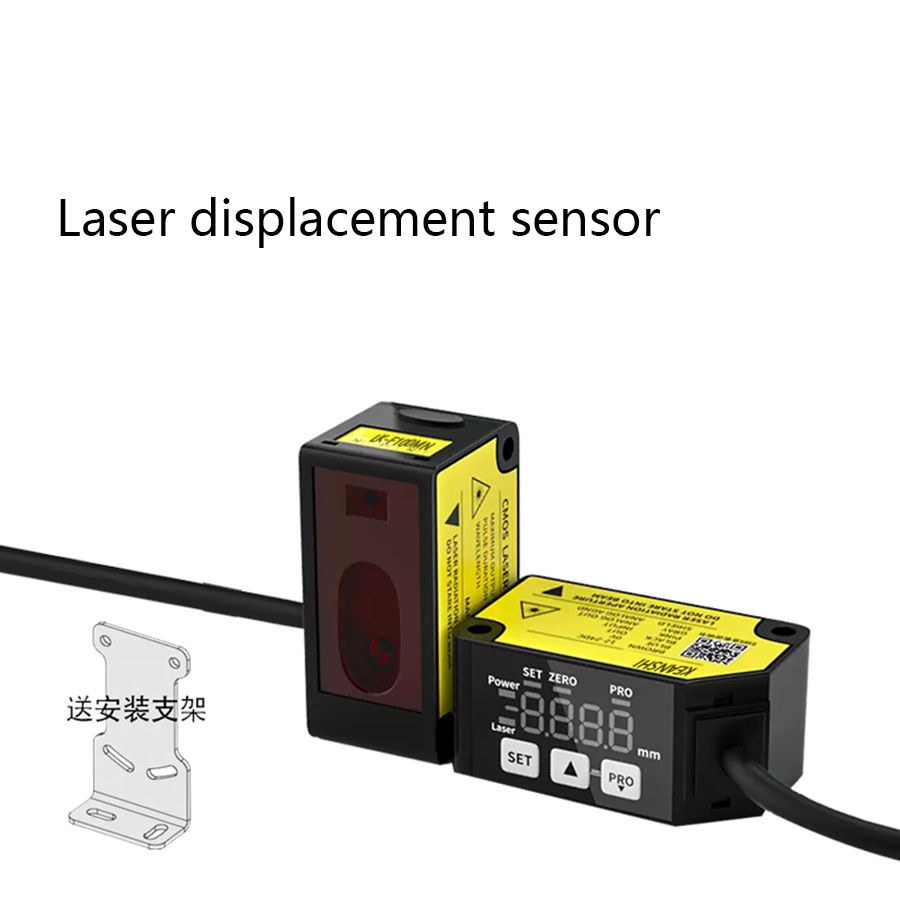
The DAIDISIKE LK-F series CMOS laser displacement sensor offers high-precision, non-contact measurement for industrial automation. Using laser triangulation, it achieves micron-level accuracy for displacement, thickness and surface-profile measurement on various materials. Available in short (30 – 100 mm), mid (200 mm) and long-range (400 mm) models, with high repeatability, low linearity error and strong anti-interference performance.
Product Description
The DAIDISIKE LK-F series CMOS laser displacement sensor is a high-precision, non-contact measurement device designed for industrial automation, precision manufacturing and quality control. It employs advanced CMOS imaging technology for micron-level displacement measurements, with models covering short-range (30 mm – 100 mm), mid-range (200 mm), and long-range (400 mm) detection distances. The sensor uses the laser-triangulation principle to deliver stable and reliable displacement, thickness, vibration and surface-profile detection across a wide range of materials including metal, plastic and glass. The product features high repeatability, low linearity error, strong anti-interference capability, and supports NPN / PNP output modes compatible with multiple industrial protocols.
The series light source is a red visible laser (~655 nm wavelength, < 1 mW output), compliant with Class 2 laser product safety standards. The housing is made of die-cast aluminum alloy with an IP67 protection rating; operating temperature range is −10 °C to +50 °C, suitable for harsh industrial environments — automotive manufacturing, electronics assembly, semiconductor processing and similar.
Specifications Table — 16 Models
| Type | Output | Model | Detection Distance | Output Method | Repeatability | Linearity Accuracy |
|---|---|---|---|---|---|---|
| Short-range | NPN | LK-F30MN | 30 ± 5 mm | Dual Output (Analog + Switching) | 10 μm | 0.01 mm |
| PNP | LK-F30MP | 30 ± 5 mm | Dual Output (Analog + Switching) | 10 μm | 0.01 mm | |
| NPN | LK-F50MN | 50 ± 15 mm | Dual Output (Analog + Switching) | 50 μm | 0.03 mm | |
| PNP | LK-F50MP | 50 ± 15 mm | Dual Output (Analog + Switching) | 50 μm | 0.03 mm | |
| Mid-range | NPN | LK-F100N | 100 ± 35 mm | Switching Output | 100 μm | 0.1 mm |
| PNP | LK-F100P | 100 ± 35 mm | Switching Output | 100 μm | 0.1 mm | |
| NPN | LK-F100MN | 100 ± 35 mm | Dual Output (Analog + Switching) | 100 μm | 0.1 mm | |
| PNP | LK-F100MP | 100 ± 35 mm | Dual Output (Analog + Switching) | 100 μm | 0.1 mm | |
| NPN | LK-F200N | 200 ± 80 mm | Switching Output | 200 μm | 0.2 mm | |
| PNP | LK-F200P | 200 ± 80 mm | Switching Output | 200 μm | 0.2 mm | |
| NPN | LK-F200MN | 200 ± 80 mm | Dual Output (Analog + Switching) | 200 μm | 0.2 mm | |
| PNP | LK-F200MP | 200 ± 80 mm | Dual Output (Analog + Switching) | 200 μm | 0.2 mm | |
| Long-range | NPN | LK-F400N | 400 ± 200 mm | Switching Output | 400 μm / 800 μm | 0.8 mm |
| PNP | LK-F400P | 400 ± 200 mm | Switching Output | 400 μm / 800 μm | 0.8 mm | |
| NPN | LK-F400MN | 400 ± 200 mm | Dual Output (Analog + Switching) | 400 μm / 800 μm | 0.8 mm | |
| PNP | LK-F400MP | 400 ± 200 mm | Dual Output (Analog + Switching) | 400 μm / 800 μm | 0.8 mm |
Additional Specifications
- Measurement light source: red visible semiconductor laser, wavelength 655 nm, output power < 1 mW (Class 2 laser product).
- Spot size: short-range ≈ φ 50 μm, mid-range ≈ φ 100 μm, long-range ≈ φ 150 μm – φ 900 μm.
- Power supply voltage: 12 – 24 V DC ± 10 %, ripple within 10 %.
- Current consumption: ≤ 40 mA (≤ 50 mA for analog-output variants).
- Analog output: voltage −5 V to +5 V, impedance 100 Ω; current 4 – 20 mA, load resistance 300 Ω.
- Switching output: NPN / PNP open-collector, max load 50 mA, residual voltage ≤ 1.5 V.
- Response time: selectable 1.5 ms / 5 ms / 10 ms.
- External input: NPN / PNP laser input, input resistance 10 kΩ.
- Protection rating: IP67 (IEC).
- Operating temperature: −10 °C to +45 °C; storage −20 °C to +60 °C.
- Operating humidity: 35 – 80 %RH, non-condensing; storage 35 – 85 %RH.
- Vibration endurance: 10 – 55 Hz, double amplitude 1.5 mm, 2 h in each X / Y / Z axis.
- Shock endurance: ≈ 30 g, half-sine 10 ms, 3 times per axis.
- Weight: ≈ 35 g (excluding cable); cable ≈ 5 g/m.
- Material: aluminum alloy housing, polycarbonate lens.
- Cable length: standard 2 m, bending life up to 20 million cycles.
Technical Parameters
The LK-F series focuses on high-precision measurement with multi-mode operation — displacement detection, thickness measurement and surface scanning. Sensor resolution reaches 0.01 μm (typical), sampling rate up to 1 kHz, supporting external triggering for synchronized measurements. Linearity accuracy is ± 0.03 % F.S., repeatability ± 0.01 % F.S., and the temperature drift coefficient is less than 0.01 % / °C.
The product integrates a digital signal processor (DSP) for real-time compensation of ambient-light interference and surface-reflectance changes. Laser safety complies with IEC 60825-1; electromagnetic compatibility (EMC) is CE-certified. RS-232 or Ethernet communication is supported as an option, with data output in ASCII or binary formats. Power consumption is as low as 300 mW, suitable for battery-powered devices. Advanced features include adaptive light-intensity adjustment, multi-point calibration, and anomaly-alarm output.
Working Principle
The DAIDISIKE LK-F series uses laser-triangulation technique, an optical non-contact measurement method widely used in precision industrial applications. A semiconductor laser diode emits a visible red beam (≈ 655 nm), focused through a collimating lens into a small spot projected onto the target object. The beam undergoes diffuse or specular reflection on the surface, and the reflected light is imaged through a receiving lens onto a linear CMOS image sensor — a high-resolution pixel array that detects the centre position of the spot.
According to the triangulation principle, the sensor calculates the geometric relationship of the triangle formed by the emitted beam, the reflected beam and the object surface. The distance is given by d = (f × b) / (x′ − x₀), where f is the focal length of the receiving lens, b the baseline distance between transmitter and receiver, x′ the imaging position of the spot on the CMOS, and x₀ the reference position. A built-in ADC and microcontroller process the pixel data in real time and convert it into a displacement value. This process is unaffected by target colour or texture (under compensation algorithms), reaching sub-micron resolution.
The sensor also integrates a photodiode for laser- intensity monitoring, enabling automatic power control (APC) to maintain stability. The entire measurement cycle has a response time of less than 1 ms, supporting high-speed dynamic measurement suitable for vibration analysis or in-line inspection. Compared with capacitive or eddy-current sensors, the laser-triangulation method offers a longer measurement range and higher accuracy — keep the surface tilt angle within ± 10° to avoid measurement errors.
Frequently Asked Questions
How does a CMOS laser displacement sensor measure distance?
The LK-F series uses laser triangulation: a 655 nm Class 2 laser projects a spot on the target, and the diffusely reflected light is imaged onto a linear CMOS array. The sensor calculates displacement from the spot's position on the array, giving non-contact, micron-level measurement of distance, thickness and surface profile on metal, plastic and glass.
What measuring range and repeatability does the LK-F series offer?
Detection distance spans short-range 30 ± 5 mm and 50 ± 15 mm, mid-range 100 ± 35 mm and 200 ± 80 mm, and long-range 400 ± 200 mm. Repeatability ranges from 10 μm on the 30 mm model up to about 400–800 μm at 400 mm, with linearity accuracy from 0.01 mm to 0.8 mm depending on the chosen range.
Should I choose an NPN or PNP output, and is analog available?
Every range is offered in both NPN and PNP open-collector switching versions, so you can match your PLC's sinking or sourcing inputs. Short-range and dual-output (M) variants also provide analog output: −5 V to +5 V or 4–20 mA. Pick the model suffix N/P for switching only, or MN/MP for combined analog plus switching.
Is the LK-F laser displacement sensor safe and rugged enough for the factory floor?
Yes. The light source is a red visible 655 nm laser under 1 mW, classified as a Class 2 laser product and compliant with IEC 60825-1. The aluminum-alloy housing carries an IP67 rating, withstands 10–55 Hz vibration and roughly 30 g shock, and operates from −10 °C to +45 °C, suiting automotive, electronics and semiconductor lines.
Can the LK-F replace a Keyence or Panasonic laser displacement sensor?
In most cases yes. It shares the laser-triangulation principle, NPN/PNP plus analog (4–20 mA / ±5 V) outputs, 12–24 V DC supply and IP67 housing common to those brands, so it fits similar brackets and wiring. Match the measuring range (30–400 mm), output type and required repeatability to the unit being replaced.
Specs reviewed by Engineer Cai, Senior Application Engineer. CE-certified (IEC 60825-1) — see certificates.
Safety Light Curtain — Customer Cases
Real installations from DAIDISIKE clients. Click any case to view in full. Filter by scenario to quickly find a similar setup.